Showing posts with label goldfish. Show all posts

Sunday, October 11, 2015

My tanks: 11 Oct 215

I'M BACK! Since it's been over a year, lots of changes have happened with my tanks. Fish have come and gone. I'll try to remember to say what happened to all of my projects, but if I don't mention one feel free to remind me!

The biggest change that happened is I moved to Georgia for graduate school. This means I had to leave my pond back in Virginia. It is in good hands, tho. My mother still resides in the house and has been taking care of it and keeping me updated. I periodically return especially around the holidays, so photo updates will still come in for the pond.

Even before I moved to Georgia, all of my betta fish died, and I did not replace them with more. Betta are beautiful, but they are so fragile. Fall of 2013 the two betta in my divided tank died after contracting what I believe was lymphocystis from the pet store.  They were both plakats and very beautiful, but I think if I return to betta fish it will be the wild Betta spp. I do plan to keep up my betta care sheet and quick reference page as betta are very popular fish in the hobby.

While my betta did not make the trip with me to Georgia, my goldfish did. However, due to the stresses of grad school, I was unable to give them the care they needed. One succumbed to bad water quality before I realized what had happened. I gave away the other. Unfortunately Mr. Waddles, my rescue, died before I moved, most likely due to issues with his tank before he arrived at my house. I don't see myself returning to goldfish keeping any time soon, but I will continue to update my goldfish care sheet because they are such an misunderstood fish. The more misinformation I can correct, the better.

Last but not least (I do still have ONE tank) is the 29 gallon community. I still have my adorable loaches. They happily made the trip with me to Georgia. A few cardinal tetra did, too. An accident with dechlorinator was their end. Let this be a lesson to everyone: always add dechlor before you add water back into the tank.

Current state of the 29 gallon. Plants are mostly low-light. Filter is a Finnex P-360

However, you may notice there are still little tetra swimming around in the 29 gallon. Recently I got a different species of tetra to fill the upper spaces of the tank. I opted for glowlight tetra (Hemigrammus erythrozonus) due to their hardy nature. They are commonly recommended for beginners due to their forgiving nature, and I've always thought they were pretty. So I wanted to try them out. I received 10 of them and have already been smitten by them. They are surprisingly easier to photograph than my cardinals were. It probably also helps that I got a new camera, too.

Glowlight tetra (Hemigrammus erythrozonus)
And a shot of my loaches because I love them too much not to include them! ^-^

So those are all the changes that have occurred since my unplanned hiatus. I do not expect to be setting up any more tanks until I finish grad school, have a career, and a house. So future updates will be few and far between. 

Saturday, June 1, 2013

My Tanks: Special Update

The Story of Mr. Waddles

Normally I wouldn’t do an update this close together, but this isn’t a regular update. This is a special fish that I’ve welcomed into my fishy family: Mr. Waddles. He came to me from a friend on my home fishkeeping forum, and he has a troubled past.

Mr. Waddles shared a 29 gal tank with other goldfish of various ages, most won at fairs. The owners of this tank didn’t take care of it at all. Instead of finding out why some of their fish would die after a couple of months, they would just buy a replacement. This happened for years until they just stopped replacing the fish. Mr. Waddles was the last one they put in there and the last one left standing.

Enter Jes, a fishkeeper who with a heart of gold and a love of kids. The family who owned Mr. Waddles had a young girl who became very attached to him. Fearing that he would die and their daughter would be heartbroken, the family asked their friend, Jes, to help them get the tank back in shape. She reluctantly agreed but had no clue how bad it was. Knowing that I keep and love goldfish, she contacted me before even seeing the tank to ask for goldfish care tips.

I tried to prepare her for how bad that filter and tank could be, but it shocked even me. Jes being a bit of a shutterbug snapped some pictures of the tank before she cleaned it just to prove how bad it was. There was slimy algae on everything and the substrate was filled with crap (literally). She tested the water, and the nitrate and phosphate readings were off the charts. Her mission was to teach the young girl just how to care for her beloved fishy while cleaning up his current tank. On top of scrubbing the walls of algae and cleaning the filter of gunk, Jes also siphoned the gravel like mad and removed handfuls of it. She said it was at least 4 inches deep and a disgusting nitrate factory.

Mr. Waddles' tank at his first home (Jes's photo)

Jes continued this routine for a couple of months. Once a week she would head to Mr Waddles’ family’s house, teach the young girl about fish, and help her clean the tank. But as young children can, the little girl lost interest in Mr. Waddles and the tank. This put Jes in a bind as she didn’t have room to take Waddles and didn’t want to leave him with a family who was known to be terrible at fishkeeping.

My heart melted for this adorable little oranda. I offered to take Mr. Waddles if Jes and his former family would be willing to ship him. Jes wanted to make sure the young girl knew that rehoming a fish isn’t something to be done lightly. Fish aren’t just toys you can give away when you are tired of playing with them. Eventually she agreed to give him away, and Jes and I began to make arrangements.

Jes started to do 20% daily changes on Waddles’ tank to give him the best possible water to travel in. She also contacted her wonderful local pet store who agreed to pack him for shipping. This was Jes’s largest worry which was greatly assuaged by that awesome store. Less than a week before he was due to be shipped, Jes decided to bring Waddles to her house to make daily water changes much easier. She dug out an old 20 gal and set him up in a temporary position in her bedroom, much to the chagrin of her husband.

Jes was able to get better photos of him at her house. (Jes's photo)

As even the most well-thought-out plans go, a wrench can still make its way into them. The day Jes was to ship Waddles her children came down with the stomach flu. She couldn’t leave to ship him. The following week, I couldn’t receive him because I was going away that weekend to watch my boyfriend graduate university. I didn’t want to leave him alone just a few short days after getting him. What was supposed to be a few night’s stay at Jes’s house turned into a couple weeks.

Last week, the planets aligned and Jes shipped him without incident to my house! Because of his troubled past I have him in strict quarantine for a month. If and only if everything looks spotless at the end of that month, he will join my three other goldfish in my 55 gal. Waddles is about a year old but is already stunted from his poor care. He is about the same size as my other four, and while I expect him to grow I don’t expect him to get as large as an oranda should.

Waddles on day one (23 May). He was pretty skinny and very shy.

Waddles after nine days (1 June). He is steadily gaining weight and cuteness.

Waddles has come a long way from his cramped, dirty home. I thank Jes for giving me the opportunity to be part of this courageous story and for all the hard work she put into getting him healthy. I hope that I can send Jes and Waddles’ former family a picture of him doubled in size in a couple of years. And yes, his name is going to stay.

Saturday, May 18, 2013

My Tanks: 18 May Update

The times between my updates keep stretching out because my tanks are going through fewer and fewer changes. Once every couple of months is more than enough to cover everything. That said, I only have a few things to report this week.

My comminuty tank got some new residents in the form of Amano shrimp (Caridina multidentata). The gourami did pick off a few, but the remaining three are hard at work keeping down the algae. I have a bit of staghorn algae in the tank, and they have been very diligent in eating it. Amano shrimp are much larger than cherry shrimp and do just fine with the fish.

My new amano shrimp.

I have also added a new plant: Hygrophilia sp tiger. It is another stem plant, but it is one of the few low-light stem plants. It's in a temporary position right now, but during the summer I'm going to put a canister on the community tank. Then the hygro can be moved to where I want it. Thanks to the sharp eye of a friend, I've also realized I have a fourth species of crypt in my tank. He pointed out that I have a C. pontederiifolia as well as the C. spiralis, C. undulata, and C. wendtii. I'm guessing it came as an extra with my last order of crypts from Aquariumplants.com.

You can see the C. pontederiifolia to the right of the rock in the center.
The hygro is in the back left. And there is a bonus amano.

The shrimp tank underwent the most changes. Because my starting population was so low, I ordered 10 sakura red shrimp from HomelessAquatics.com. They arrive in good condition and acclimated well, but I had a mass die-off like 4 days after they went into the tank. I attribute it to first-time shrimping mistakes which could have been anything from not feeding enough, feeding too much, an immature tank, pH too high. I wasn't really sure, but either way only about 3 of the original 10 are still alive. I was about to give up on shrimps when a female became berried, but she died shortly after that. I put her body in a net over the filter in an attempt to hatch her eggs like I'd read online. And it actually worked! I was able to hatch about five eggs.

As for cosmetic changes in the tank, I have also made some large ones. I added two large pieces of driftwood as well as some X-mas moss and java moss. I removed the bacopa because I just didn't like the look of it. I also added some floating plants such as frogbit and dwarf water lettuce. I currently have one berried female and a few saddled ones.

Current state of the shrimp tank. I also added a feeding dish to the tank.

There aren't nearly as many updates as I would like with the pond because we've had a very cold spring. We even had a frost earlier this week. The plants are just flowering now. I added some water hyacinth to the pond, but it's not in top shape due to the cold weather.

Yellow iris and the koi

Stout blue-eyed grass

Up close on the iris and koi

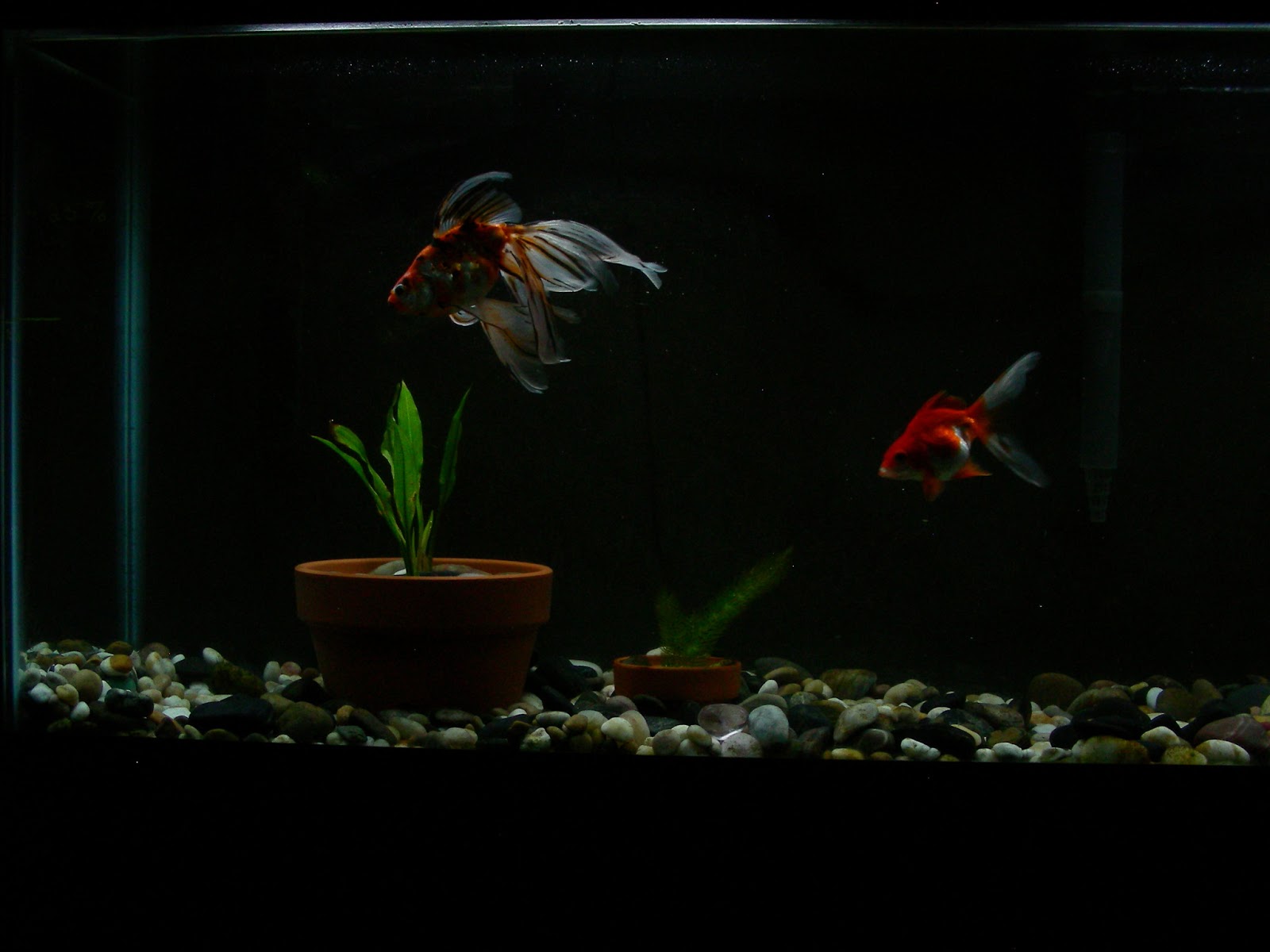
The other major change in my fish tanks is a new goldfish!!! Mid April I bought a ranchu from DandyOrandas.com, and I'm in love with this little girl! She's slightly larger than my ryukin and oranda, but they are catching up fast. I have named her Ponyo, but my mother calls her Marlyn because she has a black dot on her check. She took to hand feeding extremely well, and fits in with the group perfectly. I am so happy to have her!!

Look at that cute face!!!

Like three peas in a pod.

The last and rather small (right now) change in the goldfish tank was the addition of six apple snails. A friend had too many in his tank and was giving away babies. I plopped them in while distracting the goldfish, but Ponyo was too quick and completely ate one, spitting out the operculum. So the apple snails are in a breeder box getting daily feedings so they grow large enough not to be goldfish food. 

My new snails with a cameo from Burbbles.

There will be something special in the next update! :3

Saturday, April 13, 2013

One Year!!

Personal Reflections

Today is the one-year anniversary of my blog's first post! A lot has happened in that year in my personal life and my hobby. I'll take this opportunity to look back on what has happened in the hobby, both in my tanks and around the world.

The biggest change for me has been the loss and gain of fish. The biggest loss was that of my two oldest goldfish, Goldeen and Seaking. They both died of separate causes, but it was so close to each other that I can't help but wonder what it was that killed them and whether or not the loss of one was just too much to bear for the other. Goldfish are much more social creatures than most people realize and Goldeen did appear to pine away until he died.

One of my favorite pictures of Goldeen and Seaking

The other losses I've suffered have been those of my two oldest bettas. One succumbed to complications from a lymphocystis infection and the other to a failing swim bladder. But I have to remember to smile for the time I had them and know that they helped me learn even more about those wonderful little fish.

I have really only added fish to one tank: my community, but in terms of numbers I have added more than I have lost. It's a total of  22 fish added to my community. It may sound like a lot, but these guys are tiny compared to the goldfish and bettas. I have only added one betta: my giant halfmoon plakat. I consider most of my tanks completed in the stocking aspect, so I don't plan to add any more fish for a long while.

The other major change has been in the appearance of my tanks; I've added a lot live plants. I had always had things like an anubias or a java fern in some of my tanks, but I never thought I could have a gorgeous planted tank until this past year when some friends convinced to me to give it a try. I've had a lot of success so far, and I've really come to appreciate and enjoy plants even more. All of my tanks have plants that are thriving. I used to just plan what fish I would want in my dream tanks, but now I'm planning the plants for them, too.

One of my new favorite plants, Myriophyllum mattogrossense

Another large change is my new-found appreciation for invertebrates. They were once just algae cleaners in my tanks, but now I enjoy watching them so much more. I even set up a tank completely dedicated to them! I haven't even come that far with plants, and I've had plants for much much longer! This change was even more recent than my new love for plants; it has just been since the New Year that discovered how interesting shrimp are to watch. Now, just like plants, every single one of my tanks has some kind of invert in it be they shrimps, snails or both.

Just like any hobby based in science and technology, this hobby is always changing. New species are always being discovered and described, and new breakthroughs are made with the technology that support our aquariums. A couple events that stick out in my mind are the describing of the adorable panda loach (Yaoshania pachychilus) and the re-evaluation of the ever so common barb genus Puntius. There were also discoveries like WWF article that detailed the 13 new fish species that have recently come out of the Mekong River delta in Asia.

Juvenile panda loach Yaoshania pachychilus (SeriouslyFish.com)

I consider this past year of fishkeeping a year of great growth.  I've become more of an advanced fishkeeper and taken my hobby in slightly different direction that others. We each have fish we prefer keeping. Some people love cichlids, some people enjoy guppies and livebearers, and some people enjoy the fish they can breed. I think I've discovered my niche in shoaling fish and shrimps. We all bring something to the table and that's what makes this hobby so interesting. I hope to be able to keep fish for the rest of my life.

Saturday, April 6, 2013

My tanks: 6 April Update

With spring comes a lot of new things including lots of updates! The weather is finally warming up here, and I'm gearing up for some outdoor summer projects that I will fill you in on later.

First off, the pond is open for 2013! Earlier this week we took the net off the pond. I spent a few hours cleaning out a lot of the algae that built up over the winter and clearing out any debris that made it through the net. The koi were out to greet me and the water is almost warm enough to start feeding them. I start them out with Cheerios at 55F (13C) and move them to wheat germ when the temp hits 65F (18C).

Freshly uncovered and cleaned of most algae

The koi just hanging out in the sunshine.

The next major change is a new tank! I removed the red cherry shrimp from my community and set up a tank dedicated to breeding them. My gourami were making it next to impossible to breed them, so I just removed the shrimp. I moved over the remaining adults and later that week found four juveniles hiding in the moss. Thus far the female has released one clutch of eggs and is holding a second. Because the founding population is so small, I'm going to order more red cherries. Too much inbreeding produces shrimp that are far to weak. The plants are mostly stems with some anubias. The plant list: Bacopa carolinia, dwarf sagittaria (Sagittaria subulata), Myriophyllum mattogrossense, Rotala rotundifolia, Anubias spp, riccia, Subwassertang, and java moss.

Full tank shot

Two males and juvvie eating sinking wafers.

There have also been large changed in my community tank. I've finally added the cardinal tetra. I bought 12 from msjinxkd.com. They came in excellent condition and have been flourishing ever since. They are as gorgeous as they are in pictures, and I'm completely in love. The shoal has been dubbed "The Shinies" and my family remarked that they almost look like they are glowing.

My new cardinal tetra; I apologize for the dark picture.

The other major change in my community has been an addition of more crypts. The dwarf sagittaria (Sagittaria subulata) and dwarf chain sword (Echinodorus tenellus) I had in there was just languishing. I don't know if it was the light or the tannins or just what, but they never grew for me. So I removed what was still alive and placed it in the shrimp tank. I replanted that side of the tank with green wendtii (Cryptocoryne wendtii var green) and red wendtii crypts (Cryptocoryne wendtii var red) and C. spiralis from AquariumPlants.com. I've had minimal melt with them and even see new growth. I'm very pleased with them. You can see them on the right side of the tank.

Full tank shot; the bettas are still in the breeder boxes.

The first of my summer projects I have begun are my snail bowls. Since my goldfish are growing larger and more apt to eat the smaller snails, I need to grow out my snails before I introduce them into that tank. I have set up two old betta bowls as snail bowls. One has hornwort and the other has anarcharis clippings from my betta tank, and both have a layer of duckweed. Because my water is so soft I have crushed coral substrate to maintain a steady pH and enough water hardness for the plants and snail shells. They get weekly water changes with the waste water being used to water the terrestrial plants in the terrarium window.

Right bowl - hornwort; left bowl - anarcharis

Ramshorn snails in the anarcharis bowl
....

Friday, March 29, 2013

Just One Fish

The Problems of Aquarium Release 

A lot of people buy fish that grow too large for their aquariums. Most times it isn’t their fault as pet stores often don’t inform people how large their goldfish, oscar, or pleco will grow. A couple of years down the road, these massive fish can cause problems for unsuspecting aquarists. Some stores will take back overgrown fish and try to re-home them, but this is costly for the store.

Oscar in a 20 gal (Oscarfish.com)

Many times these large pets are just released into local lakes and rivers because people assume just one fish won’t cause any harm. This leads to things like a pacu being caught in North Carolina and Utah. This is by no means good, but it isn’t the end of the world as most of these fish die when winter comes. But what happens when you get a cold-tolerant species like goldfish? Or when the winters just aren’t cold enough to kill off tropical fish like in southern Texas and Florida? If enough fish are released you can, and do, get breeding populations of these fish.

This causes major problems for the local ecosystems. In the case of oscars (Astronotus ocellatus) suddenly local fish have to deal with a whole new predator. Those small fish are what feed the gamefish like bass and perch. The large predators of the lake suddenly have to deal with competition, something they might not have dealt with before. A lot of times, the new fish is a stronger competitor and drives the native fish towards extinction.

In the case of goldfish (Carassius auratus auratus), they don’t directly compete with the native fish; it’s the feeding action of these fish that cause trouble. In the wild, goldfish quickly lose their gold coloring and look more like regular carp. Just like carp, they root around in the substrate. This causes the water to become cloudy, impeding the growth of plants in the substrate. These plants offer a refuge for juvenile native fishes; without them the juveniles become prey for larger fishes. The increased turbidity can also be a problem for fishes that feed on benthic insects as the insects rely on a layer of algae that cannot form when the water is cloudy. So far two species have suffered negative effects on wild populations since goldfish were introduced into their habitats: the Sacramento sucker Catostomus occidentalis (Moyle 1976) and Pahrump poolfish Empetrichthys latos latos (Deacon et al. 1964; Lee et al. 1980 et seq.) There may be many more that haven’t been studied yet.

Researcher holds up a giant goldfish pulled from Lake Tahoe
where they have been causing unrest in the local ecosystem.
(kcra.com)

Not only are released aquarium fish a problem with the native fish, but they can be problematic for humans, too. Loricariid catfish, commonly called plecos, can’t survive the winters in the  northern US, but they can and do thrive in the southernmost states. Florida, Texas, Louisiana, and Nevada all report breeding populations of these fish. These large catfish breed in burrows, which becomes a problem when they are found in high numbers. These burrows lead to increased erosion (Nico 2009). This can be very problematic when they burrow into levees as this causes the levees to erode from within. The damage may not be noticed until after the levee has breached. 

It’s not just freshwater fish that present a problem. Saltwater fish released into non-native habitats can also cause problems. The most notable is the lionfish (Pterois volitans). These are beautiful fish that outgrow most normal sized home aquariums and when released into the ocean survive and thrive. They have been reported as far north as Massachusetts and breeding populations are established from North Carolina to Florida, Bermuda, and all around the Caribbean. Lionfish are predatory and have a voracious appetite. They prey on important local fishes such as those that keep reefs clear of algae and juvenile foodfish that are economically important like grouper and grunts. Lionfish have no predators in the Caribbean ecosystem and are covered in large, venomous spines. These spines deter anything from eating them and cause harm to divers that approach them. Luckily there is something divers and fisheries managers can do about these fish: harvest them. They are targeted by spearfishing operations which appear to be having an impact on the population.


It’s not just fish released from aquariums that can cause trouble; plants have also been known to make it into local waterways when aquarists toss them as well.. Some of the most notable examples of this come from floating plants like water hyacinth, hygrophila, water lettuce, and giant salvinia. These plants are rapid-growing and will choke out waterways making boat travel very difficult. Controlling them requires intensive management.

These are some of the worst cases of the consequences of aquarium release. I don’t want this to turn you against the aquarium hobby—I want these examples to open your eyes to what happens beyond your fish tanks. These examples are sad, and we can’t do anything to stop what they have already done. But we can prevent more examples from being added to this list. Never release fish from your aquarium into the wild. Never buy a fish you can’t house. Never expect someone else to take care of your fish when it gets larger. Speak up if you know someone who wants to release an aquarium fish. They may see it as just one fish, but they don’t know that hundreds of “just one fish” have already led to problems. We all can make a difference, and it starts with just one fish. 

Works Referenced

Deacon, J.E., C. Hubbs, and B.J. Zahuranec. 1964. Some effects of introduced fishes on the native fish fauna of southern Nevada. Copeia 1964(2):384-388.
 
Lee, D.S., C.R. Gilbert, C.H. Hocutt, R.E. Jenkins, D.E. McAllister, and J.R. Stauffer, Jr. 1980 et seq. Atlas of North American freshwater fishes. North Carolina State Museum of Natural History, Raleigh, NC.

Leo Nico, Pam Fuller, and Matt Neilson. 2013. Astronotus ocellatus. USGS Nonindigenous Aquatic Species Database, Gainesville, FL. nas.er.usgs.gov/ Updated: 4 March 2013. Retrieved: 28 March 2013. 

"Lionfish Pterois volitans." Florida Fish and Wildlife Conservation Commission. http://myfwc.com/wildlifehabitats/nonnatives. Updated: 2013. Retrieved: 28 March 2013. 

"Lionfish Research Program." REEF. www.reef.org. Updated: 2012. Retrieved 28 March 2013.

Moyle, P.B. 1976. Inland fishes of California. University of California Press, Berkeley, CA.

Nico, Leo G., Howard L Jelks, Travis Tuten. 2009. Non-Nativev Suckermouth Armored Catfishes in Florida: Description of Nest Burrows and Burrow Colonies with Assessment of Shoreline Conditions. Aquatic Nuisance Species Research Program 09: 1-29. 

Nico, L.G., P.J. Schofield, J. Larson, and A. Fusaro. 2013. Carassius auratus. USGS Nonindigenous Aquatic Species Database, Gainesville, FL. nas.er.usgs.gov/ Updated: 4 Jan 2012. Retrieved: 27 March 2013. 

"Piranha-like fish caught in Utah Lake was a Pacu." The Salt Lake Tribune. www.sltrib.com. Updated: 21 July 2006. Retrieved 27 March 2013.

Taylor, Fred. 27 Sept 2006. "Wild life experts don't bite on tale of piranha in Lake Gaston." WRAL News. www.wral.com. Retrieved: 28 March 2013. 

Saturday, March 23, 2013

My Favorite (Aquarium) Fish

As soon as people here I keep aquariums they ask me what my favorite fish are. It's so hard to just pick one, so I've come up with a list of my top ten favorite aquarium fish! Let's count them down!

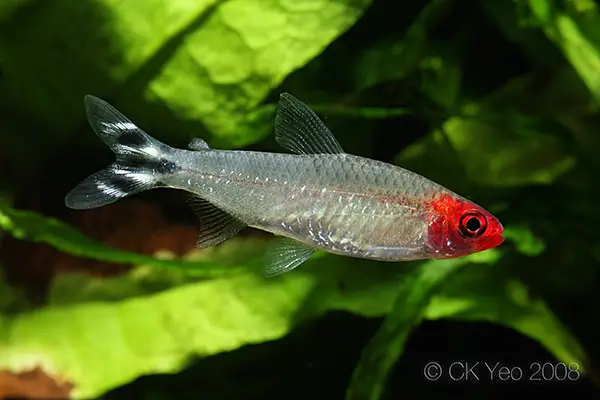
10. Rummynose Tetra (Hemigrammus bleheri)

Rummynose tetra individual (SeriouslyFish.com)

These little beauties are some of the most tightly shoaling tetras in the freshwater world. Sure other tetra will shoal from time to time, but these guys do it almost nonstop. They aren't the most colorful of the tetra, but that lovely red nose sure can shine! Like most of the fish on my list, they are softwater fish. These little beauties can withstand the high temperatures that discus need and are often recommended with them. 

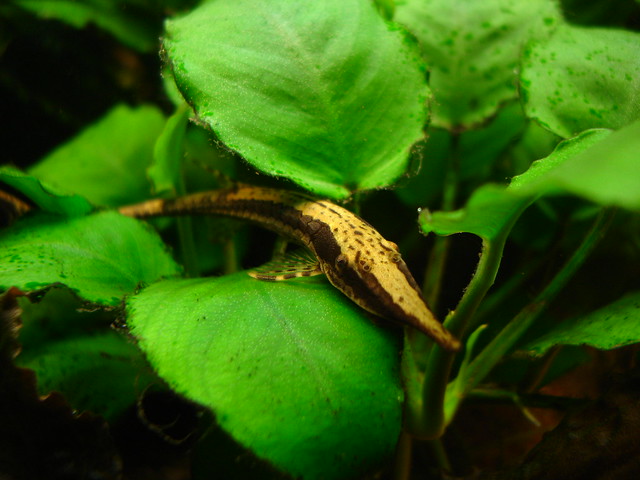
9. Twig Catfish (Farlowella spp)

Farlowella spp clinging to Anubias (sampukko @ Flickr)

This fish lives up to its name. In poorer quality video and pictures it can easily be mistaken for a twig. Its appearance is its camouflage and helps it remain undetected in the wild (and in the aquarium sometimes!). Even though I don't see him every day, I still love my farlowella. They are closely related to plecos but have an almost entirely vegetarian diet. They get quite long (7 inches [17 cm]) but lack the girth to go with it. They get along very well with small fish and shrimps. I've even seen my shrimps climb on him like he was a real twig!  

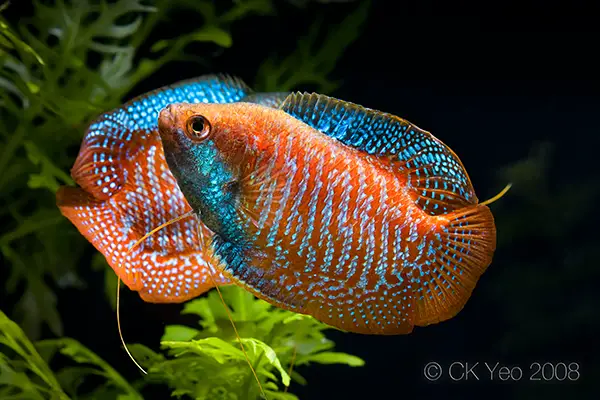
8. Gourami (Trichogaster spp)

Male dwarf gourami in territorial display (SeriouslyFish.com)

An air-breather just like bettas, these little fish can make excellent centerpieces for a small tank. They do fine alone or in groups, but it's best to have multiple females per male in a group. They can be a bit territorial towards other gourami and fish that resemble gourami like bettas and cichlids, so if you are keeping multiple gourami in a tank you need to have a lot of hiding spaces for them. Gourami love areas of thick planting as well as floating plants. While I know my male gourami would do fine on his own, I just love watching his colors shine as he displays for his females.

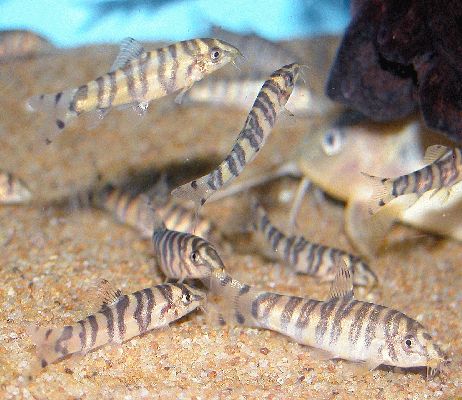
7. Botine loaches (Botia spp)

Juvenile ladder loaches Botia rostrata playing (Emma Turner @ Loaches Online)

I fell in love with these guys years ago but have not been able to get them in a tank of mine yet. I saw them playing in a petstore and fell in love. If I were a more capricious person I would have bought them then and there, but I went home and did research.  For the most part, the botine loaches need tanks 55 gallons (208 L) or larger. They get larger than you would expect (3+ inches [8 cm] depending on species) and need to be in groups of 6 or more. On top of that, they are very active. But what made me fall in love with these little buggers was the way they interact with each other. They really look like they are playing. They also like to pose in strange positions around the tank which includes laying on their sides or at otherwise odd angles just because they feel like it. For little fishes, they have lots of personality, and I can't wait to get some of these in a tank of mine one day.

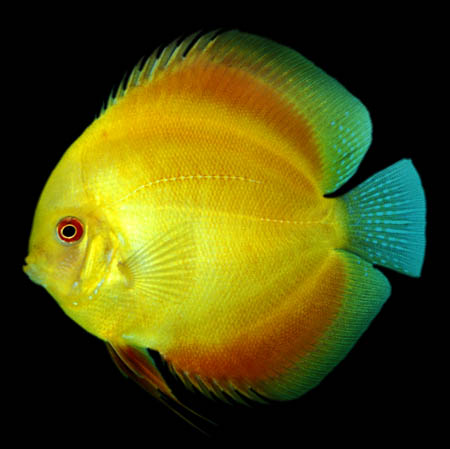
6. Discus (Symphysodon spp)

Captive bred discus Symphysodon aequifasciata (SeriouslyFish.com)

They are called the kings of the aquarium and for good reason. Growing to approximately the size of a CD and coming in rainbow of colors, discus make an impressive sight in an aquarium.Their unusual shape and myriad of colors are what first grabbed my attention, but I was hooked when I saw them swimming in an aquarium. They are so graceful! But with that grace and beauty comes a great amount of care. This coupled with their cost doesn't make them a fish for beginner or even most intermediates. It also makes them difficult to pair with other fish; it's not that they are aggressive, but it's that they need very warm, soft, and acidic water.

5. Cardinal Tetra (Paracheirodon axelrodi)

Cardinal tetra shoal (Leino88 @ Flickr)

Another one of the few fish that can withstand the high temperatures discus need, they also rival discus in coloration. Those blue streaks stand out across a room and make them the most beautiful tetra in my opinion. Up close the deep red streak that runs their full body length becomes apparent. Their relaxed and calm nature makes them a great pair with other beautiful fish like gourami and discus. Whether they are in a loosely shoaling group of 12 or in a tight shoal of 50 these tetra stand out in a tank and in my heart. If I could have any tetra in a tank, it would be these guys.

4. Fighting Fish (Betta splendens)

One of my personal bettas, Lumi the halfmoon plakat

A lot of people call these little fish with a big attitude, and I'm more than inclined to agree. Every single betta I've owned has been very personable. Those long flowing fins entice many people in, but I am more fond of the rainbow of colors they come in. Another one of my favorite things about bettas is their adaptability to smaller tanks and different water parameters. Bettas were the only fish that I could have in my 5 gal tanks while I was in college. They will also do well in hard or soft water, so you can keep them no matter what your tap water is. 

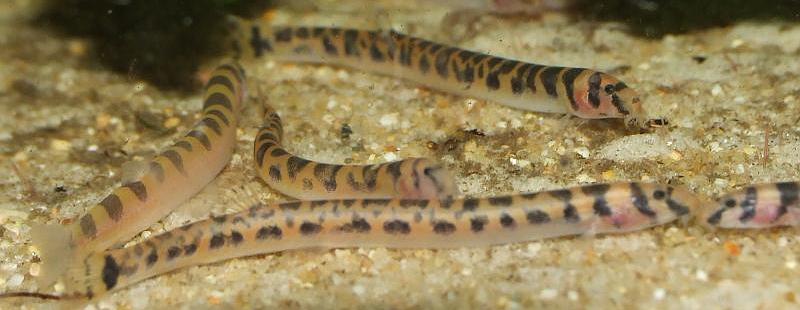
3. Kuhli loaches (Pangio spp)

A group of Pangio shelfordii (SeriouslyFish.com)

Along with the twig catfish, these little guys are some of the strangest looking fish on my list because they don't look like fish! They look like little worms! This is especially true of the brown species. Kuhli loaches have squirmed their way into my heart. Just like the botine loaches they are full of energy and spunk. They like to drape themselves in odd positions around the tank and use those adorable whiskers to sniff out food. They love the company of other loaches and it's not uncommon to see three or four squished together in the same hidey-hole. Many people have trouble with these guy hiding a lot, but I never have. I think it's because I give them enough hiding spaces that they feel comfortable to come out all the time. 

2. Goldfish (Carassius auratus auratus)

My two current fancy goldfish, Magikarp and Burbbles

Years ago when I was a young girl, these bubbly little fish stole my heart. My knowledge of their care and love of them have only increased through the years. Yes they need large tanks and lots of water changes, but it's worth it for those wiggly bodies and cute faces. I can't imagine my life without goldfish.

1. Koi (Cyprinus carpio)

Byakko, my shiro utsuri koi. Taken in 2011.

While not a true aquarium fish, they are a big part of the hobby and one of my favorite fish. But they didn't start out that way. I never really appreciated them until my little koi that I bought back in 2007 grew into 18 inch (45 cm) beauties. I spend hours in the summer just watching them swim around the pond. In the store, they do just look like large goldfish, but when they are grown there is nothing that rivals their beauty and grace. 

I am lucky enough to own a good number of these including goldfish, bettas, koi, kuhli loaches, and twig catfish. One day I will have all of these fish, but some like the botine loaches and discus are potentially a decade away. It's good to have dreams.

Saturday, February 2, 2013

Is my fish a girl or a boy?

How to determine the sex of your fish

Most people like to name their fish and want to have a name that fits the fish’s gender. Other people want to try breeding and need to know if they have males and females. Sexing fish can be a tricky thing, but there are some species and families of fish that are relatively easy. Before we get into those, I’ll talk about some general trends in sexing fish.

Females are rounder

Of course this only works with mature animals, but for the most part the female will have slightly thicker bodies. This is because the eggs that females carry take up more space than sperm. The females also need larger fat reserves to produce the eggs.

Males are smaller and more colorful

Just as in birds, males are the more colorful of the genders. Males compete with other males by showing off their vibrant colors. The most colorful male gets to mate. They are also slightly smaller than the females.

Sexing popular fish

Goldfish (Carassius auratus auratus)

These fish can actually be a little tricky as they have no obvious differences when the fish are not breeding, but there are two things you can look for when they breed: breeding stars and the shape of the vent.

Breeding stars or breeding tubercules will only appear on the males. They appear on the gill plate and pectoral fins. These are a sign of virility, and a study performed on a relative of the goldfish found a correlation between the number of breeding stars and how healthy a male fish is. These stars help a female fish decide who she wants to mate with.

Breeding stars on pectoral fin and gill cover (goldy fk @ flickr)

The next thing to look for is the shape of the vent (this is also called the cloaca and is the opening near the anal fin). The vent of the male will be slightly larger and concave (meaning it curves inward). The vent of the female will be smaller and protrude slightly. The pictures below better illustrate this.

Circled male vent (mikroll @ TheGAB)

Circled female vent (mikroll @ TheGAB.org)

I find using the vent method to be a little difficult as my goldfish usually like to have their heads facing towards me begging for food. I prefer to use the breeding star method because they are more visible in my experience.

Betta fish (Betta splendens)

These small, popular tropical fish are a little easier than goldfish to sex because some of it can be done out of the breeding season. There are two main ways to sex bettas: fin length and the presence of an ovipositor.

If you see a long-finned betta it is a male. There have been cases where females have longer than normal fins, but they aren’t nearly as long as the typical halfmoon spread seen below.

These extremely long fins indicate a male(Aquariumloto @ Flickr)

Sexing bettas gets a little trickier when you are dealing with plakat (or short-finned) bettas because the male and female fins are the same length. Now you have to look for the ovipositor on the female. The ovipositor is a small white tube protruding from the vent of the female; in breeding she uses this to position eggs. It will appear as a small white dot behind the ventral fins. The lack of such indicates a male.

Arrow points to ovipositor (Stuart Halliday)

Angelfish (Pterophyllum spp)

Another extremely popular aquarium fish, but much harder than bettas or goldfish to sex. They have no discernible differences when they are not spawning, and when they are spawning you have to look very closely to see the only difference:  the males will have a thinner breeding tube which is visible in the vent of the fish. Both males and females have breeding tubes, so the key is to look for the smaller one.

Female angelfish breeding tube (koiangelfish.com)

Male angelfish breeding tube (koiangelfish.com)

Neon tetra (Paracheirodon innesi)

Like angelfish, neon tetra are difficult to sex. The only difference will be in size. The females will be slightly larger and fatter especially when they are ready to breed. Males may show slightly better color, but these differences are so minute that they will likely go unnoticed.

Livebearers (Poecilidae)

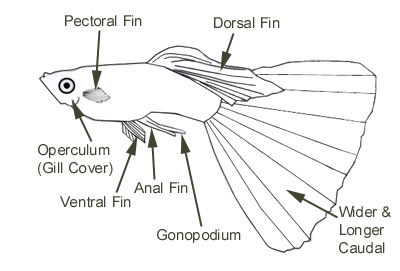
These are fish like guppies, platies, swordtails, and mollies. The males and females are very easy to tell apart. There is a large size difference with some females being almost one and a half times the size of the males. The males will have long, flowing fins and are very colorful. Males also possess a modified anal fin called a gonopodium; this is used to transfer sperm to the females. Below you can see two illustrations showing the differences between male and female guppies
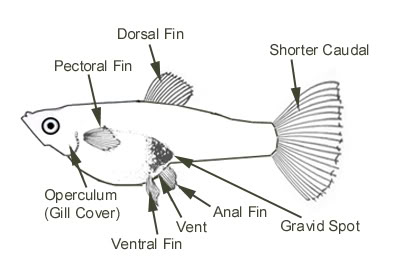
General female livebearer characteristics (jabraguppyroom.blogspot.com)

General male livebearer characteristics (jabraguppyroom.blogspot.com)

Cory catfish (Corydoras spp)

Another popular but difficult fish to sex, cories have no highly visible differences between the genders. Females will tend to be the larger ones and look much chubbier when they are breeding, but for the most part males and females look exactly alike.

Bristlenose pleco (Ancistrus spp)

These small plecos are surprisingly easy to sex. Both males and females will have the bristly nose, but the number and size of the bristles will be much greater in the males. This is especially true when the fish are in breeding condition. Scientists believe that males evolved the bristles to mimic young fish because females are more likely to mate with a male who is already caring for eggs.

Male bristlenose with month old offspring (goldy fk @ Flickr)

Oscar (Astronotus ocellatus)

Probably the most popular of the cichlids next to angelfish, but even more difficult to sex. Among wild populations the males show more color than females, but this isn’t reliable with the captive-bred fish that show up in stores nowadays because they have been bred for color.

Cherry barb (Puntius titteya)

This is a species that is easy to sex based on the general trends in fish genders. The males are smaller and have more red color and the females are larger and will be more brown in color. This holds true with wild-caught and naturally bred cherry barbs. There are some that have been specifically bred to make the red even brighter; these are much more difficult to gender. 

Female cherry barb on left, male on right (aquapage.cz)

Gourami

They aren’t as easy to sex as livebearers, but they are pretty easy if you know what to look for. If it’s not a captive-bred variant, the males will be a brighter color especially when breeding. If they are a color variant you have to look for a few other things. For the Trichogaster gourami (this is dwarf, honey, thicklips, and banded) look at the end of the dorsal fin; males will have a pointed dorsal, and females will have a rounded dorsal. These pictures below illustrate this as it can be hard to pick out if you’ve never seen it.

Male honey gourami (CK Yeo @ Flickr)

Female honey gourami (CK Yeo @ Flickr)

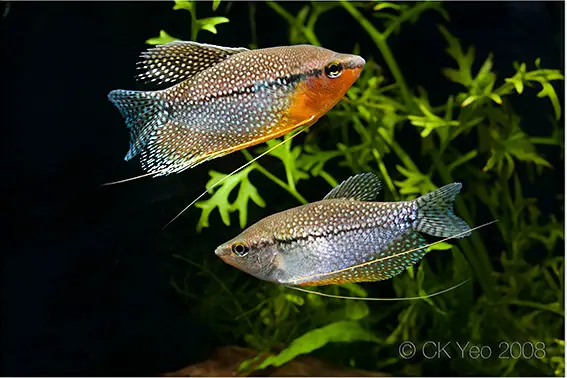
For the Trichopodus gourami (opaline, three-spot, blue, gold, pearl, and moonlight) you also look at the dorsal fin. The males will have a longer dorsal fin. Males of the pearl and moonlight species will show more red color than the females.

Pearl gourami. Male above, female below (seriouslyfish.com)

With some of our aquarium fish it can be very easy to tell the males from the females, but others can give you a lot of trouble. Some like oscars and angelfish can even give breeders trouble in determining gender. If you wish to breed any of these fish, I highly suggest you do a lot of research and read personal experiences. While breeding can be fun and rewarding, it can also be costly and heartbreaking when done incorrectly.

Works referenced

Christie F. 2006. Sexing Bettas: The Ovipositor. nippyfish.net. Retrieved: 31 Jan 2013

How to tell Male and Female Guppy Apart. Jabraguppyroom.blogspot.com. Updated: 29 July 2011. Retrieved: 1 Feb 2013.

Kortet R., J. Taskinen, A. Vainikka, and H. Ylonen. 2004. Breeding Tubercles, Papillomatosis and Dominance Behavior of Male Roach (Rutilus rutilus) During the Spawning Period. Ethology 110:591-601.

Seriously Fish

Sexing Angelfish. Koiangelfish.com. Updated: 2013. Retrieved: 1 Feb 2013. 

Sexing Goldfish. Bristol-aquarists.org.uk. Updated: 26 October 2012. Retrieved: 31 Jan 2013

Sexing Goldfish. theGAB.org. Updated: 16 Aug 2009. Retrieved: 31 Jan 2013