Showing posts with label oscar. Show all posts

Friday, March 29, 2013

Just One Fish

The Problems of Aquarium Release 

A lot of people buy fish that grow too large for their aquariums. Most times it isn’t their fault as pet stores often don’t inform people how large their goldfish, oscar, or pleco will grow. A couple of years down the road, these massive fish can cause problems for unsuspecting aquarists. Some stores will take back overgrown fish and try to re-home them, but this is costly for the store.

Oscar in a 20 gal (Oscarfish.com)

Many times these large pets are just released into local lakes and rivers because people assume just one fish won’t cause any harm. This leads to things like a pacu being caught in North Carolina and Utah. This is by no means good, but it isn’t the end of the world as most of these fish die when winter comes. But what happens when you get a cold-tolerant species like goldfish? Or when the winters just aren’t cold enough to kill off tropical fish like in southern Texas and Florida? If enough fish are released you can, and do, get breeding populations of these fish.

This causes major problems for the local ecosystems. In the case of oscars (Astronotus ocellatus) suddenly local fish have to deal with a whole new predator. Those small fish are what feed the gamefish like bass and perch. The large predators of the lake suddenly have to deal with competition, something they might not have dealt with before. A lot of times, the new fish is a stronger competitor and drives the native fish towards extinction.

In the case of goldfish (Carassius auratus auratus), they don’t directly compete with the native fish; it’s the feeding action of these fish that cause trouble. In the wild, goldfish quickly lose their gold coloring and look more like regular carp. Just like carp, they root around in the substrate. This causes the water to become cloudy, impeding the growth of plants in the substrate. These plants offer a refuge for juvenile native fishes; without them the juveniles become prey for larger fishes. The increased turbidity can also be a problem for fishes that feed on benthic insects as the insects rely on a layer of algae that cannot form when the water is cloudy. So far two species have suffered negative effects on wild populations since goldfish were introduced into their habitats: the Sacramento sucker Catostomus occidentalis (Moyle 1976) and Pahrump poolfish Empetrichthys latos latos (Deacon et al. 1964; Lee et al. 1980 et seq.) There may be many more that haven’t been studied yet.

Researcher holds up a giant goldfish pulled from Lake Tahoe
where they have been causing unrest in the local ecosystem.
(kcra.com)

Not only are released aquarium fish a problem with the native fish, but they can be problematic for humans, too. Loricariid catfish, commonly called plecos, can’t survive the winters in the  northern US, but they can and do thrive in the southernmost states. Florida, Texas, Louisiana, and Nevada all report breeding populations of these fish. These large catfish breed in burrows, which becomes a problem when they are found in high numbers. These burrows lead to increased erosion (Nico 2009). This can be very problematic when they burrow into levees as this causes the levees to erode from within. The damage may not be noticed until after the levee has breached. 

It’s not just freshwater fish that present a problem. Saltwater fish released into non-native habitats can also cause problems. The most notable is the lionfish (Pterois volitans). These are beautiful fish that outgrow most normal sized home aquariums and when released into the ocean survive and thrive. They have been reported as far north as Massachusetts and breeding populations are established from North Carolina to Florida, Bermuda, and all around the Caribbean. Lionfish are predatory and have a voracious appetite. They prey on important local fishes such as those that keep reefs clear of algae and juvenile foodfish that are economically important like grouper and grunts. Lionfish have no predators in the Caribbean ecosystem and are covered in large, venomous spines. These spines deter anything from eating them and cause harm to divers that approach them. Luckily there is something divers and fisheries managers can do about these fish: harvest them. They are targeted by spearfishing operations which appear to be having an impact on the population.


It’s not just fish released from aquariums that can cause trouble; plants have also been known to make it into local waterways when aquarists toss them as well.. Some of the most notable examples of this come from floating plants like water hyacinth, hygrophila, water lettuce, and giant salvinia. These plants are rapid-growing and will choke out waterways making boat travel very difficult. Controlling them requires intensive management.

These are some of the worst cases of the consequences of aquarium release. I don’t want this to turn you against the aquarium hobby—I want these examples to open your eyes to what happens beyond your fish tanks. These examples are sad, and we can’t do anything to stop what they have already done. But we can prevent more examples from being added to this list. Never release fish from your aquarium into the wild. Never buy a fish you can’t house. Never expect someone else to take care of your fish when it gets larger. Speak up if you know someone who wants to release an aquarium fish. They may see it as just one fish, but they don’t know that hundreds of “just one fish” have already led to problems. We all can make a difference, and it starts with just one fish. 

Works Referenced

Deacon, J.E., C. Hubbs, and B.J. Zahuranec. 1964. Some effects of introduced fishes on the native fish fauna of southern Nevada. Copeia 1964(2):384-388.
 
Lee, D.S., C.R. Gilbert, C.H. Hocutt, R.E. Jenkins, D.E. McAllister, and J.R. Stauffer, Jr. 1980 et seq. Atlas of North American freshwater fishes. North Carolina State Museum of Natural History, Raleigh, NC.

Leo Nico, Pam Fuller, and Matt Neilson. 2013. Astronotus ocellatus. USGS Nonindigenous Aquatic Species Database, Gainesville, FL. nas.er.usgs.gov/ Updated: 4 March 2013. Retrieved: 28 March 2013. 

"Lionfish Pterois volitans." Florida Fish and Wildlife Conservation Commission. http://myfwc.com/wildlifehabitats/nonnatives. Updated: 2013. Retrieved: 28 March 2013. 

"Lionfish Research Program." REEF. www.reef.org. Updated: 2012. Retrieved 28 March 2013.

Moyle, P.B. 1976. Inland fishes of California. University of California Press, Berkeley, CA.

Nico, Leo G., Howard L Jelks, Travis Tuten. 2009. Non-Nativev Suckermouth Armored Catfishes in Florida: Description of Nest Burrows and Burrow Colonies with Assessment of Shoreline Conditions. Aquatic Nuisance Species Research Program 09: 1-29. 

Nico, L.G., P.J. Schofield, J. Larson, and A. Fusaro. 2013. Carassius auratus. USGS Nonindigenous Aquatic Species Database, Gainesville, FL. nas.er.usgs.gov/ Updated: 4 Jan 2012. Retrieved: 27 March 2013. 

"Piranha-like fish caught in Utah Lake was a Pacu." The Salt Lake Tribune. www.sltrib.com. Updated: 21 July 2006. Retrieved 27 March 2013.

Taylor, Fred. 27 Sept 2006. "Wild life experts don't bite on tale of piranha in Lake Gaston." WRAL News. www.wral.com. Retrieved: 28 March 2013. 

Saturday, February 2, 2013

Is my fish a girl or a boy?

How to determine the sex of your fish

Most people like to name their fish and want to have a name that fits the fish’s gender. Other people want to try breeding and need to know if they have males and females. Sexing fish can be a tricky thing, but there are some species and families of fish that are relatively easy. Before we get into those, I’ll talk about some general trends in sexing fish.

Females are rounder

Of course this only works with mature animals, but for the most part the female will have slightly thicker bodies. This is because the eggs that females carry take up more space than sperm. The females also need larger fat reserves to produce the eggs.

Males are smaller and more colorful

Just as in birds, males are the more colorful of the genders. Males compete with other males by showing off their vibrant colors. The most colorful male gets to mate. They are also slightly smaller than the females.

Sexing popular fish

Goldfish (Carassius auratus auratus)

These fish can actually be a little tricky as they have no obvious differences when the fish are not breeding, but there are two things you can look for when they breed: breeding stars and the shape of the vent.

Breeding stars or breeding tubercules will only appear on the males. They appear on the gill plate and pectoral fins. These are a sign of virility, and a study performed on a relative of the goldfish found a correlation between the number of breeding stars and how healthy a male fish is. These stars help a female fish decide who she wants to mate with.

Breeding stars on pectoral fin and gill cover (goldy fk @ flickr)

The next thing to look for is the shape of the vent (this is also called the cloaca and is the opening near the anal fin). The vent of the male will be slightly larger and concave (meaning it curves inward). The vent of the female will be smaller and protrude slightly. The pictures below better illustrate this.

Circled male vent (mikroll @ TheGAB)

Circled female vent (mikroll @ TheGAB.org)

I find using the vent method to be a little difficult as my goldfish usually like to have their heads facing towards me begging for food. I prefer to use the breeding star method because they are more visible in my experience.

Betta fish (Betta splendens)

These small, popular tropical fish are a little easier than goldfish to sex because some of it can be done out of the breeding season. There are two main ways to sex bettas: fin length and the presence of an ovipositor.

If you see a long-finned betta it is a male. There have been cases where females have longer than normal fins, but they aren’t nearly as long as the typical halfmoon spread seen below.

These extremely long fins indicate a male(Aquariumloto @ Flickr)

Sexing bettas gets a little trickier when you are dealing with plakat (or short-finned) bettas because the male and female fins are the same length. Now you have to look for the ovipositor on the female. The ovipositor is a small white tube protruding from the vent of the female; in breeding she uses this to position eggs. It will appear as a small white dot behind the ventral fins. The lack of such indicates a male.

Arrow points to ovipositor (Stuart Halliday)

Angelfish (Pterophyllum spp)

Another extremely popular aquarium fish, but much harder than bettas or goldfish to sex. They have no discernible differences when they are not spawning, and when they are spawning you have to look very closely to see the only difference:  the males will have a thinner breeding tube which is visible in the vent of the fish. Both males and females have breeding tubes, so the key is to look for the smaller one.

Female angelfish breeding tube (koiangelfish.com)

Male angelfish breeding tube (koiangelfish.com)

Neon tetra (Paracheirodon innesi)

Like angelfish, neon tetra are difficult to sex. The only difference will be in size. The females will be slightly larger and fatter especially when they are ready to breed. Males may show slightly better color, but these differences are so minute that they will likely go unnoticed.

Livebearers (Poecilidae)

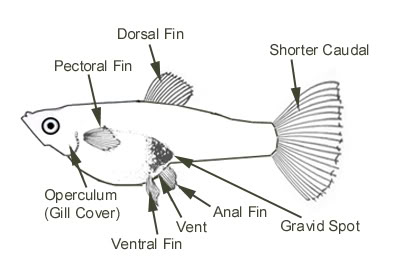
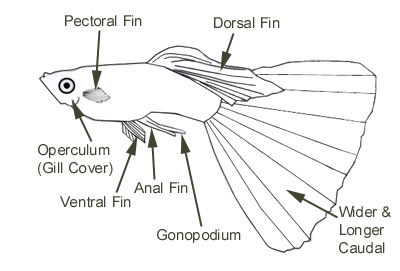
These are fish like guppies, platies, swordtails, and mollies. The males and females are very easy to tell apart. There is a large size difference with some females being almost one and a half times the size of the males. The males will have long, flowing fins and are very colorful. Males also possess a modified anal fin called a gonopodium; this is used to transfer sperm to the females. Below you can see two illustrations showing the differences between male and female guppies

General female livebearer characteristics (jabraguppyroom.blogspot.com)

General male livebearer characteristics (jabraguppyroom.blogspot.com)

Cory catfish (Corydoras spp)

Another popular but difficult fish to sex, cories have no highly visible differences between the genders. Females will tend to be the larger ones and look much chubbier when they are breeding, but for the most part males and females look exactly alike.

Bristlenose pleco (Ancistrus spp)

These small plecos are surprisingly easy to sex. Both males and females will have the bristly nose, but the number and size of the bristles will be much greater in the males. This is especially true when the fish are in breeding condition. Scientists believe that males evolved the bristles to mimic young fish because females are more likely to mate with a male who is already caring for eggs.

Male bristlenose with month old offspring (goldy fk @ Flickr)

Oscar (Astronotus ocellatus)

Probably the most popular of the cichlids next to angelfish, but even more difficult to sex. Among wild populations the males show more color than females, but this isn’t reliable with the captive-bred fish that show up in stores nowadays because they have been bred for color.

Cherry barb (Puntius titteya)

This is a species that is easy to sex based on the general trends in fish genders. The males are smaller and have more red color and the females are larger and will be more brown in color. This holds true with wild-caught and naturally bred cherry barbs. There are some that have been specifically bred to make the red even brighter; these are much more difficult to gender. 

Female cherry barb on left, male on right (aquapage.cz)

Gourami

They aren’t as easy to sex as livebearers, but they are pretty easy if you know what to look for. If it’s not a captive-bred variant, the males will be a brighter color especially when breeding. If they are a color variant you have to look for a few other things. For the Trichogaster gourami (this is dwarf, honey, thicklips, and banded) look at the end of the dorsal fin; males will have a pointed dorsal, and females will have a rounded dorsal. These pictures below illustrate this as it can be hard to pick out if you’ve never seen it.

Male honey gourami (CK Yeo @ Flickr)

Female honey gourami (CK Yeo @ Flickr)

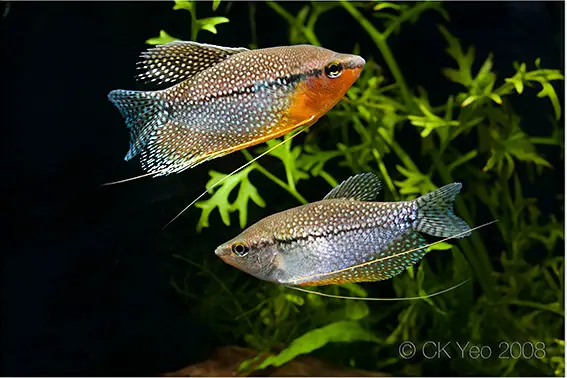
For the Trichopodus gourami (opaline, three-spot, blue, gold, pearl, and moonlight) you also look at the dorsal fin. The males will have a longer dorsal fin. Males of the pearl and moonlight species will show more red color than the females.

Pearl gourami. Male above, female below (seriouslyfish.com)

With some of our aquarium fish it can be very easy to tell the males from the females, but others can give you a lot of trouble. Some like oscars and angelfish can even give breeders trouble in determining gender. If you wish to breed any of these fish, I highly suggest you do a lot of research and read personal experiences. While breeding can be fun and rewarding, it can also be costly and heartbreaking when done incorrectly.

Works referenced

Christie F. 2006. Sexing Bettas: The Ovipositor. nippyfish.net. Retrieved: 31 Jan 2013

How to tell Male and Female Guppy Apart. Jabraguppyroom.blogspot.com. Updated: 29 July 2011. Retrieved: 1 Feb 2013.

Kortet R., J. Taskinen, A. Vainikka, and H. Ylonen. 2004. Breeding Tubercles, Papillomatosis and Dominance Behavior of Male Roach (Rutilus rutilus) During the Spawning Period. Ethology 110:591-601.

Seriously Fish

Sexing Angelfish. Koiangelfish.com. Updated: 2013. Retrieved: 1 Feb 2013. 

Sexing Goldfish. Bristol-aquarists.org.uk. Updated: 26 October 2012. Retrieved: 31 Jan 2013

Sexing Goldfish. theGAB.org. Updated: 16 Aug 2009. Retrieved: 31 Jan 2013