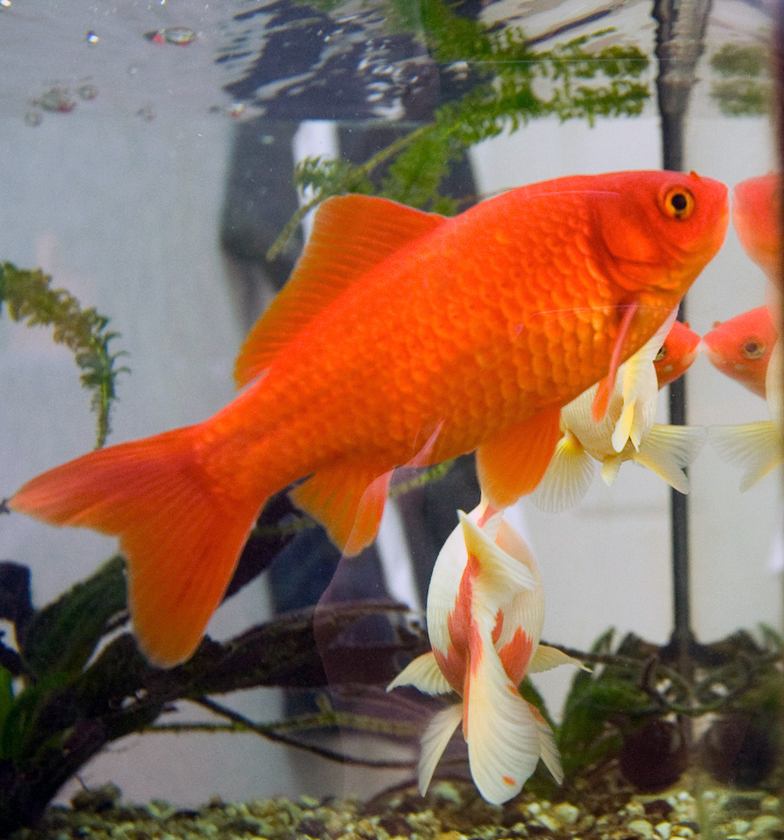
Showing posts with label fish profiles. Show all posts

Saturday, June 8, 2013

Koi (Cyprinus carpio carpio) Care

Basics


Koi (Cyprinus carpio carpio) are a common sight in ornamental ponds around the world. They represent good fortune and luck in many cultures and are sometimes referred to as living jewels. Koi are the domesticated form of wild Asian carps. The processed was begun in the 1800’s when fish that showed more gold coloring than others were pulled from fisherman’s net and put into ornamental ponds. By the 20th century many of the recognizable color patterns were firmly established.

Koi come in combinations of yellow, orange, red, black and white. One of the most common color patterns is a simple white and red koi. This is called kohaku. A kohaku koi with a single red patch on its head is called a tancho and is highly prized because they resemble the Japanese flag as well as the sacred tancho crane. Some tancho koi sell for over a thousand dollars.

Tancho koi (KoiQuestion @ Flickr)

Minimum tank size


As beautiful as they are, koi are not for the everyday hobbyist. They are large fish that require large tanks or ponds. The average size of a properly cared for adult koi is over a foot (30 cm) long. When given enough room and good food, champion koi will reach almost three feet (91 cm) long. Like goldfish, they are also copious producers of ammonia. A fish of this size and dirtiness cannot be housed in a normal sized tank. I don’t recommend anything smaller than 500 gallons (1,892 L) for a single koi. I know other people would choose to keep them in smaller tanks, but I feel it would not give the fish enough room to reach its full potential.

There are a few different ways to stock a pond. Some koi hobbyists have heavily stocked ponds with professional-grade filtration systems and do large weekly water changes. Some, like myself, chose a more relaxed approach. I only have one fish per 550 gal (2,082 L) of water. This lower stocking level means I don’t have to spend as much on equipment and maintenance. As with a lot of fish, there are a few right ways to stock a pond and most of it depends on how much money and time you want to put into it. But there is one certainty with koi: they need large ponds.

Temperature range


Koi are a hardy pond fish with a wide temperature range. They can survive in water that is almost below freezing or up to tropical temperatures. The important thing is that they experience these transitions gradually. In a large enough pond there is little worry of temperatures changing drastically overnight; this is another reason to keep koi in large volumes of water. The generally accepted range of temperature tolerance for koi is 35F (2C) to 85F (30C). I highly recommend putting a thermometer into the pond because air temperature and water temperatures can differ greatly.

Keeping the water moving helps prevent freezing over (Aquascape Inc)

The depth of a pond plays a large role in temperature control. The deeper the pond is, the cooler it will be in the summer and the warmer it will be in the winter. This may seem counter-intuitive, but the ground acts as insulator against both the cold and the warm. It is this same principle of insulation that keeps caverns the same temperature year-round. The farther north you live, the deeper you will need to dig your pond in order to prevent it from freezing solid in the winter. In the southern US you may only need to go down 2.5 feet (76 cm), but in Ontario, Canada you may have to dig down 5 feet (1.5 m) deep.

Water quality


Just because koi are hardy doesn’t mean that water quality isn’t important. If you want to grow large and beautiful koi, clean water is a must. Just like with tanks, koi need filters and water changes. The filters on ponds are large and scaled to the pond, but just like tanks they will need some kind of regular maintenance, whether it is professionally done or your own labor. I clean the debris out of my filter about three times a year: once when I take the leaf net off in the spring; once in the summer; and once in the fall before I put the leaf net on the pond for the winter.

Because ponds are located outside we get assistance from Mother Nature with water changes. Unless you live in a desert climate, water changes are taken care of for you. When it rains, the fresh water enters the pond and causes it to overflow (most ponds have directed overflow drainage that also protects the fish from getting swept out). When the pond overflows, the older dirty water flows out and is replaced with the incoming fresh water. These pond overflows can also provide a nice area to plant a bog garden.

Bog garden with pitcher plants adjascent to koi pond (mmwm @ Flickr)

Food


Koi, like goldfish, are omnivorous fish. Because they are subject to large temperature changes throughout the year, their diet has to change with the seasons. Fish are cold-blooded which means their ability to digest food is dependent on the outside temperature. In cool weather they cannot handle protein-rich foods; if fed too much it can rot in their digestive tract and kill them. For this reason there are two general types of koi food sold: warm water food and cool water food.

At temperatures above 65F (18C) koi should be fed a staple food, sometimes called summer feed. This is food with a higher protein content, usually above 35%. Koi metabolisms work fast enough at these temperatures to digest proteins. This is when most growth occurs. As the temperature increase, you increase both the volume of food and the frequencies of feeding.

Koi eating floating pellets (Kristen Shoemaker @ Flickr)

Below 65F (18C) koi should be fed a wheat germ-based food. Below 65F (18C) the koi metabolism slows and cannot handle high proteins, but until the water reaches 50F (10C) koi still need to be fed. This high-carb food is easy to digest and helps them gather enough energy for winter hibernation. As the temperature decreases you lower the amount and frequency of feedings until you are only feeding once every couple of days. Below 50F (10C) your koi should not be fed. They are in hibernation. If the temperature warms slightly in the winter, they will graze on algae and detritus in the pond. 

I have included below the temperature feeding schedule I use for my koi. There is some debate about the exact temperatures among koi hobbyists but this is what has worked for me.


TEMP (°F)
FEEDING REGIMINE
Above 86
Feed cautiously as adult koi metabolism can shut down in temperatures approaching 90F
70 – 86
Every day. As much as they can eat in about 10 minutes. Feed 3 – 4 times a day.
69 – 65
Every day, twice a day with a staple food.
64 – 61
Every day, once a day (mix of wheat germ and staple). Midday feedings are best.
60 – 55
Every 3 to 4 days (Wheat germ base)
54 – 50
Feed once a week with presoaked if koi are moving around (Wheat germ base)
Below 50
Do not feed!
 

Substrate


This is more of personal preference than koi preference. Koi thrive in bare-bottomed ponds, gravel-bottomed ponds, and mud-bottomed ponds. Bare-bottom ponds are easier to keep clean. Most serious koi hobbyists use these types of ponds because it enables them to keep the water crystal clear to grow massive koi. Some Japanese water gardens use mud bottom ponds because that is traditionally how koi were kept. Koi breeders who breed the traditional way use mud bottom ponds as spawning sites. The downside to mud-bottom ponds is that koi like to root around in the substrate, and the stirred-up mud obscures your view of these gorgeous fish. I prefer a light layer of large gravel over the pond liner as it produces a natural look without the cloudiness of mud.

Tank mates


Koi, like most carps and minnows, are social fish. They prefer the company of their own kind but also do well with goldfish (Carassius auratus auratus), golden tench (Tinca tinca), channel catfish (Ictalurus punctatus), and golden orfe (Leuciscus idus). Sturgeon (Acipenseridae) do not make good pond-mates for koi because they are shy and require a carnivore-based diet. Koi should not be housed with fish that will fit in their mouth because they can and will eat the smaller fish. While guppies (Poecilia reticulata) would look pretty in with your koi, they will likely become snacks.

Juvenile blue and golden orfe (Pete Turnbull @ Flickr)

Plants


Koi, like goldfish, are notorious for eating plants in ponds. Most people don’t keep floating or submerged plants in koi ponds for this reason. However, marginal plants, bog filters, and waterfall filters are very popular. Not only do they add an aesthetic beauty but they also help keep the water clean.

Marginal plants are placed on the edge of the pond so that just the roots are in the water. There are two types of marginal plants: hardy and tropical. Hardy marginals can survive through the winter in most places but tropical marginals cannot (unless you live in a semi-tropical climate). Most of these plants need a decent amount of sun, so in my mostly shaded pond I can only grow a few marginals. I maintain a number of yellow flag iris (Iris pseudacorus). Tall marginals like cattails (Typha spp) and arrowheads (Sagittaria spp) should be placed on the far side of the pond so as not to obstruct your view. Low-growing marginals like marsh marigolds (Caltha palustris) should be planted on the side of the pond where you will be viewing the pond most times.

Marginal plants can also be put into a bog filter. This is a separate area of the pond that the koi cannot reach. It will only have about 6 inches of water which enables the roots to stay wet. This water comes from the koi pond filled with nutrients for the plants. The plants remove the nutrients generated by the fish and the cleaned water is returned to the pond. Some people who have koi that even eat the roots find this a wonderful way to introduce plants into the system without having to worry about them becoming a koi snack.

Water hyacinth in waterfall return (source unknown)

Another way koi-keepers can sneak plants into a koi pond is with a waterfall filter. The water return at the top of the waterfall of a koi pond is often an open-top barrel. Some people (including myself) use this space to grow plants. You can use floating plants like water hyacinth or marginal plants, and I’ve even seen people grow veggies hydroponically there.

Interesting facts


Koi are renowned for their longevity. The average lifespan of a properly cared for koi is between 20 and 35 years, but there have been some special cases that long surpassed that average. In a small, creek-fed pond in Gifu, Japan there were six fish that far surpassed that average. Hanako, a scarlet koi, was the oldest of the lot. She was hatched in 1751. To put that in historical perspective she hatched 25 years before the Declaration of Independence was signed. This was verified by Prof. Masayoshi Hiro, D.Sc., Laboratory of Domestic Science, Nagoya Women's College. She removed a scale from Hanako’s body and counted the growth rings under a microscope, much as you would count the growth rings of a tree. In 1966 when the interview with Hanako’s owner was aired on radio, the other koi in the pond were 170, 155, 151, and 141. Unfortunately Hanako is no longer alive today. She died July 17, 1977 and was 226 when she died.

Hanako and her keeper (Northernkoi.org)

All over the world, koi symbolize luck and fortune, but most people don’t know the reason why. An old Chinese legends hold that long ago the supreme god of the heavens called the Yellow Emperor became displease with the humans for their evil ways. He ordered the rain god to flood the earth to destroy the humans. Kun, the Yellow Emperor’s grandson was distraught by the destruction and pleaded with his grandfather to spare the humans. The Yellow Emperor did not relent, so Kun stole some “magic mud” from his grandfather’s treasure. Kun sprinkled this mud and as it hit the water turned into land where the humans could take refuge. Furious at his grandson, the Yellow Emperor sent the fire god to kill Kun who tried to disguise himself as a white horse, but the fire god saw through it and struck Kun down.

After many years of continued flooding a golden dragon named Yu emerged from the white horse that was once Kun. He flew to the heavens to plead with his great-grandfather to stop the flood. This time his perseverance paid off, and the Yellow Emperor told Yu to take the magic mud and make land again. Yu easily carved a river through the soft mud, but when he came to rocky cliffs he had to greatly increase his effort to dig out a gorge. In doing so he created huge waterfalls hundreds of feet high. He declared the waterfalls sacred to dragons. The river eventually became known as the Yellow River and those 12-mile long gorges located in China’s Shanxi province became known as Dragon’s Gate. Every spring thousands of koi swim up the Yellow River and if they have the skill and perseverance of a dragon to climb the falls they become dragons themselves. Because of this legend, koi are symbols of hard work, patience, and skill which are all things needed to have good fortune in life.

Taking care of koi isn’t always an easy task, but just like Yu and the Dragon’s Gate waterfalls persevering through the hardships can make the final outcome that much more beautiful.

Works referenced


"Frequently asked water gardening questions." Crystal Creek Pond Supply LLC. www.pondkoi.com. Updated: 8 May 2013. Retrieved: 8 June 2013. 

"Koi Encyclopedia." Pan Intercorp. www.koi.com. Updated: 8 June 2013. Retrieved: 8 June 2013.

"Legend of Dragon's Gate." www.foolonthenet.blogspot.com. Updated: 8 November 2010. Retrieved: 7 June 2013.

"The Story of Hanako." Koi.net. www.playkoi.com. Updated: 29 January 2013. Retrieved: 8 June 2013. 

"Temperature." Koi Club of San Diego. www.koiclubsandiego.org. Updated: 7 June 2013. Retrieved: 8 June 2013.


**Disclaimer** Since there is little to no scientific research about fishkeeping published, much of the hobby today is opinion, but they are opinions given by keepers and breeders who have been doing this longer than some of us have been alive. Temperature ranges and adult sizes are not opinion. They have been scientifically documented.

Monday, April 16, 2012

Goldfish (Carassius auratus auratus) Care

Basics


Goldfish have been domesticated for around 1,000 years. They’ve been domesticated longer than any other fish species. Through the years around 20 breeds of goldfish have developed from the strange, dorsal-less celestial-eyed goldfish to the elegant shubunkin. The most common goldfish you will encounter in the hobby fall into two categories: single-tail (which I often call commons) and double-tail (which I often call fancies). Here are two examples below.

Fancy goldfish; note the shortened body and elongated fins
(pogiebate @ theGAB.org)

Single-tailed goldfish; note the long
and slender body form (public domain)

For the rest of the article I will be grouping the goldfish into these two tail groups to define the different care requirements for each.

Another category of goldfish that needs mentioning are the sight-impaired goldfish; this includes the bubble-eyes, moors (or dragon-eye), and the celestials. These are generally some of the most sensitive goldfish. It is best to keep them with only other sight-impaired goldfish. Due to their eye shapes these fish are often slow swimmers and will have trouble feeding and competing for food even with some of the other double-tailed goldfish.

Before I talk about the care requirements, I should say something about goldfish size. There are a lot of misconceptions about goldfish, one being that goldfish stay small. This is absolutely false. Fishbase.org places the average goldfish length at 12 inches (32 cm). The fish you often see in the store are babies probably no more than a month or two old. Make no mistake. They will be monsters in no time with proper care and food.

Minimum tank requirements


No matter what the sales associate tells you or how your friend was able to keep them, a bowl is not a suitable home for a goldfish! They are often less than a gallon and don’t provide enough surface area for oxygen to diffuse into the water. In fact, a fully grown goldfish couldn’t even fit in a bowl!!

Bowls are not suitable!
Original photo by Luigi Diamanti


At minimum your tank should have 10 gallons (40 L) for each fancy goldfish and an additional 10 gallons (40 L) as a buffer zone. For example, if you want four double-tailed goldfish you are looking at a minimum of a 50 gallon (190 L) tank. Single-tailed goldfish need room as well as gallons. They are fast and like a lot of swimming space. For one single-tailed goldfish you will need a 75 gallon (285 L) tank. A 125 gallon (475) is well-suited for a small group. With their large size and large swimming area needs, they make much better pond fish than aquarium fish.

I know some of you are thinking that if the pet store can cram hundreds of goldfish in a tiny tank, why can’t I? You should not base your fishkeeping habits on pet store displays. The fish are usually only there for a short time which is why the stores can get away with minimal decorations and no plants. It’s the difference between a hotel room and your bedroom. Wouldn’t you feel more comfortable in something personalized to your liking rather than generalized for everyone?

Temperature range


A common misconception about goldfish is that they are coldwater fish. This is untrue. They are temperate fish. The largest difference between a temperate and tropical fish is that the tropicals have a steady, high temperature year round while temperate fish have large fluctuations from close to freezing to around 85F (30C). All this means is that goldfish can live at a wider range of temperature than most fish commonly found in the hobby.

As I mentioned before single-tails and double-tails have different requirements in this department, too. Due to the more sensitive nature of the double-tails they are best kept at temperatures between 70F (21C) and 80F (27C). This may mean that your goldfish need a heater if the tank is in a colder area of the house in the winter time. 

Single-tails are hardy enough to withstand pond life year-round and will survive at temperatures close to freezing and as high as 95F (35C). If they are kept in an aquarium no heater is needed. They can be overwintered inside if the pond is too shallow, but the aquarium must be large enough for them. A 50 gallon (190L) is a good size.

Water quality


This is the most important aspect of having a goldfish. Clean water means a healthy fish. The best way to tell if your water is clean (nope clearness doesn’t count) is to have a home test kit. The drop kits are the best; the strips are just a waste of money. In a goldfish tank the ammonia and nitrite should ALWAYS be 0 ppm. Nitrate can be hard to control because goldfish are so messy, but we aim to keep it under 40 ppm.

The next set of parameters you have to worry about is pH and water hardness (GH and KH). Goldfish may be hardy, but they still have needs. The pH should be above 7. Between 7.2 and 8.2 is ideal. While it is not always necessary to know the exact numbers of your local water hardness, it is important to know that goldfish like hard water which is water with a high mineral content. Their protective coating called a slime coat will slough off in soft water. 

6 month old redcap orandas (Bettasngoldfish @ theGAB.org)
The only way water quality is maintained is through weekly water changes. There are some older aquarists who will say this is not needed; that line of thought is outdated. All of the current fishkeeping resources recommend weekly water changes. Because goldfish are so messy the weekly water changes should be about 40% to 50% of the tank volume. This means for a 50 gallon (190 L) tank you should take out and replace between 20 gallons (75 L) and 25 gallons (95 L) of water a week.

Filtration is another important aspect of keeping good quality water. A filter than can turn over the volume of the tank 10 times per hour is recommended for goldfish. This can also be accomplished by running two hang on the back (HOB) power filters. I am using this method with my 50 gallon (190L) goldfish tank. Filter brands vary depending on what part of the world you are in, but in the US I have found the AquaClear brand filters to be very reliable.

Food


Water quality has the largest impact on goldfish health, but without a good diet, your fish won’t reach his or her full potential. A high quality food should be used as a staple diet. New Life Spectrum is currently the best pellet food around. And you don’t just need to buy the stuff labeled for goldfish. Any of the diets will do; just make sure they fit inside your goldfish’s mouth and are not floating.

Due to the body shape of fancy goldfish, many experience gastro-intestinal problems associated with pellet food. When this happens, you should switch to gel food. Mazuri gel food is the best commercially available, but many goldfish keepers chose to make their own. It is much more cost-effective and can easily be personalized for the individual fish because like us, some fish don’t like certain foods. It can also be an interesting way to bond with your fish.

Substrate


This is something most people don’t think about, but watch your goldfish for a little while. They spend a lot of time picking at the substrate and really anything else in the tank. It is important to have a substrate that is either too large to fit in the goldfish’s mouth or small enough to pass through their system if it does get swallowed. I use large river rocks (from a store not the creek as items intended for aquariums have undergone a sterilization process) but have seen other keepers use sand. There are also keepers who have used regular aquarium gravel and never had a problem, but there are confirmed cases of gravel getting caught in the GI tract and killing the goldfish. It is at your discretion as to whether or not you want to take the risk.

Tank mates and compatibility


Goldfish are a very social species and should be kept in groups of 3 or more goldfish, but there are some compatibility issues between the single-tails and double-tails. The single-tails are much faster swimmers and more boisterous and for these reasons, should not be kept with double-tails.

When looking at non-goldfish tankmates for your goldfish you have to consider a few things like adult size, fin-nipping tendencies, and water parameters. Many livebearers such as guppies (Poecilia reticulata) share a lot of the same water parameters (cooler, hard, alkaline water), but they are small enough to be a goldfish snack. And they will be. Goldfish will try to eat anything that fits in their mouth. Personally, I believe that double-tailed goldfish should be kept with just double-tailed goldfish but others have had success keeping them with zebra danio (Danio rerio) and white cloud mountain minnows (Tanichthys albonubes).

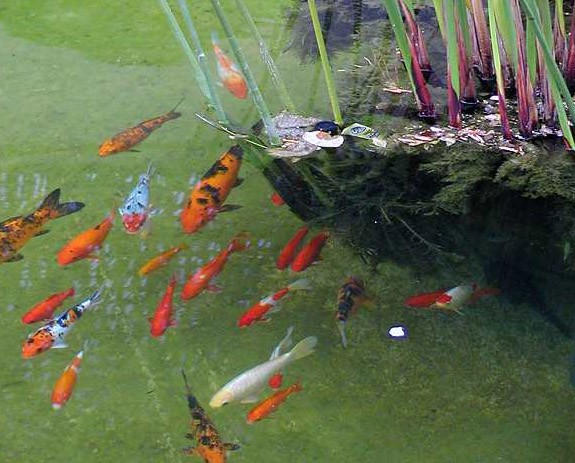
Goldfish and koi in pond (Public domain)
For the single-tailed goldfish your options are even more limited. They are a large fish to keep in home aquariums, but would do well with many of the same tankmates as the double-tails. In a pond you can keep koi (Cyprinius carpio) and single-tails together. These fish are closely related and share many of the same requirements. Mosquito fish (Gambusia spp) are another pond fish that can be kept with goldfish. 


There is some debate as to whether or not goldfish can or should be kept in typical tropical tanks. I do not believe this is a good idea for a few reasons, the first being that while goldfish can live at the higher temps in which tropical communities are kept, having them at these temperatures presents a few obstacles. First, at higher temperatures goldfish need to be fed more to maintain the same body weight. More food in means more waste out, and goldfish are messy enough as it is. Many tropicals don’t appreciate the large mess that goldfish make, and some of the more sensitive fish will succumb to it. Second, at a higher temperature goldfish take up more oxygen. Goldfish need a high level of oxygenation in the water, and the warmer the water gets, the less oxygen it holds. The other reason goldfish aren’t good for tropical communities is poor compatibility with most tropicals. Most fish typically chosen for tropical tanks like soft, acidic water, an environment in which goldfish will not thrive. Many are also small enough to become food or will see the long flowing fins as irresistible targets for fin-nipping. There are just too many complications that can come from keeping goldfish in a typical tropical tank, and I highly advise against it.

Plants


Most people have heard that goldfish will eat all live plants and will always uproot anything you put in the aquarium. While this does happen some of the time, if you are feeling adventurous you can try plants with your goldfish. Just make sure you have the right lights and lighting schedule. There is more to a planted tank than just throwing plants in there. I will give you some suggestions for plants with the understanding that more research should be done on planted tanks in general.

Of the plants that other goldfish keepers including myself have had success with, the best have been the thick-leaved plants like anubias and amazon swords. I have also had success with fast growing plants like anarcharis and hornwort. It’s usually hit or miss with goldfish and plants. But don’t ever let anyone tell you it can’t be done. Plants are great for keeping good water quality (but won’t eliminate the need for a water change).

Smashing the myths


One of the excuses I hear for someone keeping a goldfish in a one gallon (4 L) bowl or 10 gallon (40 L) tank is that “the fish will grow to the size of the tank.” This is false. It came about because goldfish kept in these small tanks often live in terribly dirty water. As a result of the poor water quality, they typically die anywhere from a few days to a year after they are purchased. The owner usually assumes that “it was the fish’s time anyway.” Due to these poor conditions the fish either grew just a bit or didn’t grow at all. The lack of growth in the small tank leads people to believe that “fish grew to the size of their tank” and then died when it got old. As we know from earlier, this isn’t true as goldfish live between 10 and 20 years and commonly grow 10 inches (25 cm) or larger.

If the fish does survive this ordeal and is either placed in a larger tank by their owner or re-homed to a larger tank, the goldfish will suffer long term effects in the form of stunting. In anecdotal studies using juvenile discus, aquarists have shown that water quality has a greater stunting effect than being kept in a small environment. So if you are reading this and have just put a goldfish in an insufficient tank: there is still hope. Large, daily water changes will ensure good water quality until you can secure your buddy a larger tank. For those on a tight budget, try to look for secondhand tanks.

With a life span comparable to a cat or dog, goldfish are a lengthy investment and may not be for every aquarist. Some people buy them and then learn about their care requirements. If you find yourself with goldfish you no longer want, do try to rehome them before you euthanize them. Many people see goldfish as throw-away fish, but they are not. They are a rather intelligent fish that will recognize the faces that feed them and be shy around new people. They feel pain, bond with their school mates, and show signs of grief when a tank mate is lost. A lot of people don’t like the ephemeral nature of fish, afraid that a child will be sad when his or her “fishy” dies. With a properly cared-for goldfish, that child won’t have to know loss so soon in life and will grow up with wonderful memories of taking care of “fishy” with mommy and daddy.

Works Referenced


"''Carassius auratus'' (Linnaeus, 1758)".  Fishbase.org. Updated 15 Nov 2011. Retrieved 16 April 2012.

Betty (Dataguru). 02 August 2009. “Goldfish Nutrition Part 2: Food and Nutrition.”  theGAB.org. Retrieved 10 April 2012.

Gay, Jeremy. 25 March 2010. “What do I need for goldfish?”  Practicalfishkeeping.co.uk. Retrieved 16 April 2012.

Hill, Nathan. 14 May 2011. “Goldfish with tropicals – wrong or right?”  Practicalfishkeeping.co.uk. Retrieved 15 April 2012.

Muha, Laura. 2006. “Fish Growth vs. Tank Size” in “The Skeptical Fishkeeper” column. Tropical Fish Hobbyist (December).


**Disclaimer** Since there is little to no scientific research about fishkeeping published, much of the hobby today is opinion, but they are opinions given by keepers and breeders who have been doing this longer than some of us have been alive. Temperature ranges and adult sizes are not opinion. They have been scientifically documented.

I publish this in the memory of my cat, Potpourri. While I wrote this article in the days before, I published it on the last night she was with us. She was sitting on my lap and purring. She always loved to watch the fish and had been my constant companion for 14 years.