Showing posts with label Carassius auratus auratus. Show all posts

Monday, January 7, 2013

Goldfish Breeds

Goldfish are some of the longest domesticated fish. Today there are something like 20 different breeds recognized around the world. Many of these breeds originated in China and Japan, but the US and some Europeans have gotten into the game in the last century. Of all the breeds of goldfish only a handful would actually be recognizable to most people as a goldfish breed. I’ll recount most of the common ones (and some uncommon ones) here.

Single-tail goldfish

Common (also called hibuna)

This is your basic pet store goldfish. These are often the fish you see in the horrible “feeder goldfish” tanks. They are the stereotypical goldfish and resemble the first ones ever domesticated. They can come in any color from white to black to yellow. Their fins are short and their bodies are stocky.  

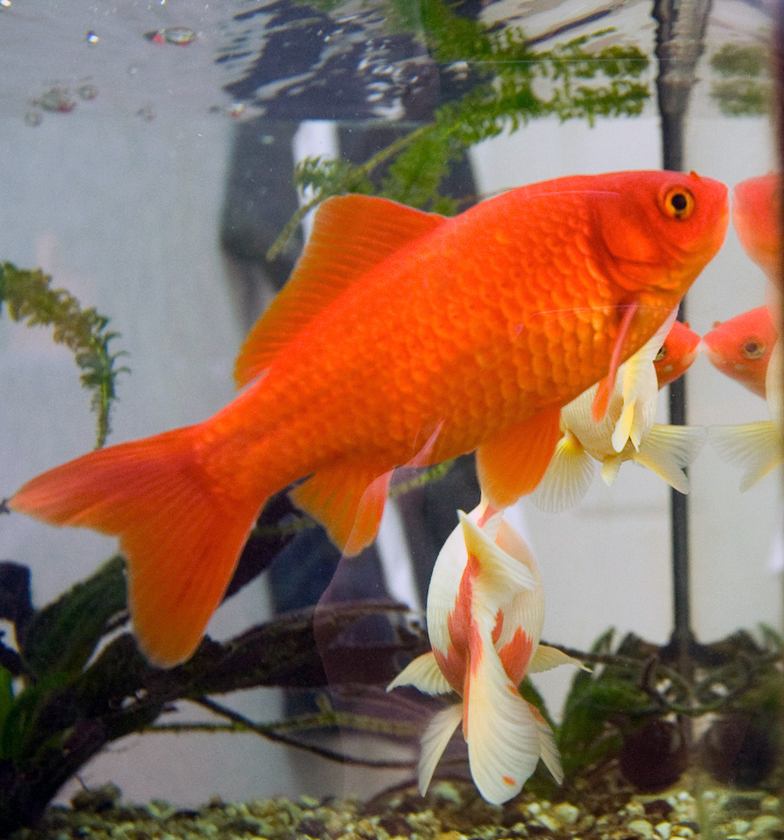
Common goldfish (Left: Bristol Aquarists Society | Right:raingarden.us)


Common goldfish, like all single-tail goldfish, are not suited for the typical home aquarium. Reports of these guys reaching 14 inches in a pond isn’t uncommon. They make good buddies with other single-tail goldfish as well as koi in a pond. They can be temporarily housed in large indoor tanks, but they are best kept in ponds away from fancy goldfish as commons will out-compete them.

Comet

These guys are one step up from the common goldfish. Their bodies are a bit slimmer, and they gain long, flowing fins. Comets come in solid or bi-color. Commonly found in pet stores, these are all too often stuffed into horrible fish bowls. But they really do best in pond with other single-tail goldfish and koi.

Comet goldfish (raingarden.us)


Shubunkin

Sometimes called the poor man’s koi, these are the goldfish that most resemble the typical koi colors. They have the same body shape and fins as the comet goldfish but are all tri-colored. A well-bred shubunkin will also have rounded ends to their caudal fins. Like koi, shubunkins don’t have a place in the home aquarium. They are best viewed in ponds with comets and common goldfish.

Shubunkin goldfish (raingarden.us)


Double-tail goldfish (fancy goldfish)

Fantail

This was the first fancy goldfish, and today remains the most common fancy goldfish. Their bodies have the typical rounded shape, and their dorsal fin is split into four segments. They come in all colors from black to yellow to tri-color and can have a variety of tail sizes from short to the elongated veiltail. These are generally hardy fish, and depending on how severe the winters are they can be kept in ponds year-round. For a fancy goldfish they are boisterous and fast and shouldn’t be combined with some of the fancier varieties I’ll cover later.

In terms of tank space, fancies are much less demanding than single-tail goldfish. A 30 gal (110 L) tank is just large enough to house two fancies, but really a 40 gal (150 L) or larger tank is best as goldfish like company.

Fantail goldfish (raingarden.us)


Wakin

Another uncommon goldfish breed that is best kept in ponds. These fish are like common goldfish in body shape and growth, but they have a short double-tail. The long-tailed version is called a wantonai. Due to their large size, these fish are best left in ponds as in fact they were bred to be viewed as such. They aren’t found in many pet stores around the country, but many goldfish breeders will have them or be able to acquire them.

Left: Wakin goldfish | Right: Wantonai goldfish (raingarden.us)

A variation of the wakin is the jikin. Jikin have the same body shape, but have all white bodies and orange fins. Since these fish are hard to breed, they are even more uncommon than the wakin.

Jikin goldfish Left: (exoticgoldfish.net) | Right: (Practical Fishkeeping)


Oranda

Similar to the fantail goldfish, but oranda have a fleshy growth on their heads and operculum called a wen. Often times the wen isn’t fully developed until three or four years of age. Oranda can be fast and feisty when they are young, but the large wen will slow them down as they age. Sometimes it will obscure the eyes and cause the fish sight problems. The fins can be long or short, and they come in a wide variety of colors. This is another variety of fancy goldfish that is hardy enough to survive in some ponds year-round provided the temperature doesn’t go below 55F (13C).

The redcap oranda is a specific variation of the oranda where the wen only develops on the top of the head. The wen is red, and the rest of the body completely white. This gives the fish an appearance like the tancho koi or the Japanese flag.

Left: calico oranda (cngoldfish.net) | Right: redcap oranda (lilopet.com)


Ryukin

My personal favorite, the ryukin, is another common variety of fancy goldfish. They have shorter bodies than fantails, but their bodies are thicker. The back should slope up sharply from the head and give a humped appearance. Their fins can be long or short, and they come in all colors from solids to calico. Because ryukin are so short, they often have digestion problems.

Ryukin goldfish (cngoldfish.net)


Telescope

Sometimes called “dragon goldfish” the telescope is another popular and widely recognizable fancy goldfish. They are defined by their bulbous, bulging eyes which give the fish a unique profile when viewed from above. This also gives them a sight disadvantage against other varieties of goldfish; for this reason they should be target-fed if kept with goldfish like fantails or orandas. They come in a wide variety of fin lengths and colors including solid, bi-color, and calico. When they are all black, telescopes are called black moors. The panda coloration (black and white) is another popular coloring.

Telescope goldfish | Center - black moor | Left - panda moor
Left: (exoticgoldfish.net) | Center (kokosgoldfish.com) | Right: (cngoldfish.net)


Tosakin

These little beauties resemble ryukin from the side, but show their true colors when viewed from above. Their fused caudal fins splay out to form a wide veil. They aren’t a very hardy breed, but are best kept in ponds as their tales are breed to be viewed from above. For this reason, they aren’t commonly seen in pet stores as few people can devote the energy to either heating a pond in the winter or constructing an indoor pond. They are most often seen in red and white, but some calico specimens are available. The breed was almost wiped out following the heavy bombing of Japan during WWII, but one breeder managed to find six fish still living in a restaurant. Today all tosakin goldfish are descended from those six fish.

Tosakin goldfish; Left (exoticgoldfish.net) |
Center (rafflesgold.com) | Right (Practical Fishkeeping)


Pearlscale

Still not common by any means, but gaining popularity is the chubby little pearlscale. These fish are even wider in body than ryukin. Their scales also have a pearlescences to them which gives them their name. Since their bodies are so bulbous, they usually have short fins to facilitate movement. They aren’t as hardy as the varieties I’ve previously listed, so they should be kept with other more fancy varieties. They are also prone to digestive problems due to their extremely rounded body.

A pearlscale with a wen is called a crowned pearlscale. Usually the wens don’t develop as fully as they do in oranda, but they do further hamper the swimming ability of these fish.

Right & Center: Pearlscale goldfish | Left: crowned pearlscale
Right (exoticgoldfish.net) | Center (Bristol Aquarists Society) | Left (petgoldfish.net)


Ranchu (sometimes called lion head)

These fish are distinguished by their lack of a dorsal fin and the presence of a wen that extends down the cheek. You may think this renders them rather useless at swimming, but they are adept enough to compete with oranda and ryukin. They come in all colors and typically have short fins. While not seen in all pet stores, they are found in some throughout the country and can be ordered online from breeders. 

Ranchu goldfish; Right: (Petgoldfish.net) | Center & Right: (raingarden.us)


Celestial

This is one of the most modified and fancy goldfish commonly seen. These goldfish have no dorsals, and their eyes bulge and face skyward, hence the name. This gives them a severe sight and swimming impediment. This is one of the breeds that does best in a single-breed aquarium with low water flow and no sharp decorations.

Celestial goldfish; Right: (Bristol Aquarist Society) | Left: (exoticgoldfish.net)


Bubble eye

Another highly modified breed of goldfish. These fish are defined by the large fluid-filled sacks that extend from under their eyes. They lack a dorsal fin and their eyes bulge upwards, too. Those fluid filled sacks are rather delicate and can be burst by objects in the aquarium. They will grow back and repair itself but the two sacks will not be equal in size anymore. Due to their delicate nature, they are best kept in single-breed aquariums. These goldfish are too delicate to combine with most other fancy goldfish.

Bubble eyes;  Right & Left (Bristol Aquarist Society) | Center (cngoldfish.net)


The images of fish and breed descriptions I have given you are from goldfish clubs and breeders. Often times pet store goldfish won’t quite fit into these categories nicely because they haven’t been bred for show. Sometimes you just have to take your best guess at what your pet goldfish is. If you have any questions, feel free to post a picture!

Monday, November 19, 2012

Differences Between Goldfish and Koi

I know there are a lot of similarities between these two fish, but getting them mixed up is one of my largest pet peeves. Maybe this is because I’ve kept both species of fish for many years. Maybe it's because I dislike people who don't bother to think about what they are seeing. Either way, I would like to point out the major differences between koi (Cyprinus carpio) and goldfish (Carassius auratus auratus).

Size


This is the most obvious difference between adult koi and goldfish. If you see a colorful fish in a pond that is larger than 15 inches, it is a koi. Fishbase.org lists 12.5 in (32 cm) as the maximum size for goldfish while it lists 43 in (110 cm) as the maximum size for koi. Younger specimens in ponds can be more difficult to tell apart, though, so this isn't always reliable.

Coloration


Goldfish are pretty limited in their patterns and colors whereas koi have a much wider variety. Goldfish tend to come in solid colors of orange, white, black/blue, or red. Yellow can be seen but is very uncommon. White and black combinations and red and black combinations are also possible but rare compared to the common red and white combination. Koi come in a much greater variety of common combinations. The base colors are red, white, black, yellow, orange, and blue. The chart below illustrates some common koi colorations and the names of the patterns. 

Koi color varieties (credit in picture)

The barbels (sometimes called whiskers)


This is the most obvious difference between koi and goldfish. Koi will have these barbels and goldfish will not. If you can see these on a pond fish, that fish is a koi. However, these aren't always easily observable. 

Barbels on koi (Stan Shebs @ Wikipedia)


The Tail


Both koi and goldfish can have elongated tails, but only goldfish will have the signature double-tail. This is where the caudal fin (tail fin) is doubled. From above, this will often give the tail a three-pronged or a four-pronged appearance. This characteristic is only found in goldfish. 

Typical split caudal as seen on wakin goldfish (fishsempai.com)

Other less obvious physical characteristics


This illustration below points out more of the morphological differences between koi and goldfish. Often times these aren't visible unless you view two fish side by side or have looked at a lot of koi and goldfish. The difference in mouth is often visible when you feed them. Sometimes it will give you a chance to look for barbels, too. 

Physical differences in koi and goldfish (credit unknown)


Can they interbreed?


Yes. When found in the same habitat (either in the same pond or in the wild), the two species will hybridize, but the hybrids are infertile. Often times these hybrids will be the natural brown, but some can come out a beautiful solid black. When these are found in the aquarium trade, they are often breeding mistakes. 

Genetically verified hybrid carp goldfish found in the wild (Jim Negus)

I hope you now have a better understanding of the differences between goldfish and koi. These are two beautiful fish that deserve to be recognized for their own merits.


Tuesday, October 2, 2012

Goldfish Salvation

I don't often talk about fish art because there simply isn't a lot of it, but the other day I found an artist who deserves recognition. Riusuke Fukahori was a struggling artist who found inspiration in his pet goldfish. These beautiful works resulted from his chubby, golden muses.

Photo of Riusuke Fukahori's work displayed at thisiscolosal.com

It looks real, doesn't it? It's all done in resin. He makes these 3D painting by pouring layers of resin on top of paint in a similar manner as a 3D printer. Watch a video of him working here:


Beautiful works inspired by beautiful fish. If you look in the background of the video, you can get a quick glimpse of his fish comfortably living in a 50 gallon tank.

Photo of Riusuke Fukahori's work displayed at thisiscolosal.com

You can find more photos from his ICN gallery expo here: Goldfish Salvation by Riusuke Fukahori at the ICN gallery.

Wednesday, September 12, 2012

Goldfish Gel Food Recipes

As many of you may know I advocate against the use of commercial pellet food for fancy goldfish. I make all of my goldfish food as I've just had too many problems with commercial food. That's not to say that fancy goldfish can't thrive on commercial pellet food, but I haven't found one that will work with my fish.

Ryukin are a breed of goldfish that commonly have problems with commercial pellet food. (dirkusmaximus @ flickr)

There are a few different types of gel foods for goldfish. There actually is a commercial gel food mix. You buy the powder and mix in the gel. Mazuri gel food is the one recommended by a lot of people. The 5ML6 composition is good for goldfish older than 3 years and the 58LK or 5M70 compositions are good for younger goldfish. If you do make these, it's always good to add more roughage to the gel food. A good gel food should be opaque.

I like to make gel food using pre-liquified food: baby food. It contains no preservatives as it is made for young children. This is the recipe I use. I originally got it from The GAB, but have since modified it for my own uses.

3 jars 4 oz baby food, green veggies (only 1 sugary*)
1/2 cup boiled hot water
2 envelopes of unflavored gelatin
1/2 adult multivitamin (no iron) **
1/2 teaspoon garlic powder **
1 1/2 oz salmon (drained if from can) half a can
1/4 cup finely chopped veggies --> spinach, kale or zucchini work
* I'll explain this in a bit
** optional

Dissolve 2 envelopes of gelatin in 1/2 cup hot, boiled water. Mix veggies, garlic powder, salmon, and crushed pill stuff in a small bowl. Pour gelatin/water mix into the bowl. Stir well. Pour into a flat container so it's about 1/4 inch thick. Put in fridge to set. Once gelled, cut into bite sized pieces.

Cutting into bite sized bits is hard for the smaller goldfish, so I just cut them into 1/2 inch chunks and then cut what I need from the chunks at each feeding.

I lay about a week's worth of food on a plastic wrap sheet, and layer them like this. I end up with one large bag of goldfish food layered in plastic wrap. Lay them flat in the freezer, and pull out a new layer of food per week. The food will sit for a while. My most recent batch will probably last me 6 months.

Now let me explain the first asterisk. Sugary vegetables are things like peas, pumpkin, and carrots. If you don't have many choices, only get one of these and two of leafy, green vegetables like spinach. The "garden vegetable" variety is good. If you can't find them then getting two green beans and one peas is fine.

In order to modify this recipe for young goldfish (under three years old), just add more salmon. Instead of half a can, use the full can. As a general rule you want one part protein to four parts veggies for adult goldfish and one part protein to three parts vegetables for younger goldfish.

Pearlscales like this one also struggle with commercial pellet food and do best on gel food. (locorosa @ The GAB)

If you are a great cook (unlike me) and want to get more creative with your gel food recipes, you can find some of them the goldfish experts at The GAB have created. Betty's Goldfish Gel Food Recipes. If you don't want to try these, the baby food recipe works perfectly fine. I've been relying on it for about a year now and could not have been happier with the results.

I encourage you to try making gel food just once for your goldfish. At the very least it's a fun and interesting way to bond with a pet that you can't cuddle with like a dog or cat.

Saturday, May 5, 2012

My Tanks: an introduction


 I’ve been talking a lot about what you should do with your tanks, so I figured I should show you mine. Now I’m really not the greatest aquatic photographer, so please bear with me. I have very few clear pictures of my fish. I’ll start with my oldest tank.

55 gallon (208 L) goldfish tank


This tank has been set up for going on 6 years now. It originally housed my koi that I overwintered inside. Since I already had the filtration for them I replaced the koi with goldfish once the koi went to the pond. It currently houses my two goldfish Goldeen the red ryukin and Seaking the calico veiltail. Both are male fish, so the next goldfish I add should also be male. If I added a female she would get harassed too much during breeding activities. I would love to find a calico ryukin or black maruko (egg fish)/ranchu.

Right now I have no plants in it as I am finishing up a salt treatment for a mysterious ailment that has plagued my calico goldfish for years. Seaking has had tattered fins his whole life as well as been plagued by these mysterious white spots. They are larger than ich and appear to be some kind of warty growth possibly caused by a virus. They appear and disappear on a whim and never seem to bother him. Occasionally these were accompanied by a bit of fungus and bacterial fin rot. That is why the salt is in there. When the salt is removed I’m going to try keeping hornwort and vallisneria in pots. I have also removed the heater for the summer as my tank gets about 80F (26C).

For the more technical aspects I run two HOB filters, one Aquaclear 70 and a Marineland Penguin 200. Both have been running since the tank was established and both have the flow baffled to prevent them from blowing around my fancy goldfish. I have an air pump connected to a bubble wand that runs during the summer to ensure good oxygenation. The substrate is large river rock, and the lighting is 6500k 15w 12 inch T8 bulbs (x2). I have a bag of CaribSea crushed coral in the Aquaclear to raise the GH and KH to more acceptable levels for goldfish. Weekly water changes are 40% of the tank volume.

4000 gal (15,141 L) koi pond


It was completed in spring of 2007 and has been stocked with koi ever since. I initially added 4 koi and added another 2 the following year to bring me to a total of 6 koi. Everyone is about 16 inches (40 cm) long and has a very healthy appetite. The pond is understocked, but I don’t plan to add any more koi. I believe one of the reasons it has succeeded (despite a pump failure one winter) is due to the light stocking. I also have a breeding colony of mosquitofish (Gambusia holbrooki) in there.

The pond runs on a bog and snorkel system. Water from the pond drains into a bog (a large reservoir designed to always keep the pump underwater), and from there the pump moves it up to the top of the waterfall. Because the surface area is so large, I have an autofill system in the snorkel. This prevents the water levels from dropping too low in case of a dry spell.

I have done very little with planting the pond aside from some iris that were given to me the summer my pond was completed. The iris also came with some bog plants that are now found around the edges of my pond. Due to the high surface movement I have trouble keeping floating plants like water lettuce and water hyacinth. My pond is almost completely shaded in the summer which helps keep the temperature at a more manageable level, but that means I can’t grow lilies.

10 gal (37 L) divided betta tank


While this tank now has betta, it didn’t start off that way. On one trip home to take care of my goldfish tank, I noticed these odd looking fish at walmart. I researched them and found them to be brown kuhli loaches (Pangio oblonga). I was immediately smitten with them and had to have them. I picked up a 10 gal (37 L) setup from Walmart and whisked away with 5 of them. There they stayed throughout my college years. I added some live plants and bogwood as I read they liked. Through the years, I lost two. One was a different species, and I can’t remember what happened to the other. When I returned from college I play musical tanks and moved these guys to a larger setup to prepare this tank for two betta fish.

Right now it houses Knucker and Lumi. Knucker is a blue halfmoon rosetail. Lumi is a white halfmoon plakat. The tank has 4 species of plants: java fern, anarcharis, anubias, and duckweed. I use a Aqueon Pro 50w heater and run a home-made bubble filter as I don’t like power filters with long-finned bettas. The light is a 6500k 15w 18 inch T8 bulb. I currently don’t fertilize the tank but plan to in the future. The substrate is plain, natural colored gravel that is aerated by a colony of Malaysian trumpet snails. I change 30% of the water weekly.

29 gal (109 L) softwater community


I know. This isn’t much to look at now, but I’ve got big plans for it. I just need to get a steady source of income first. This tank started out as emergency housing for a pair of dojo loaches I bought to live with my goldfish. Well it turns out the dojos loaches took a liking to the goldfish’s slime coat, so the dojos had to go. They lived in the 29 gal for a few months before I found another aquarist to take them from me. I was sad to see them go, but I knew it was for the best.

The tank currently houses my remaining brown kuhli loaches, a huge colony of malaysian trumpet snails, java fern, anubias, and water sprite (Ceratopteris cornuta). My future plans for it are to heavily plant it and add a school of cardinal tetra (Paracheirodon axelrodi) as well as a thicklips gourami (Trichogaster labiosa). I would also like to switch out the gravel for black sand. This will be the first change I make. The tank currently has a Penguin Biowheel 150, Aqueon Pro 150w heater, and 6500k 17w 24 inch T8 bulb. Water changes are 25% weekly due to the very light stocking levels. The breeder box is in there to keep the plants where I want them.

Another 10 gal (37 L) divided betta tank


This tank is almost a mirror of my other tank. It has all the same plants (but these are in worse condition) and the same setup, but the hood is different which means my lighting is different. It’s stronger in this tank, so I’m having an algae problem. The two betta that are in here are Orchid the red copper dragon halfmoon and Moonie the pastel butterfly superdelta. Due to my algae problem which is partially attributed to the lights and the hornwort that shed all of its needles in my tank, weekly water changes are 50%.

Monday, April 16, 2012

Goldfish (Carassius auratus auratus) Care

Basics


Goldfish have been domesticated for around 1,000 years. They’ve been domesticated longer than any other fish species. Through the years around 20 breeds of goldfish have developed from the strange, dorsal-less celestial-eyed goldfish to the elegant shubunkin. The most common goldfish you will encounter in the hobby fall into two categories: single-tail (which I often call commons) and double-tail (which I often call fancies). Here are two examples below.

Fancy goldfish; note the shortened body and elongated fins
(pogiebate @ theGAB.org)

Single-tailed goldfish; note the long
and slender body form (public domain)

For the rest of the article I will be grouping the goldfish into these two tail groups to define the different care requirements for each.

Another category of goldfish that needs mentioning are the sight-impaired goldfish; this includes the bubble-eyes, moors (or dragon-eye), and the celestials. These are generally some of the most sensitive goldfish. It is best to keep them with only other sight-impaired goldfish. Due to their eye shapes these fish are often slow swimmers and will have trouble feeding and competing for food even with some of the other double-tailed goldfish.

Before I talk about the care requirements, I should say something about goldfish size. There are a lot of misconceptions about goldfish, one being that goldfish stay small. This is absolutely false. Fishbase.org places the average goldfish length at 12 inches (32 cm). The fish you often see in the store are babies probably no more than a month or two old. Make no mistake. They will be monsters in no time with proper care and food.

Minimum tank requirements


No matter what the sales associate tells you or how your friend was able to keep them, a bowl is not a suitable home for a goldfish! They are often less than a gallon and don’t provide enough surface area for oxygen to diffuse into the water. In fact, a fully grown goldfish couldn’t even fit in a bowl!!

Bowls are not suitable!
Original photo by Luigi Diamanti


At minimum your tank should have 10 gallons (40 L) for each fancy goldfish and an additional 10 gallons (40 L) as a buffer zone. For example, if you want four double-tailed goldfish you are looking at a minimum of a 50 gallon (190 L) tank. Single-tailed goldfish need room as well as gallons. They are fast and like a lot of swimming space. For one single-tailed goldfish you will need a 75 gallon (285 L) tank. A 125 gallon (475) is well-suited for a small group. With their large size and large swimming area needs, they make much better pond fish than aquarium fish.

I know some of you are thinking that if the pet store can cram hundreds of goldfish in a tiny tank, why can’t I? You should not base your fishkeeping habits on pet store displays. The fish are usually only there for a short time which is why the stores can get away with minimal decorations and no plants. It’s the difference between a hotel room and your bedroom. Wouldn’t you feel more comfortable in something personalized to your liking rather than generalized for everyone?

Temperature range


A common misconception about goldfish is that they are coldwater fish. This is untrue. They are temperate fish. The largest difference between a temperate and tropical fish is that the tropicals have a steady, high temperature year round while temperate fish have large fluctuations from close to freezing to around 85F (30C). All this means is that goldfish can live at a wider range of temperature than most fish commonly found in the hobby.

As I mentioned before single-tails and double-tails have different requirements in this department, too. Due to the more sensitive nature of the double-tails they are best kept at temperatures between 70F (21C) and 80F (27C). This may mean that your goldfish need a heater if the tank is in a colder area of the house in the winter time. 

Single-tails are hardy enough to withstand pond life year-round and will survive at temperatures close to freezing and as high as 95F (35C). If they are kept in an aquarium no heater is needed. They can be overwintered inside if the pond is too shallow, but the aquarium must be large enough for them. A 50 gallon (190L) is a good size.

Water quality


This is the most important aspect of having a goldfish. Clean water means a healthy fish. The best way to tell if your water is clean (nope clearness doesn’t count) is to have a home test kit. The drop kits are the best; the strips are just a waste of money. In a goldfish tank the ammonia and nitrite should ALWAYS be 0 ppm. Nitrate can be hard to control because goldfish are so messy, but we aim to keep it under 40 ppm.

The next set of parameters you have to worry about is pH and water hardness (GH and KH). Goldfish may be hardy, but they still have needs. The pH should be above 7. Between 7.2 and 8.2 is ideal. While it is not always necessary to know the exact numbers of your local water hardness, it is important to know that goldfish like hard water which is water with a high mineral content. Their protective coating called a slime coat will slough off in soft water. 

6 month old redcap orandas (Bettasngoldfish @ theGAB.org)
The only way water quality is maintained is through weekly water changes. There are some older aquarists who will say this is not needed; that line of thought is outdated. All of the current fishkeeping resources recommend weekly water changes. Because goldfish are so messy the weekly water changes should be about 40% to 50% of the tank volume. This means for a 50 gallon (190 L) tank you should take out and replace between 20 gallons (75 L) and 25 gallons (95 L) of water a week.

Filtration is another important aspect of keeping good quality water. A filter than can turn over the volume of the tank 10 times per hour is recommended for goldfish. This can also be accomplished by running two hang on the back (HOB) power filters. I am using this method with my 50 gallon (190L) goldfish tank. Filter brands vary depending on what part of the world you are in, but in the US I have found the AquaClear brand filters to be very reliable.

Food


Water quality has the largest impact on goldfish health, but without a good diet, your fish won’t reach his or her full potential. A high quality food should be used as a staple diet. New Life Spectrum is currently the best pellet food around. And you don’t just need to buy the stuff labeled for goldfish. Any of the diets will do; just make sure they fit inside your goldfish’s mouth and are not floating.

Due to the body shape of fancy goldfish, many experience gastro-intestinal problems associated with pellet food. When this happens, you should switch to gel food. Mazuri gel food is the best commercially available, but many goldfish keepers chose to make their own. It is much more cost-effective and can easily be personalized for the individual fish because like us, some fish don’t like certain foods. It can also be an interesting way to bond with your fish.

Substrate


This is something most people don’t think about, but watch your goldfish for a little while. They spend a lot of time picking at the substrate and really anything else in the tank. It is important to have a substrate that is either too large to fit in the goldfish’s mouth or small enough to pass through their system if it does get swallowed. I use large river rocks (from a store not the creek as items intended for aquariums have undergone a sterilization process) but have seen other keepers use sand. There are also keepers who have used regular aquarium gravel and never had a problem, but there are confirmed cases of gravel getting caught in the GI tract and killing the goldfish. It is at your discretion as to whether or not you want to take the risk.

Tank mates and compatibility


Goldfish are a very social species and should be kept in groups of 3 or more goldfish, but there are some compatibility issues between the single-tails and double-tails. The single-tails are much faster swimmers and more boisterous and for these reasons, should not be kept with double-tails.

When looking at non-goldfish tankmates for your goldfish you have to consider a few things like adult size, fin-nipping tendencies, and water parameters. Many livebearers such as guppies (Poecilia reticulata) share a lot of the same water parameters (cooler, hard, alkaline water), but they are small enough to be a goldfish snack. And they will be. Goldfish will try to eat anything that fits in their mouth. Personally, I believe that double-tailed goldfish should be kept with just double-tailed goldfish but others have had success keeping them with zebra danio (Danio rerio) and white cloud mountain minnows (Tanichthys albonubes).

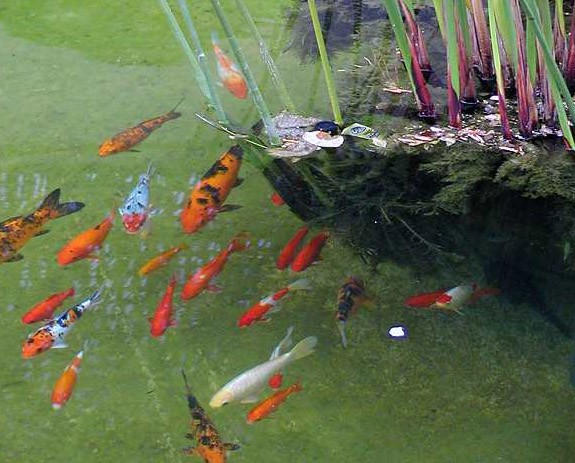
Goldfish and koi in pond (Public domain)
For the single-tailed goldfish your options are even more limited. They are a large fish to keep in home aquariums, but would do well with many of the same tankmates as the double-tails. In a pond you can keep koi (Cyprinius carpio) and single-tails together. These fish are closely related and share many of the same requirements. Mosquito fish (Gambusia spp) are another pond fish that can be kept with goldfish. 


There is some debate as to whether or not goldfish can or should be kept in typical tropical tanks. I do not believe this is a good idea for a few reasons, the first being that while goldfish can live at the higher temps in which tropical communities are kept, having them at these temperatures presents a few obstacles. First, at higher temperatures goldfish need to be fed more to maintain the same body weight. More food in means more waste out, and goldfish are messy enough as it is. Many tropicals don’t appreciate the large mess that goldfish make, and some of the more sensitive fish will succumb to it. Second, at a higher temperature goldfish take up more oxygen. Goldfish need a high level of oxygenation in the water, and the warmer the water gets, the less oxygen it holds. The other reason goldfish aren’t good for tropical communities is poor compatibility with most tropicals. Most fish typically chosen for tropical tanks like soft, acidic water, an environment in which goldfish will not thrive. Many are also small enough to become food or will see the long flowing fins as irresistible targets for fin-nipping. There are just too many complications that can come from keeping goldfish in a typical tropical tank, and I highly advise against it.

Plants


Most people have heard that goldfish will eat all live plants and will always uproot anything you put in the aquarium. While this does happen some of the time, if you are feeling adventurous you can try plants with your goldfish. Just make sure you have the right lights and lighting schedule. There is more to a planted tank than just throwing plants in there. I will give you some suggestions for plants with the understanding that more research should be done on planted tanks in general.

Of the plants that other goldfish keepers including myself have had success with, the best have been the thick-leaved plants like anubias and amazon swords. I have also had success with fast growing plants like anarcharis and hornwort. It’s usually hit or miss with goldfish and plants. But don’t ever let anyone tell you it can’t be done. Plants are great for keeping good water quality (but won’t eliminate the need for a water change).

Smashing the myths


One of the excuses I hear for someone keeping a goldfish in a one gallon (4 L) bowl or 10 gallon (40 L) tank is that “the fish will grow to the size of the tank.” This is false. It came about because goldfish kept in these small tanks often live in terribly dirty water. As a result of the poor water quality, they typically die anywhere from a few days to a year after they are purchased. The owner usually assumes that “it was the fish’s time anyway.” Due to these poor conditions the fish either grew just a bit or didn’t grow at all. The lack of growth in the small tank leads people to believe that “fish grew to the size of their tank” and then died when it got old. As we know from earlier, this isn’t true as goldfish live between 10 and 20 years and commonly grow 10 inches (25 cm) or larger.

If the fish does survive this ordeal and is either placed in a larger tank by their owner or re-homed to a larger tank, the goldfish will suffer long term effects in the form of stunting. In anecdotal studies using juvenile discus, aquarists have shown that water quality has a greater stunting effect than being kept in a small environment. So if you are reading this and have just put a goldfish in an insufficient tank: there is still hope. Large, daily water changes will ensure good water quality until you can secure your buddy a larger tank. For those on a tight budget, try to look for secondhand tanks.

With a life span comparable to a cat or dog, goldfish are a lengthy investment and may not be for every aquarist. Some people buy them and then learn about their care requirements. If you find yourself with goldfish you no longer want, do try to rehome them before you euthanize them. Many people see goldfish as throw-away fish, but they are not. They are a rather intelligent fish that will recognize the faces that feed them and be shy around new people. They feel pain, bond with their school mates, and show signs of grief when a tank mate is lost. A lot of people don’t like the ephemeral nature of fish, afraid that a child will be sad when his or her “fishy” dies. With a properly cared-for goldfish, that child won’t have to know loss so soon in life and will grow up with wonderful memories of taking care of “fishy” with mommy and daddy.

Works Referenced


"''Carassius auratus'' (Linnaeus, 1758)".  Fishbase.org. Updated 15 Nov 2011. Retrieved 16 April 2012.

Betty (Dataguru). 02 August 2009. “Goldfish Nutrition Part 2: Food and Nutrition.”  theGAB.org. Retrieved 10 April 2012.

Gay, Jeremy. 25 March 2010. “What do I need for goldfish?”  Practicalfishkeeping.co.uk. Retrieved 16 April 2012.

Hill, Nathan. 14 May 2011. “Goldfish with tropicals – wrong or right?”  Practicalfishkeeping.co.uk. Retrieved 15 April 2012.

Muha, Laura. 2006. “Fish Growth vs. Tank Size” in “The Skeptical Fishkeeper” column. Tropical Fish Hobbyist (December).


**Disclaimer** Since there is little to no scientific research about fishkeeping published, much of the hobby today is opinion, but they are opinions given by keepers and breeders who have been doing this longer than some of us have been alive. Temperature ranges and adult sizes are not opinion. They have been scientifically documented.

I publish this in the memory of my cat, Potpourri. While I wrote this article in the days before, I published it on the last night she was with us. She was sitting on my lap and purring. She always loved to watch the fish and had been my constant companion for 14 years.