Showing posts with label fish tank. Show all posts

Tuesday, November 24, 2015

The Classroom Aquarium

Pets are a common fixture in many elementary classrooms all around the country. I still remember walking into my 2nd grade teacher’s room and brimming with joy that she had a fish tank. And I’m not alone in that delight. Many researchers have found that classroom pets have a positive impact on students. Pets increase students’ positive attitude towards school and can actually make them want to come to school (Anderson & Olsen). They have been found to improve the emotional well-being of students and contribute to humane education (Daly & Suggs). Contrary to popular belief, one study showed pets did not distract from the teacher (Kortschal & Ortbauer).  And of all the possible choices for classroom pets, fish are the most common (Rud & Beck).

Freshwater aquarium (Neale Monks)
This is with good reason. Fish are relatively easy to care for. They don’t need to be fed daily, so they can easily be left over the weekend or a short break. During the summer, they can be taken home or just cared for on a weekly basis. There are also a wide variety of species that can be very easily acquired. It is also possible to keep fishes that are native to your location to give students a view of wildlife they don’t normally see.


Aquariums also have a well-established relaxing effect. Watching aquariums is known to reduce heart rate and blood pressure (Cracknell et al). And if I remember school correctly, tests certainly can generate some elevated heart rates! My mother is a middle school teacher and if there is one thing teachers need, it’s reduced stress levels. So in this way, the fish tank will help the teacher as much as the students. 

Lessons with an Aquarium


Aquariums can be very useful teaching tools. Students can examine how a fish tank attempts to reproduce a native habitat. How the light emulates the sun; how the filter gives the fish clean water like a stream; how the pump oxygenates the water like a waterfall. If native species are available students can observe their natural habitat and try to recreate it. Fish don’t have to be the only inhabitants in an aquarium. Plants can be added to further simulate a natural environment. Plants can also be used to introduce students to the idea of nutrient cycling.

Trout Unlimited volunteer helping with tank maintenance on the class's Trout in the Classroom project. Trout in the Classroom is a program started by the nonprofit Trout Unlimited which seeks to preserve freshwater streams and rivers around the USA. Students raise fish from eggs and release them at the end of the year. (Julia Ross, Troutfest.org)

Water chemistry and pollution are other lesson that can be taught with fish tank. Many pet stores carry small freshwater testing kits simple enough for middle school students. They can measure, record, and graph the temperature, pH, and nitrate levels in their fish tank. These water quality readings can be compared to local a river or pond. Teachers can actually let the fish tank get dirty to show students what happens to fish in polluted environments.

The nitrogen cycle is very important to success with an aquarium, and although it isn’t the same nitrogen cycle that happens in the air, it can be used to introduce students to the concept. Fish tanks can also help illustrate the water cycle from cloud to ocean. Students can even measure how much water evaporates from the tank on a weekly basis.

Math and science are very tightly linked, so an aquarium can also help with math lessons! Students can calculate the volume and surface area of the fish tank and convert those measurements from metric to standard units. From the volume, you can have them calculate the weight of the aquarium (hint hint, water weights 8.34 lb/gallon). These fun examples bring math out of the textbook and into real world.

Help Setting up a Tank


Right about now, you may be thinking, this sounds great but where do I start? Thankfully fish tanks aren’t difficult to set up and maintain, but they will require a bit of effort on your part initially. The first thing you will want to read and research is the freshwater nitrogen cycle. This is the article I wrote on it. Many many resources exist online to help you in starting a fish tank, and I encourage you to check out the other fish blogs I recommend for additional resources. My friend Mari at Aquariadise has some wonderful articles to help new fishkeepers such as types of filters & choosinga substrate. The National Science Teachers Association also has guidelines for keeping live animals in the classroom which I highly recommend reading.

Suggestions to a New Fishkeeper


If native fish are at all an option, I highly recommend them. In the eastern USA we have many stunningly beautiful fish right in our own backyard. You can read more about them in my article: The Beauty in Your Backyard.

 If native fish aren’t an option, then the next best suggestions I can make are small tetra like the glowlight (Hemigrammus erythrozonus) and X-ray tetra (Pristella maxillaris). Small barbs like cherry barbs (Puntius titteya) and gold barbs (Barbodes semifasciolatus) also make great classroom fish. Zebra danio/glo-fish (Danio rerio) are a staple and great, hardy fish. All of these species need to be in groups larger than 10 because they are shoaling species, meaning they survive best when in groups. They all need a tank larger than a 10 gallon, too. You can read more about these species in my article: Best and Worst Beginner Fish.

A few of the glowlight tetra in my personal tank. They are rather hardy and don't mind me leaving them for a weekend. 

For tank size, I recommend starting with a 20 or 30 gallon tank. It seems counter-intuitive but small tanks are actually harder to keep. Larger volumes of water mean there is more of a buffer in case something goes wrong. Larger tanks also mean you’ll be able to keep more fish which are always delightful to students.  

I highly recommend plants in an aquarium. They create a soothing natural environment and open new doors for educational opportunities in addition to helping keep it clean. To successfully grow plants you will need a plant-specific light. An aquarium kit should come with a hood and light, but that light isn’t going to be tailored to plants. You will need to get a 6500k full spectrum daylight bulb. Many pet stores also sell these, but hardware stores will have them if your pet store doesn’t. They only need to be replaced once a year to keep your plants growing green and beautiful. Some plant species that are a good, hardy beginner species are anubias, java fern, amazon sword, and duckweed. Pet stores often have these common plants for sale.

Help with Funding


Aquariums (like all pets) require money, but fortunately for you, there is a nonprofit organization that gives grants for teachers interested in getting a classroom pet. Pets in the Classroom allows teachers to submit proposals for grants to assist with setting up and maintaining classroom pets. Their website also contains lesson plan and habitat ideas for many species of pets. I highly encourage you to check it out. If regulations and demographics allow, you can ask for a small donation from your students to help fund your classroom pet experience.

Works Referenced

Anderson, K.L. and M.R. Olson. 2006. The value of a dog in a classroom of children with severe emotional disorders. Anthrozoös 19(1): 35-49.

Aquatic WILD: K-12 Curriculum & Activity Guide. 2013. Revised ed. Council for Environmental Education, Houston.

Cracknell D., M. P. White, S. Pahl, et al. 2015. Marine Biota and Psychological Well-Being: A Preliminary Examination of Dose-Response Effects in an Aquarium Setting. Environment and Behavior. DOI: 10.1177/0013916515597512

Daly, B. and S. Suggs. 2010. Teachers’ experiences with humane education and animals in the elementary classroom: implications for empathy development. Journal of Moral Education 39(1): 101-112.

Kortschal, K. and B. Ortbauer. 2003. Behavioral effects of the presence of a dog in a classroom. Anthrozoös 16 (2): 147-159.

Responsible Use of Live Animals and Dissection in the Science Classroom.” National Teachers Science Association. www.nsta.org/. Updated: March 2008. Retrieved: 24 Nov 2015.

Rotman, E. 2008. Hatching Stewardship. Outdoor California (March-April): 33-35.

Rud, A.G. and A.M. Beck. 2003. Companion animals in Indiana elementary schools. Anthrozoos 16 (3):241-251.

Rutherford, B. 28 March 2015. Tanks in Classrooms: Setting Up an Educational Aquarium. Reef to Rainforest Media. Retrieved: 24 Nov 2015.

Trout in the Classroom.” Trout Unlimited. www.troutintheclassroom.org/. Updated: Nov 2015. Accessed: 24 Nov 2015.

Friday, February 22, 2013

Divided Betta Tanks

The easiest way to keep multiple bettas!

Everyone knows that bettas need clean, warm water. Personally I don’t like to keep bettas in anything smaller than a 5 gal (19 L) because they are harder to maintain a cycle or proper temperature in. Most people have two to four bettas, and cleaning that many 5 gal (19 L) tanks can take a while. This is why the divided tank is my favorite way to keep bettas.

The Basic Setup


The idea is to separate the bettas by a solid divider. Some people use plastic mesh, and some will use solid glass or plexiglass with tiny holes drilled for water movement. The intention is to physically separate the fish so they cannot touch each other. But the two fish can still see each other.

Left without any visual barriers, they will flare uncontrollably which is stressful to them. This can lead to fin-biting or wasting away. Some fish will refuse to eat and attempt to fight the other fish until they die. This is counter-productive. So you have to obscure their view of each other by placing numerous tall decorations along both sides of the divider. Some people use fake plants; some people use décor like castles and other trinkets. I prefer to use live plants. What is important is that these decorations make it easy for one betta to get out of sight of the other. 

Newly set up divided 10 gallon tank (Pixiefarts @ Flickr)

Other decorations in the tank such as caves should be angled away from the divider to give the bettas more refuge from each other. As always a tank stuffed with decorations and live plants seems to be the best habitat for a betta. In this situation it also gives the bettas ample space to avoid looking at each other.

Most any size tank above 5 gallons (19 L) can be easily divided. The kinds of tanks you want to stay away from dividing are the tall tanks like hexigons. A tall and long tank like a 40 gal (150 L) breeder could be divided, but you would need to provide the bettas ample resting places close to the top. That is a tall tank for a fish with heavy fins. The most commonly divided tanks are 10 gal (38 L), 15 gal (56 L), 15 gal (56 L) long, 20 gal (75 L), and 20 gal (75 L) long.

Variations


There are a couple of variations on this idea, but they all have the basic concept. Some people add multiple dividers to a long tank such as a 20 gal (75 L) long. In a tank like this you could have between three and four (depending on preference) dividers. But you have to take special care to provide the betta in the middle with more than average hiding spaces because he will think he’s being attacked from both sides.

Divided 20 long (Jadesong520 @ photobucket)

Some people take this a step further and create betta barracks. The methods to do this vary greatly from placing a lot of dividers in a tank to having glass custom cut and siliconed into place, but the outcome is the same. There are usually 4+ compartments in the front for bettas and a single large compartment behind the bettas to facilitate water flow, allow for a heater, and a filter. This method is preferred by breeders because it allows you to house hundreds of bettas in a pretty compact area using multiple barracks and industrial shelving racks.

Betta barracks for 10 bettas (LittleBettaFish @ Bettafish.com)

My personal favorite dividing method is the double divider. Instead of just one divider in the tank, I use two to create three compartments, but only two compartments house fish. The middle one houses the heater and filter and a few plants. The additional divider makes it more difficult for the bettas to see each other and also offers a buffer zone in case of a jumper. Bettas are known to jump, and they do jump the divider from time to time. This HAS happened to me before while I was on vacation, but because of this middle buffer zone the bettas did not tear each other apart. They were there for hours until they were discovered. If not for this middle section, I could have come home to one or two dead bettas.
My personal divided betta tank.


View from the side. Note how opaque the divider is.

Problems


No setup is perfect and when you put two bettas in a tank together (even with a divider) you still have the potential for problems. As I was just talking about with my tank, jumping is a serious issue. Just last week a friend of mine who also has divided tanks lost one of her bettas when the other jumped the divider and beat him to death. The double divider is one way to help prevent that. The other thing you can do is make a jump guard. Because I made my dividers from craft mesh, which is bought in sets of multiple sheets, I had some left over. I cut the leftover mesh to make a jump guard. It’s just a piece of mesh that rests on top of the divider and hangs out over the edges about 3 inches (7 cm). If a betta jumps at the divider, he or she will just hit the mesh.
Jump guard made with craft mesh.

Another issue is the spread of waterborne diseases like ich, fungus, and columnaris. If one fish gets sick you have to treat the whole tank for it because the other betta (or bettas) have been exposed. Most disease can be prevented by having a good quarantine regimen.

Sometimes you will just get males or females that just can’t handle living in a divided tank. Even with lots of plants along the divider they will fin-bite or pace all day, trying to get away. Generally the bettas that are more relaxed tend to do better in divided tanks. Having two very aggressive bettas in a divided tank can be a problem. This is a specialized setup; it isn’t for every betta.

As I have said before this is my favorite way to keep bettas. You get double the fish for the same amount of maintenance. My betta tank gets one 30% water change weekly and takes the least time of all of my tanks. I highly recommend this type of setup to anyone. I leave you with a video of my divided betta tank. The two males do not notice each other at all.


Sunday, September 2, 2012

Common Beginner Aquarist Mistakes

Okay, so you've gotten your first tank, and it’s fully cycled. Whew. Glad that ordeal is over. But you have to be careful. There are still a few beginner mistakes that will trip up a new fishkeeper. I’ll recount some of the big ones here and ways to avoid them.

Trusting the pet store implicitly


When you are just beginning you get a lot of advice from a lot of people. Some of it will be good, but some of it will be bad. The majority advice will from pet stores will fall under the bad category. The large chain stores like Petsmart and Petco are notorious for this. I can’t tell you how many times I’ve heard someone say “But this is what the lady at Petsmart told me to do,” when I asked why they were doing something wrong.

It’s actually in pet store’s short-term benefit to give bad advice because it leads to stress on the fish. Stressed fish get sick. And where do you buy medications to cure the illnesses? The pet store. So instead of just making money from the tank, the fish, the décor, and the filter, they also make money on the medications. And they sell a lot of them.

So to be safe, double check whatever advice you get from pet stores. For the most part they are thinking about money not your fish.

German blue ram (Mikrogeophagus ramirezi),
beautiful but fragile  (sapienssoultions @ Flickr)

Leaving the light on too long


While this usually won’t kill your fish, it will do your tank more harm than good in the long-run. I’ve heard people say they want to use the tank as a night light, but people often forget that fish need sleep, too. They don’t have eyelids and can’t block out light like we can.

All living thing have a circadian rhythm; this is basically your body’s clock. Scientifically it’s a series of hormonal responses that govern a variety of processes in the body from hunger to the need to use the bathroom. It makes you sleepy before you normally go to bed. It’s how your dog always knows when it’s feeding time. Fish have this, too. Part of the circadian rhythm is the day/night cycle. The circadian rhythms of fish are directly related to the amount of light. These changes in light govern things like metabolism, sleep, and breeding behavior. Sleep in fish is induced by an absence of light much in the same way as with humans. Without a period of darkness the hormones that govern these processes won’t be produced. As a result of this, the fish won’t live a normal existence.

Excess light in the aquarium will also lead to outbreaks of algae. Some algae is normal. No healthy tank is without it. But when it starts to take over the walls and coat the décor, it becomes a nuisance. One of the easiest ways to get rid of algae is to reduce the amount of light coming into an aquarium which usually means reducing the amount of time the tank light is on. This leads me to my next point.

Getting a fish to “clean the tank”


There is no fish that will do this for you. Algae eaters (and not all fish that are advertised as such will eat algae) may physically remove the algae, but it’s not gone. They just convert it into poop. This poop decomposes to become ammonia which is algae fuel. Combine this with the lights being left on too long and you have a recipe for even more algae.

I’ve also seen people get substrate fish like cories and loaches for the purpose of cleaning the tank. They want something to eat the food the other fish miss. But when these fish aren’t given some kind of supplement they often die of malnutrition (yes it is possible to underfeed). All fish in all levels of the aquarium must be fed. Even the true algae eaters like the oto catfish and farlowella catfish need supplements from time to time.

I’ll take this moment as aside to talk about the fish that are commonly sold as algae eaters and the problems most come with. These fish include plecos, Siamese algae eater, Chinese algae eaters, and oto catfish. These fish are often “buyer beware” as the labels in the pet store rarely tell you everything you need to know about them. Plecos only graze algae when they are juveniles and actually become predatory scavengers as they age. The adults need levels of protein similar to most community fish. They often achieve this by latching on to the sides of slower moving fish like discus and goldfish. Some species like the bristlenose (Ancistrus spp) will stay small enough for a regular community, but the fish commonly traded as “common pleco” will get over a foot long and need a very large aquarium. 

Young male bristlenose pleco (public domain)

The Siamese Algae Eater (SAE) is another one that can cause problems as there are three fish traded under this name: true SAE (Crossocheilus langei), false SAE (Garra cambodgiensis), and flying fox (Epalzeorhynchos kalopterus). All of these fish look remarkably similar, but have different behaviors. The true SAE and false SAE are both peaceful provided they are maintained in groups of more than 5 individuals, but false SAE won’t eat algae like the true SAE. The flying fox is the bad apple; they are rather nasty to members of their own species and any other fish that likes to be near the substrate. They hardly ever touch algae. The name of the Chinese algae eater (Gyrinocheilus aymonieri) is rather misleading as it won’t eat any algae either. It’s also rather aggressive and not recommended for either a community aquarium or algae control. Oto catfish are actually very good at keeping an aquarium free of algae, but they are a rather fragile fish and still need supplements to be healthy. 

Overfeeding


It’s another major problem that plagues the new aquarist. Every single time you walk by the aquarium, the fish are at the front, and they’re begging for food. They always look so hungry, and you want to feed them. Just because fish look hungry doesn’t mean you should feed them. It’s a good thing that your fish are acting hungry. A hungry fish is a healthy fish. But overfeeding can change that.

When you overfeed (add more than the fish can consume in a minute) then the extra food sits at the bottom and decays. This releases more ammonia into the water and contributes to the overall nitrate level in the tank. The decaying food will also lower the pH in the tank as well as use up oxygen. Even if you remove the uneaten food, the fish will poop more when they are fed more. This poop will also decay and cause the same problems as uneaten food.

Koi begging for food (Barbara L. Hanson @ Flickr)

“But they always look so hungry.” I know. But fish metabolisms operate much differently than a mammal’s metabolism. Because we have to spend so much energy maintaining our core body temperature we need to eat a lot of food. Fish don’t need half the calories we do because they don’t heat their bodies. In fact, most healthy adult fish can go about 2 weeks without eating and still remain fine.

Messing with water chemistry


I’ve seen a few beginners make this mistake, but not as many as you would think. Sometimes the pet store employees encourage the purchase of products to stabilize pH, and other times people just see them and assume they are necessary because they believe a perfectly neutral pH is essential for fish. In most cases these products are not needed at all and can actually harm the fish by creating a constantly changing environment as they rarely ever stabilize the pH. Fish are adaptable, and many of the best beginner fish will adapt to any pH within a normal range (6.0 – 8.0). Stable water is always safer than water with a rapidly changing pH.

Adding too many fish at once


This is probably the second most common mistake after trusting the pet store. Too many fish added to a tank too fast will cause problems in any tank, even the established tanks of old pros. Adding a lot of fish at once creates a large influx of ammonia. The beneficial bacteria that comprise a cycle don’t replicate that fast and need time to adjust to large changes. In the meantime, the ammonia is poisoning your fish. Whenever you add fish, you will have an increase in ammonia, but if you add them a few at a time, the influx will be small enough that the plants and bacterial colonies can easily take care of it and grow accordingly.

In an uncycled tank, adding a large amount of fish can be deadly. They will be producing ammonia at a fast rate and there will be basically no bacteria to take care of it. Ammonia levels can rise to fatal amounts within a matter of days. This is called new-tank syndrome. It’s easily avoidable by either cycling the tank with a small number of very hardy fish or by cycling the tank before you add the fish.

Harlequin rasbora shoal (Chantal Wagner @ flickr)

The most important thing to remember is this hobby is about patience. I've heard it said that nothing good happens fast. Plants and fish don’t grow overnight and neither do the good bacteria. If you need a “fish fix” in the meantime, join a fish forum and talk to other hobbyists!

Works Referenced


10 Biggest Mistakes in Fishkeeping.” practicalfishkeeping.co.uk. Updated: 2 December 2011. Retrieved 1 Aug 2012.

Helfman, G. S et al. 2010. The diversity of fishes, second edition. Wiley-Blackwell, Oxford.

Zhdanova, I. V. and S. G. Reebs. 2006. Circadian rhythms in fish. Pages 197 - 238 in K. A. Slowman, editor. Behaviour and Physiology of Fish, vol 24. Gulf Professional Publishing. 

Saturday, July 14, 2012

How to stock a fish tank

A very common beginner question is “how many fish can I put in my tank?” The process of adding fish to a tank is called stocking and is more of an art than a bright line rule. However, there are some generic guidelines that will help you understand the thought process that goes into choosing fish for an aquarium. When you are in doubt don’t hesitate to ask a more experienced aquarist.

Tank size

This is probably the single most important aspect. A jack dempsey (Rocio octofasciata) could hardly turn around in a 10 gal tank. An adult koi (Cyprinus carpio) would be bouncing off the walls in a 20 gal. Some fish simply won’t fit in certain tanks. Size matters.

Length

The most important subset of size is length. Look at the body of a typical fish. It’s streamlined for moving forward not up and down. Fish need room to swim side to side more than they need room to swim vertically.

Footprint

This is the how much surface area the water will have. It is dependent on the length and width of the aquarium. Since oxygen exchange happens through the surface of the water, the larger the footprint, the more fish you will be able to have. Conversely, tanks that are taller than they are wide will have a smaller footprint than a long tank of equal volume. This will limit the number of fish the tank can hold.

Volume

While this isn’t as important as length and footprint, it still had great impact on stocking capacity. The more of it, the better; it dilutes more waste and gives fish more room to swim. A good way to think about it is to look at a 20 gal long which is 30" L x 12" W x 12" H versus a 29 gal tank which is 30" L x 12" W x 18" H. Both of these tanks are the same length and width, but the 29 gal is 6 inches higher than the 20 gal long. They both have the same footprint and swimming space, but you will be able to add more fish to the 29 gal simply because it has a larger volume of water.

Pulling these all together

What all of this means is that you will always be able to have more fish in a long tank rather than a tall tank. Long tanks give fish more room to swim, have more water surface area for oxygen exchange, and will allow you to have more fish.

School of angelfish Pterophyllum spp (Mr. Sepia @ flickr)

Bioload

This is most easily defined as the amount of waste an organism produces. Waste can come in the form of solid or liquid. The total bioload of the aquarium (and therefore the total number and species of fish) is limited by the surface area the bacteria can colonize. The good bacteria in an aquarium live on solid surfaces instead of the water column. Without enough surface area to grow a large enough colony of bacteria to handle the bioload, the water will become toxic to the fish.

Not only does the shape of your tank matter, but the shape of the fish you plan to add matters too. While deep-bodied fish such as many cichlids, fancy goldfish, and puffers may be as long as some tetra and gourami, the deep-bodied fish will produce more waste because they have a greater total volume. You will always be able to keep more fish with a naturally slim profile in a tank than fish that are naturally thick. Larger fish have a larger bioload, so you will always be able to keep more small fish in a tank than larger fish.

While I’m talking about fish size and shape, I need to mention that you always look at the adult size instead of the current size. Yes a baby oscar could physically fit in a 20 gallon tank, but you will end up buying a completely different setup as it grows. Save your money and only buy one tank: the tank where it can live its whole life healthily. It’s not a good idea to buy a fish and plan to upgrade later because many things can happen in between now and when the fish needs the upgrade such as unemployment, family emergencies, personal injury, and any number of things that can remove your financial resources.

Poop matters

Oto catfish (Otocinclus spp) with
von rio tetra (Hyphessobrycon flammeus)
in the background (lejoe @ flickr)
The amount of fecal matter a fish produces is also important. Fish that eat continuously like many oto catfish, plecos, and goldfish produce a lot of poop. The poop breaks down into ammonia which is toxic to fish. The ammonia is made non-toxic by colonies of bacteria, but these bacteria need a surface on which to grow. In a small tank, the surface area is greatly limited, and the bacteria won’t have as much room to grow; this is one of the major factors that limit how many fish you can stock to a tank.

Water changes

While I’m talking about the biology of stocking, I should mention how water changes play a role in this process. While they won’t do anything for the physical size and swimming needs of each fish, they do affect how many fish you can add. A typical healthy water change is between 25% and 50% of the total tank volume once a week. The more water you change on a weekly basis, the more fish you can have in the tank. This is because water changes remove nitrates, dissolved organic matter like hormones, and other crud from the tank. These can’t be removed any other way. Without weekly water changes the continued presence of these molecules in high concentrations in tanks causes stress to the fish. Larger water changes won’t allow you to cram your tank full of fish, but it will allow you to add another 4 or 5 fish to your tetra or corydora school.

Compatibility

Not all fish can get along. Some will gladly eat anything small enough to fit in their mouths, and some are so aggressive they will bully anything in the tank. Before you put more than one species in a tank together, you need to check compatibility. There are some general trends you can follow, but always double-check the individual species before you buy them.

Gourami males are territorial with other gourami males. Most males can be housed with two or more females, but to house more than one male together, you will need a rather large tank as all males need room to establish their territories. The exception to this rule is betta fish. The males and females should never be housed together except for breeding purposes. 

Tetra, rasbora, and barbs are schooling fish and need to be in the company of their own kind. This means if you want to add one species of tetra to your tank, you should add at least 6 individuals of that same species. Having less than 6 usually results in these fish being aggressive towards any other fish in the tank.

Tetra look much better in large schools (nikkorsnapper @ flickr)

Cichlids in general are aggressive. Different species can be housed together in specific setups. As I am no cichlid expert, I will just leave you with the caution that each species has specific needs as far as number of other fish around and decorations in the tank; cichlids need to be heavily researched before you buy as the wrong setup can lead to one fish killing everything.

Why your tap water matters

This is something almost no new fishkeeper considers. Not all water is the same, and fish have requirements. Livebearers need hard water; and tetra prefer soft water. The beginner aquarist should always get fish that can easily live in her or his tap water. Stock the fish to your water not the water to your fish. It is possible to change your tank’s water parameters, but it is not easy. A new aquarist could easily kill his or her fish attempting this. There are beginner fish for all water types. Right now focus on keeping fish alive and healthy.

What parameters you need to know

Hardness (GH and KH) and pH of your water are most important parameters that determine what fish you can have. The GH and pH directly impact fish physiology through osmoregulation and ion exchange; the KH just determines how much the pH will change. Each species of fish has preferences as a result of the environment in which they evolved. Some have a wide range (like the beginner fish in my Best and Worst Beginner Fish article), and some have very narrow ranges.

How to find your local water hardness

In the US, many cities will post the GH, KH, and pH in a water quality report. You can often find these online. If you can’t find it there, you can call your local water treatment plant. They have this information on record. If you are on well water, the hardness should be in your well water report. Call the company that manages your well for it. There are home test kits for GH and KH, but these kits are expensive; they aren’t worth it for beginner fishkeepers.

Hardness matters to sensitive fish like discus (Jessa BC @ flickr)

While this is just a general map, it seems to be pretty accurate for water hardness across the US based on my conversations with other aquarists. Chart of city water hardness in the US. However, since it gives ranges, I still recommend you find the exact number for your source water (the water you will be using on your aquarium).

The “one-inch-per-gallon rule” and why it is bad

I often hear this rule quoted in stocking plans by people who don’t understand it. The rule says you can have one inch of fish per gallon of water in the tank. It was originally used as a guideline years ago to make fishkeeping easier to explain to the general public. No limitations were placed on it, so people thought it could be used across the board. It fails for the single reason that fish grow in three dimensions not just one. I’ll use a bit of basic math to explain why.

Let’s take a generic fish named Bob. Bob is only 1 inch long and has a certain width and height because he is a three dimensional object. To find the mass of Bob, multiply width x height x length. This gives us 1 for the mass. For simplicity’s sake we’ll say Bob needs 1*H of oxygen, and produces 1*W of waste with H and W as variables representing units of oxygen and waste.

Bob will grow and grow proportionately in all directions. When he is 2 inches long, he has also grown twice as wide and twice as tall. We multiply to get the mass: twice as long x twice as tall x twice as wide = 8 times the mass. Now Bob requires 8*H the oxygen and produces 8*W the waste compared to when he was 1 inch long.

Bob will continue to grow proportionately in all directions. When Bob is 3 inches long, he has also grown three times as wide and three times as tall as when he was a 1 inch fish. To find the mass, multiply: 3 x 3 x 3 = 27 times the original mass. Now Bob requires 27*H the oxygen and produces 27*W the waste. While length exhibits linear growth, mass has exponential growth. Mass will always grow faster than length. This is why a 3 inch fish cannot be compared to a 1 inch or 2 inch fish in terms of aquarium needs. Due to the larger volume (and therefore larger bioload) of the 3 inch fish, it will need a significantly larger tank.

Examples of good stocking plans

This is a lot to digest, so to help you get started, I have selected fish from my Best and Worst Beginner Fish article to give beginners examples of a stocked tank.

Hard water (GH 12, pH 7.5), 20 gal tank, 24 inches long

This is a great size for a beginner. Even weekly water changes of 50% would only be 10 gallons. In this size tank you can comfortably fit two schools of 6 to 8 fish each: one fish that swims in upper regions of the tank (column-swimming fish) like X-ray teta (Pristella maxillaris), bloodfin tetra (Aphyocharax anisitsi), or zebra danio (Danio rerio) and one fish that spends most of its time in the gravel (substrate fish) like the bandit cory catfish (Corydoras metae).

Soft water (dGH 4 pH 7.0), 40 gal tank

While on the large size for a beginner, it’s a good tank as it allows you to add a few more species of fish. In a tank this size you can have four species of fish: two schools of column swimming fish like glowlight tetra (Hemigrammus erythrozonus) and cherry barbs (Puntius titteya), one species of substrate fish like bronze cories (Corydoras aeneus), and a centerpiece fish such as the honey gourami (Trichogaster chuna).

I hope I haven’t overwhelmed you. I know this is a lot to take in. Just remember, when in doubt with stocking, less is more. If you don’t think you can fit that extra school of tetra in, don’t add them. Happy fishkeeping!

Pangio loaches (Rhizae @ flickr)

Works Referenced

Hemdal, Jay. 2009. "How much swimming space do your fish need?" practicalfishkeeping.co.uk Retrieved 12 July 2012.

Tuesday, May 29, 2012

Best and Worst Beginner Fish

I see a lot of people ask “what fish should I start with?” I also see a lot of people starting with fish that they were lead to thinking were easy.  Most people want a tank full of beautifully colored fish. I understand this, but often the most beautiful fish are also much more delicate. However, there are some very pretty and hardy fish with which you can start your hobby. They may not look like much in the store tanks, but once you get them home and into a good setup, they will show their true colors for you.

Through personal experience and discussion with other aquarists, I have gathered a list of fish that are good for the budding fishkeeper. These fish were chosen for their hardiness (ability to survive a cycle and live in less than ideal conditions), adaptability (can live in a wide range of parameters), small size (ideal for the first aquarium), and peacefulness. I have also compiled a list of fish that beginners should avoid for various reasons such as size, aggressiveness, and sensitivity.

Before I go into the fish, let me take a minute to explain what a good first aquarium size is. While bigger is always better, the beginner might not want to start with a massive tank of 55 gallons (209 L) or larger. This is a big tank (and a big expense), and big tanks mean big water changes which a new aquarist might not want. Conversely a 10 gallon (40 L) isn’t a great beginner tank because it is so small, and small tanks can have fast and dangerous water parameter swings. Also you can only fit one or two species of fish in a tank of that size. I’ve come to believe that tanks from between 20 gallons (75 L) and 40 gallons (151 L) make great beginner tanks because they are large enough to be mostly stable but not too large as to be a pain to perform water changes and they enable the first time fishkeeper to keep more than two species. 

The Bad Choices


Many fish that the pet stores tout as easy and great for beginners are far from that for many reasons. Some grow too large, some are hard to keep alive, and some are aggressive. Since there is a multitude of fish that would make poor first choices, I’m going to group them into categories and give you examples of fish that fall into these categories.

The first category of poor beginner fish are chosen because they get so large. They are sold as cute, inch-long babies, but they will soon be busting the walls of a normal beginner aquarium. These fish include goldfish (Carassius auratus auratus), common pleco (Hypostomus plecostomus), oscar (Astronotus ocellatus), and kissing gourami (Helostoma temminkii). Many people are surprised to see goldfish on this list because all you see in the stores are cute little goldfish. Trust me: these little golden wonders will soon be around a foot long and all the while they grow, pooping like a fiend. They are a hardy fish, but they just get too large for most beginners to handle.

You also don’t want to start off with a fish that is too sensitive. Oto catfish (Otocinclus macrospilus), angel fish (Pterophyllum spp), cardinal tetra (Paracheirodon axelrodi), and many more fall into this category. They should never be introduced to a cycling tank (tank where colonies of beneficial bacteria are not established and harmful levels of ammonia and nitrite are present) because they can’t handle the stress of a cycle. Oto catfish specifically need a setup that has had time to grow algae because they primarily eat algae. They come to stores starving because they are captured from the wild where they only eat algae. By the time they get to the store they haven’t seen any in weeks; they will starve to death in a brand new setup because it lacks algae.

Another mistake that beginners often make is buying fish that are too aggressive to keep with much else; they end up with a moderately large tank and nothing in it but a single school of fish. Or they buy a “freshwater shark” because the name sounds cool, and then end up with a tank full of fish cowering in the corner trying to stay away from the shark’s bullying nature. If you just want to keep a school of these fish or a freshwater shark, then go right ahead, but you won’t be able to add anything else to the tank. Fish that fall into this category are tiger barbs (Puntius anchisporus), black skirt tetra/black widow tetra (Gymnocorymbus ternetzi), and the freshwater sharks like rainbow shark (Epalzeorhynchos frenatus), bala shark (Balantiocheilos melanopterus), and red-tailed shark (Epalzeorhynchos bicolor).

Guppies (Poecilia reticulata) are a great beginner fish, right? You’d be surprised to learn that they are not. They were many years ago, but commercial scale breeding and continuous inbreeding has made what was once an extremely hardy fish into a weak, disease-ridden fish terrible for beginners. If you can find guppies from a hobby breeder, then you have the chance to get some good fish, but pet store guppies are so weak, they can hardly be considered a good fish anymore. Sadly, neon tetra (Paracheirodon innesi) and dwarf gourami (Trichogaster lalius) have also gone down this same route. Commercial-scale breeding programs are now producing weak, inbreed, and disease ridden fish. In fact, both fish now have a disease named after them because these fish so commonly carry them: dwarf gourami iridovirus and neon tetra disease. These diseases have no cure and can spread to other species.

I know you want to start off with strange and unusual fish to wow your friends, but these fish are usually delicate, difficult to keep alive, and have specific needs. This brings me to my final category of fish that are bad for beginners: the oddballs. These are fish like the black ghost knifefish (Apteronotus albifrons), German blue ram (Mikrogeophagus ramirezi), and African butterfly fish (Pantodon buchholzi). A good rule of thumb is if it looks strange, it’s going to be hard to keep alive. 

The Good Choices 


Don’t despair. While those are fish you shouldn’t start with, you have plenty of attractive and interesting options that can be your first fish. Instead of grouping them like the bad beginner fish, I have listed them out with pictures and general care information. All of these fish are not picky eaters and will readily accept any flake or pellet food.

Blue Tetra (Catxx @ the Aquarium Wiki)

Blue Tetra, Cochu (Boehlkea fredcochui)
Tank size: 20 gallons, 24 inches long (75 L, 61 cm)
Temp: 72 - 79F (22 - 26C)
pH: 6.0 - 8.0
Water hardness: up to 15 dGH
Notes: Like most tetra species this is a schooling species and needs to be maintained in groups of 6 or more. When buying schooling fish like this it is best to buy about 9 so in case you have a death, these fish won’t start bullying other fish. Don’t keep them with fish with long fins like betta fish. This fish will be most colorful in an aquarium with lots of cover such as decorations and plants (live or fake).

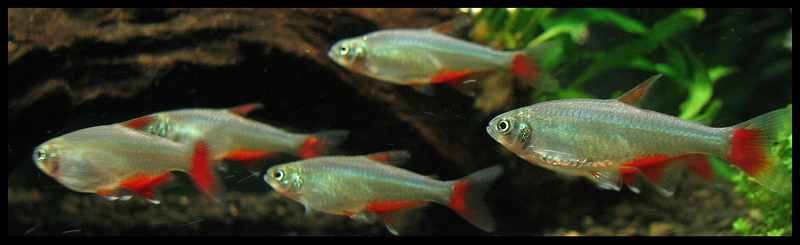
Group of Flame Tetra (Catxx @ the Aquarium wiki)

Flame tetra, Fire tetra, Von Rio tetra (Hyphessobrycon flammeus)
Tank size: 20 gallons, 24 inches long (75 L, 61 cm)
Temp: 72 - 82F (22 - 28C)
pH: up to 7.8
Hardness: up to 25 dGH
Notes: This is another gorgeous and hardy tetra species. They should be kept in a minimum of 6, but keeping them in larger numbers will make them more attractive and reduce the nipping tendencies common with tetra. Don’t keep them with slow-moving fish. It will show its best colors in an aquarium with lots of decorations such as fake or live plants.

X-ray tetra (Debivort @ Wikipedia)
 
Pristella tetra, X-ray tetra, X-ray fish, Goldfinch tetra (Pristella maxillaris)
Tank size: 10 gal, 20 inches long (40 L, 50 cm)
Temp: 74 - 82F (24 - 28C)
pH: up to 8.0
Hardness: up to 30 dGH
Notes: In my opinion, this is one of the best beginner fish because it is so easy to keep. It will survive in all but the most hard of municipal water supplies. Like all tetra, it should be kept in groups of 6 or more at a minimum.

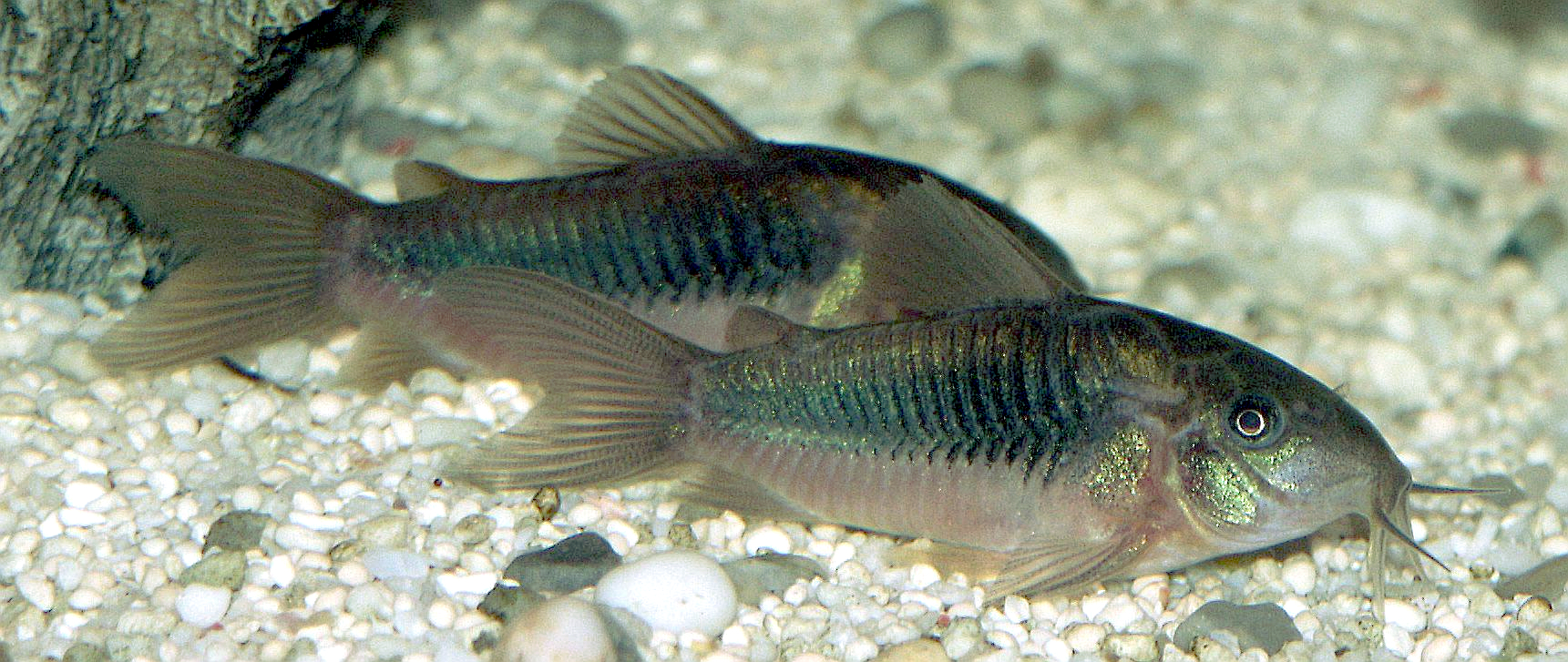
Bronze cory cats (public domain)

Bronze Cory Cat, Albino cory (Corydoras aeneus)
Tank size: 20 gal, 24 inches long (75 L, 61 cm)
Temp: 70 - 80F (21 - 27C)
pH: 6.0 - 8.0
Hardness: up to 20 dGH
Notes: Also found in an albino form, the bottom-swimming bronze cory is a great addition to a new fishkeeper’s aquarium. They will do best with a sand bottom but can manage with smooth gravel. It will be most active when kept in groups larger than 5. Three is the minimum that should be kept together as these fish are very social.

Two harlequin rasbora (Stee @ flickr)

Harlequin Rasbora, Red rasbora (Trigonostigma heteromorpha)
Tank size: 20 gal, 24 inches long (75 L, 61 cm)
Temp: 70 - 82F (21 - 28C)
pH: below 7.5
Hardness: up to 15 dGH
Notes: A common fish in pet stores, it is a great choice for a beginner. This is another social fish that needs to be maintained in groups of 6 or more, but it will fare best with groups of 10 or more.

Two Bandit cories (Stuart Halliday)

Bandit cory, Masked cory (Corydoras metae)
Tank size: 10 gallons, 20 inches long (40 L, 50 cm)
Temp: 70 - 77F (22 - 25C)
pH: up to 7.5
Hardness: up to 15 dGH
Notes: As they are more shy than bronze cories, they should be kept in groups of 6 or more. They will be much more active in larger groups. When kept singly or with 1 or 2 other bandit cories, they will not be seen much and may be too shy to feed. They like a sand bottom best as they enjoy rooting around in the sand for morsels of food.

Regular zebra fish (public domain)

Glofish, genetically modified zebra danio (www.glofish.com)

Zebra danio/glofish (Danio rerio)
Tank size: 20 gallons, 24 inches long (75 L, 61 cm)
Temp:  65 - 77F (18 - 25C)
pH: 6.0 - 8.0
Hardness: up to 20 dGH
Notes: Also sold as the brilliantly colored glofish, these peaceful little schoolers make a much better candidate for a smaller unheated aquarium than goldfish do. The zebra danio that are sold as glofish aren’t dyed. They are actually genetically engineered to be that way by having jellyfish and coral genes implanted in their own. They will pass this down to their children, too. Like all schooling fish, these active little swimmers need at least 6 of their own kind to feel safe (you can mix glofish and the regular zebra danio). As a precautionary, I feel like I need to mention that due to massive inbreeding, this fish are becoming less and less hardy; one day they might not be good beginner fish.

Glowlight tetra (gonzalovalenzuela @ flickr)

Glowlight tetra (Hemigrammus erythrozonus)
Tank size: 20 gal, 24 inches long (75 L, 61 cm)
Temp: 74 - 82F (24 - 28C)
pH: up to 7.5
Hardness: up to 15 dGH
Notes: Like all the other tetra, this little beauty is a schooling fish and should be kept in groups of at least 6, but if you have the room and biological capacity add as many as you can. They are most colorful in large groups. An albino form is also seen and is just as hardy as the normal form. The albinos will school with the regular glowlights.

School of bloodfin tetra (public domain)

Bloodfin tetra (Aphyocharax anisitsi)
Tank size: 20 gal, 24 inches long (75 L, 61 cm)
Temp: 64 - 82F (18 - 28C)
pH: 6.0 to 8.0
Hardness: up to 30 dGH
Notes: This fish gets my vote as the best beginner species. It can survive a wide range of water parameters and is commonly found at petstores. Kept in groups of 6 or more, its brilliant red fins will sparkle in the water.

Male cherry barb (Sannse @ wikipedia)

Cherry Barb (Puntius titteya)
Tank size: 20 gallons, 24 inches long (75 L, 61 cm)
Temp: 74 - 81F (23 - 27C)
pH: 6.0 to 8.0
Hardness: up to 20 dGH
Notes: Barbs, like tetra, need groups of 6 or more to feel safe. They will be more colorful and be out in the open more if they have large groups. Unlike the tetra, the males are more colorful than females. The males have a much more red color while the females take on a yellow-brown hue.

Male swordtail on left; female on right (MacAnthony @ flickr)

Swordtail (Xiphophorus hellerii)
Tank size: 29 gallons, 30 inches long (109 L, 76 cm)
Temp: 68 - 82F (20 - 28C)
pH: 7 to 8
Hardness: 9 - 30 dGH
Notes: As this fish is a livebearer it is the best choice for a new aquarist with hard water. The catch is, if you put males and females in a tank together, you will get more swordtails. If you don’t want baby fish, get only males. If you want baby fish, make sure there are 3 females to every male. Males are also the more attractive of the sexes, so an all-male tank would be ideal for a beginner. Pretty and you don’t have to worry about babies.

These next two fish are good beginner choices, but they come with a catch which I will highlight in italics.

Male betta (copperarabian @ deviantart)

Betta fish/Siamese Fighting Fish (Betta splendens)
Tank size: 5 gallons (18 L)
Temp: 76F - 84F
pH: 6.0 - 8.0
Hardness: up to 20dGH
Notes: Betta fish are a great first fish if they are the only fish in the tank. They are very hardy, easy to care for, and will generally take any beginner mistakes in a stride. Their small tank requirement also makes them great as a dorm pet. Due to their aggressive nature, keeping betta with other fish makes the difficulty go up and can be a bit much for a new fishkeeper. Keep him in his own 5 gal tank and you will have an easy setup with a very interactive fish.

Male honey gourami (Kooshking @ flickr)

Honey gourami (Trichogaster chuna)
Tank size: 20 gal, 24 inches long (75 L, 61 cm)
Temp: 72 - 82F (22 - 27C)
pH: 6 - 7.5
Hardness: up to 20 dGH
Notes: This little jewel is the smallest and most peaceful of the gourami. It will make a great centerpiece fish in a small tank provided it is the only gourami in the tank. This also includes bettas as they are gourami, too. Male gourami are territorial and will fight when placed in the same tank. The males are the most colorful, so just one would be the perfect addition to a beginner’s tank.

Don’t feel limited by what the pet stores tell you are good beginner fish (because they are often wrong). The beginner has many attractive options for their first fish tank. As I discuss in my How to Stock a Fish Tank article, combining a species of cory cats and a school of tetra in a 20 gal tank could make a very nice display for the first-time aquarist. While not all of these fish may be available at your local pet store, I’m sure you will be able to find some of them to help you get started in your fishkeeping hobby.

Works Referenced


Monks, Neale. 2008. “Fish Viral Disease.” www.fishchannel.com. Retrieved 28 May 2012.

Monks, Neale. 2011. “Neon Tetra Disease.” www.fishchannel.com. Retrieved 28 May 2012.

Ramsey, Graham. 3 March 2010. “Top Ten – worst beginner fish.” fcas.wordpress.com. Retrieved 27 May 2012.