Showing posts with label betta. Show all posts

Saturday, April 13, 2013

One Year!!

Personal Reflections

Today is the one-year anniversary of my blog's first post! A lot has happened in that year in my personal life and my hobby. I'll take this opportunity to look back on what has happened in the hobby, both in my tanks and around the world.

The biggest change for me has been the loss and gain of fish. The biggest loss was that of my two oldest goldfish, Goldeen and Seaking. They both died of separate causes, but it was so close to each other that I can't help but wonder what it was that killed them and whether or not the loss of one was just too much to bear for the other. Goldfish are much more social creatures than most people realize and Goldeen did appear to pine away until he died.
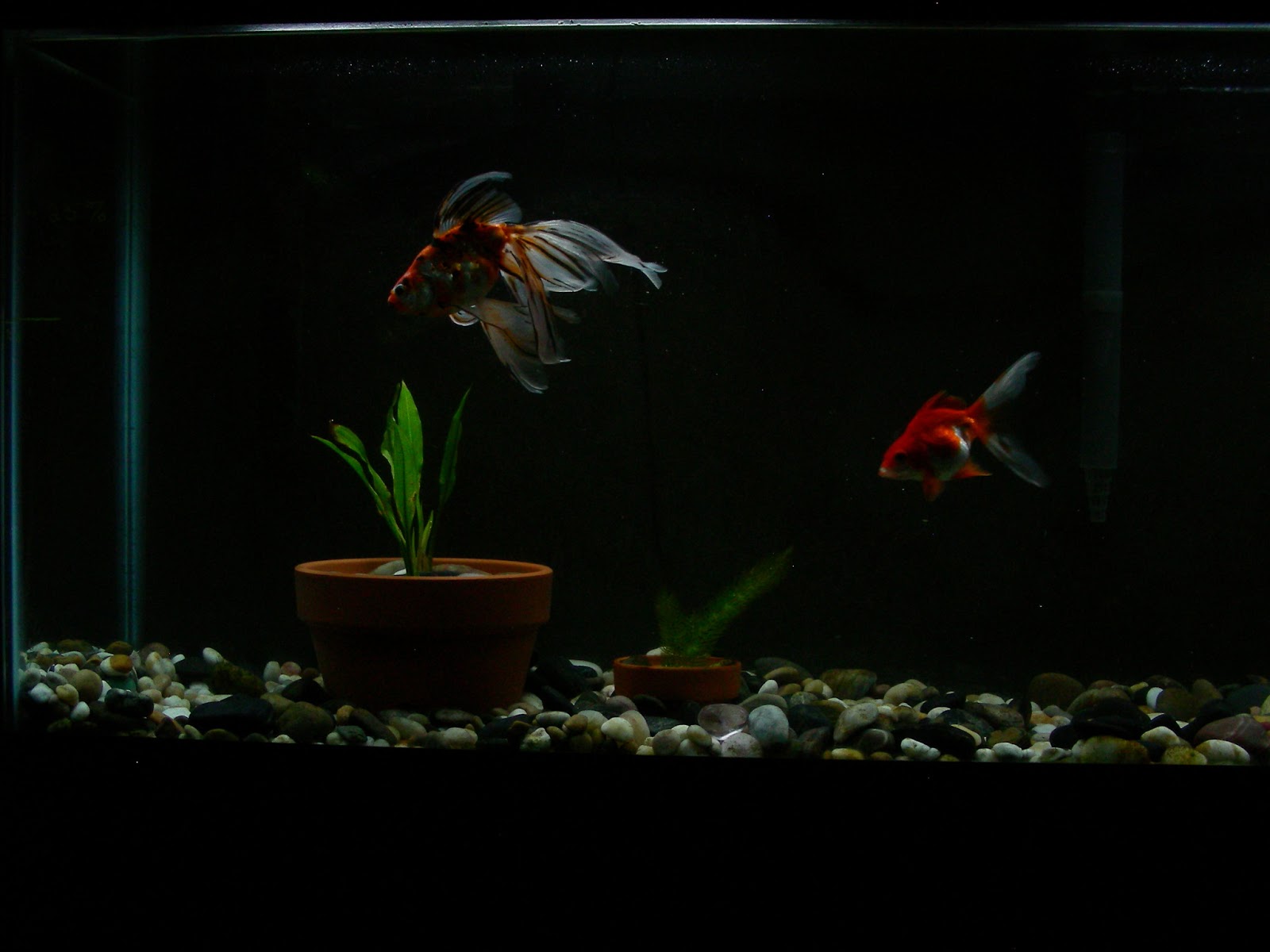
One of my favorite pictures of Goldeen and Seaking

The other losses I've suffered have been those of my two oldest bettas. One succumbed to complications from a lymphocystis infection and the other to a failing swim bladder. But I have to remember to smile for the time I had them and know that they helped me learn even more about those wonderful little fish.

I have really only added fish to one tank: my community, but in terms of numbers I have added more than I have lost. It's a total of  22 fish added to my community. It may sound like a lot, but these guys are tiny compared to the goldfish and bettas. I have only added one betta: my giant halfmoon plakat. I consider most of my tanks completed in the stocking aspect, so I don't plan to add any more fish for a long while.

The other major change has been in the appearance of my tanks; I've added a lot live plants. I had always had things like an anubias or a java fern in some of my tanks, but I never thought I could have a gorgeous planted tank until this past year when some friends convinced to me to give it a try. I've had a lot of success so far, and I've really come to appreciate and enjoy plants even more. All of my tanks have plants that are thriving. I used to just plan what fish I would want in my dream tanks, but now I'm planning the plants for them, too.

One of my new favorite plants, Myriophyllum mattogrossense

Another large change is my new-found appreciation for invertebrates. They were once just algae cleaners in my tanks, but now I enjoy watching them so much more. I even set up a tank completely dedicated to them! I haven't even come that far with plants, and I've had plants for much much longer! This change was even more recent than my new love for plants; it has just been since the New Year that discovered how interesting shrimp are to watch. Now, just like plants, every single one of my tanks has some kind of invert in it be they shrimps, snails or both.

Just like any hobby based in science and technology, this hobby is always changing. New species are always being discovered and described, and new breakthroughs are made with the technology that support our aquariums. A couple events that stick out in my mind are the describing of the adorable panda loach (Yaoshania pachychilus) and the re-evaluation of the ever so common barb genus Puntius. There were also discoveries like WWF article that detailed the 13 new fish species that have recently come out of the Mekong River delta in Asia.

Juvenile panda loach Yaoshania pachychilus (SeriouslyFish.com)

I consider this past year of fishkeeping a year of great growth.  I've become more of an advanced fishkeeper and taken my hobby in slightly different direction that others. We each have fish we prefer keeping. Some people love cichlids, some people enjoy guppies and livebearers, and some people enjoy the fish they can breed. I think I've discovered my niche in shoaling fish and shrimps. We all bring something to the table and that's what makes this hobby so interesting. I hope to be able to keep fish for the rest of my life.

Friday, February 22, 2013

Divided Betta Tanks

The easiest way to keep multiple bettas!

Everyone knows that bettas need clean, warm water. Personally I don’t like to keep bettas in anything smaller than a 5 gal (19 L) because they are harder to maintain a cycle or proper temperature in. Most people have two to four bettas, and cleaning that many 5 gal (19 L) tanks can take a while. This is why the divided tank is my favorite way to keep bettas.

The Basic Setup


The idea is to separate the bettas by a solid divider. Some people use plastic mesh, and some will use solid glass or plexiglass with tiny holes drilled for water movement. The intention is to physically separate the fish so they cannot touch each other. But the two fish can still see each other.

Left without any visual barriers, they will flare uncontrollably which is stressful to them. This can lead to fin-biting or wasting away. Some fish will refuse to eat and attempt to fight the other fish until they die. This is counter-productive. So you have to obscure their view of each other by placing numerous tall decorations along both sides of the divider. Some people use fake plants; some people use décor like castles and other trinkets. I prefer to use live plants. What is important is that these decorations make it easy for one betta to get out of sight of the other. 

Newly set up divided 10 gallon tank (Pixiefarts @ Flickr)

Other decorations in the tank such as caves should be angled away from the divider to give the bettas more refuge from each other. As always a tank stuffed with decorations and live plants seems to be the best habitat for a betta. In this situation it also gives the bettas ample space to avoid looking at each other.

Most any size tank above 5 gallons (19 L) can be easily divided. The kinds of tanks you want to stay away from dividing are the tall tanks like hexigons. A tall and long tank like a 40 gal (150 L) breeder could be divided, but you would need to provide the bettas ample resting places close to the top. That is a tall tank for a fish with heavy fins. The most commonly divided tanks are 10 gal (38 L), 15 gal (56 L), 15 gal (56 L) long, 20 gal (75 L), and 20 gal (75 L) long.

Variations


There are a couple of variations on this idea, but they all have the basic concept. Some people add multiple dividers to a long tank such as a 20 gal (75 L) long. In a tank like this you could have between three and four (depending on preference) dividers. But you have to take special care to provide the betta in the middle with more than average hiding spaces because he will think he’s being attacked from both sides.

Divided 20 long (Jadesong520 @ photobucket)

Some people take this a step further and create betta barracks. The methods to do this vary greatly from placing a lot of dividers in a tank to having glass custom cut and siliconed into place, but the outcome is the same. There are usually 4+ compartments in the front for bettas and a single large compartment behind the bettas to facilitate water flow, allow for a heater, and a filter. This method is preferred by breeders because it allows you to house hundreds of bettas in a pretty compact area using multiple barracks and industrial shelving racks.

Betta barracks for 10 bettas (LittleBettaFish @ Bettafish.com)

My personal favorite dividing method is the double divider. Instead of just one divider in the tank, I use two to create three compartments, but only two compartments house fish. The middle one houses the heater and filter and a few plants. The additional divider makes it more difficult for the bettas to see each other and also offers a buffer zone in case of a jumper. Bettas are known to jump, and they do jump the divider from time to time. This HAS happened to me before while I was on vacation, but because of this middle buffer zone the bettas did not tear each other apart. They were there for hours until they were discovered. If not for this middle section, I could have come home to one or two dead bettas.
My personal divided betta tank.


View from the side. Note how opaque the divider is.

Problems


No setup is perfect and when you put two bettas in a tank together (even with a divider) you still have the potential for problems. As I was just talking about with my tank, jumping is a serious issue. Just last week a friend of mine who also has divided tanks lost one of her bettas when the other jumped the divider and beat him to death. The double divider is one way to help prevent that. The other thing you can do is make a jump guard. Because I made my dividers from craft mesh, which is bought in sets of multiple sheets, I had some left over. I cut the leftover mesh to make a jump guard. It’s just a piece of mesh that rests on top of the divider and hangs out over the edges about 3 inches (7 cm). If a betta jumps at the divider, he or she will just hit the mesh.
Jump guard made with craft mesh.

Another issue is the spread of waterborne diseases like ich, fungus, and columnaris. If one fish gets sick you have to treat the whole tank for it because the other betta (or bettas) have been exposed. Most disease can be prevented by having a good quarantine regimen.

Sometimes you will just get males or females that just can’t handle living in a divided tank. Even with lots of plants along the divider they will fin-bite or pace all day, trying to get away. Generally the bettas that are more relaxed tend to do better in divided tanks. Having two very aggressive bettas in a divided tank can be a problem. This is a specialized setup; it isn’t for every betta.

As I have said before this is my favorite way to keep bettas. You get double the fish for the same amount of maintenance. My betta tank gets one 30% water change weekly and takes the least time of all of my tanks. I highly recommend this type of setup to anyone. I leave you with a video of my divided betta tank. The two males do not notice each other at all.


Friday, February 15, 2013

My Tanks: 15 Feb Update

Wow. It's been a long time since an update, and I have a lot to tell. There will be a lot of pictures.

Community Tank

The biggest changes have been in the 29 gal community. It is almost completely stocked. In the beginning of January I ordered my Farlowella acus from Invertibrates by Msjinkzd. Since I knew it might still be a while before there was some color and movement in the tank I also ordered a handful of red cherry shrimp (Neocaridina heteropoda var. red) to add some movement and color. Everyone arrived safe and in great health; I highly recommend buying from this seller! I know I will be a repeat customer. Just take a look at what she sent me! 

Farlowella acus on his first week in the tank. He's cleaned up that algae now.

From the side. The seller did an excellent job of making sure he was eating
before selling him. Comes off his wood when the algae wafers go down.

One of my female RCS just a few days after introduction. She is now berried.

The crypts that I added back in December have really taken off. Both plants have very little melting, and I see lots of new leaves. The tiger lily did not make it. It showed good growth for a few weeks and then the leaves just withered away and never came back. I noticed a problem with the flow behind the smaller piece of driftwood, and had to move the wood and the dwarf sag and pygmy chain sword that was behind it. The sword never recovered and my other sword that was in the tank died off, too. The dwarf sag is slowly recovering, but I don't think it will ever do well there. So I'm looking to put some more crypts on the right side later this year.

In the beginning of February I ordered kuhli loaches (Pangio oblonga) and a trio of honey gourami (Trichogaster chuna) from The Wet Spot in Oregon. Everyone came through quarantine without a hitch so they were put in the main tank a week after they arrived. In fact, they actually spawned twice in the QT to give you an indication of the health of the fish when they arrived. The Wet Spot is another seller I highly recommend.

Full tank shot. You can see the male just to the left of the wood.

One of the females defending her position.

My male gourami trying to romance one of the females.

I believe this is one of the new loaches. It's rare that I get
a picture of them at all, so a butt shot will have to do!

Other tanks

Not too much has changed in my betta and goldfish tanks. I removed the fake floating plants in the goldfish tank since the live plants have grown large enough to fight the current from the filters. It took the goldfish a little bit to get used to, but they're adjusted now.

In the betta tanks I've replaced the home-made sponge filters with Hydro II sponge filters. I noticed some algae issues a few months back and decided I needed a bit more flow. The Hydro II's have give that to me but still keep the flow low enough for the bettas. It's a win-win!

And I did a bit of decorating both tanks for Valentine's Day!

Goldfish tank! Pardon the algae on the back wall.

Hearts on the betta tank! They flared at them for a few minutes.

My last bit of news is a plan to set up a new tank! The plants in my second betta tank just never did well. So I'm breaking down that setup, finding new homes for the bettas and setting up a dedicated red cherry shrimp tank! Those little shrimps were just supposed to be a placeholder until I could get some movement in the tank, but I've fallen in love with them. I have seen the female RCS holding eggs in the community, but I've never seen the babies. I'm pretty sure the fish are eating them. So instead of fighting nature I'm going to dedicate a tank to my shrimps!

Wednesday, January 16, 2013

Better alternatives for an unheated tank

Goldfish and bettas are the most common fish found in small, unheated tanks. The irony of it is that neither fish is suited for this environment. Goldfish can live in unheated tanks, but they need large volumes of water. Bettas can live in small aquariums, but they need heated water. It may surprise you to learn that there actually are a few species of fish that are suited to living in a small aquarium (not a bowl). Some of these small aquariums can actually support schools of these little beauties.  Today I will introduce you to some of these fish.

Golden form on left; wild form on right (Seriouslyfish.com)

Name: Golden barb (Puntius semifasciolatus)
Size: 3 inches (7 cm)
Water params: up to 20dGH, pH 6.0 – 8.0
Temp range: 64 – 75F (18 – 24C)
Min tank size: 30 gal (113 L) 36 inches (91 cm) long
Additional: The golden variety is not found in nature and has been bred for the aquarium trade. While these little guys don’t get very large, they are a very active fish. They are also a schooling fish and can have a tendency to nip if the school isn’t large enough; for this reason most places recommend groups of 10 or more.

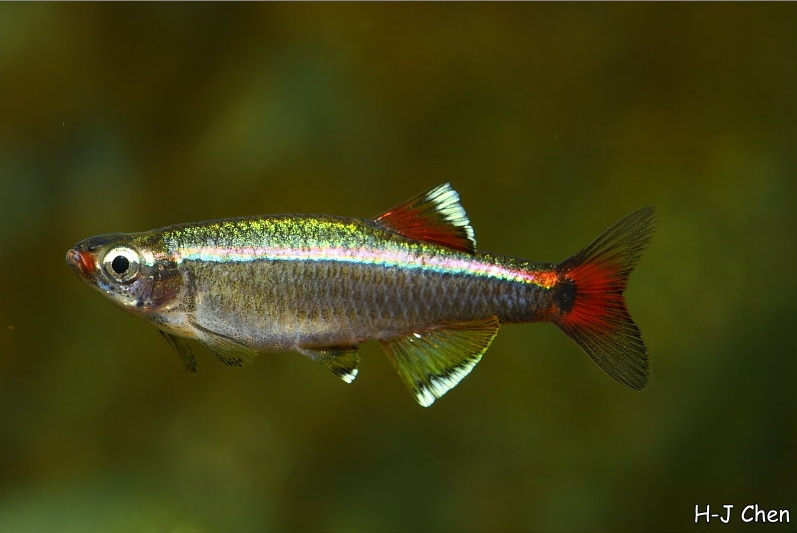
Male white cloud (Seriouslyfish.com)

Name: White Cloud Mountain Minnow (Tanichthys albonubes)
Size: 1.5 inches (3 cm)
Water params: up to 20dGH, pH 6.0 – 8.5 
Temp range: 60 – 75F (15 – 24C)
Min tank size: 10 gal (37 L) 18 inches (45 cm) long
Additional: These are small but rowdy fish and some sites suggest as much as a 20 gallon minimum on these little beauties. These fish commonly spawn in aquariums, and if your tank is heavily planted enough you may find a few fry making it to maturity. They are a shoaling fish, so a group of 6 or more is recommended and they will easily fit into a community that doesn’t include fish large enough to eat them.

Pair of paradise fish, male on right (public domain)

Name: Paradise fish (Macropodus opercularis)
Size: 3.5 inches (9 cm)
Water params: up to 30dGH, pH 6.0 – 8.0 (very adaptable)
Temp range: 61 – 80F (16 – 27C)
Min tank size: 20 gal (75 L) 24 inches (61 cm) long for a single fish; 30 gal (113 L) 30 inches (76 cm) long for a group
Additional: These fish are actually cousins to betta. And just like bettas, these fish can be temperamental. They will eat smaller fish and can bully fish of similar colors. The males are aggressive towards each other, so you will need a larger tank if you intend on keeping multiple males together. They are best kept with 3-4 females per male. They do best with tankmates like barbs and danio that can handle their volatile nature.

Captive-bred rosy red minnows (Practicalfishkeeping.co.uk)

Name: Rosy red minnow (Pimephales promelas)
Size: 3 inches (7.5 cm)
Water params: up to 20dGH, pH 6.0 – 8.0 (adaptable)
Temp range: 45 – 75F (7 – 23C)
Min tank size: 30 gal (113 L) 36 inches (91 cm) long
Additional:  These little beauties are actually color morphs of a fish common to the eastern US, the fathead minnow, so-called because the males will grow fatty lumps and breeding tubercules on their heads. They readily breed in aquariums and the males will guard the eggs. They are a shoaling fish and best kept in groups of 6 or more. While they may be small, they are active which warrants a minimum aquarium size of 30 gallons. 

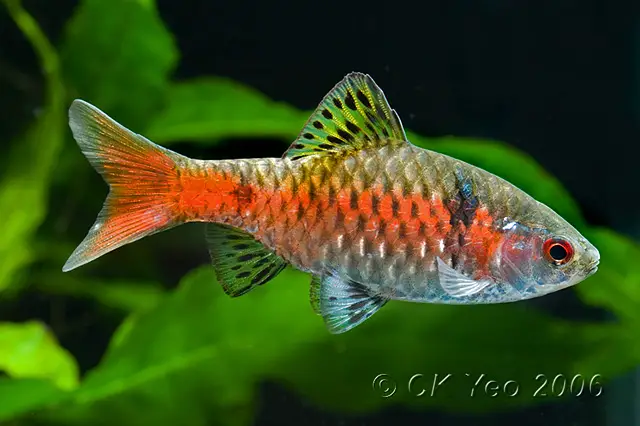
Male odessa barb (Seriouslyfish.com)

Name: Odessa Barb (Puntius padamya)
Size: 2.5 inches (7 cm)
Water params: 5 – 20dGH, 6.0 – 8.0 pH
Temp range: 61 – 78F (16 – 26C)
Min tank size: 30 gal (113 L) 36 inches (91 cm) long
Additional:  They are another shoaling barb that does best in groups of 6 or more and tend to stay around the middle of the aquarium. Despite their small size, they are rather active swimmers but peaceful to tankmates. Their boisterous nature may disturb slower-moving fish so tankmates should be active as well. Rival males will spar but serious injuries rarely result.

Captive-bred form of Rosy Barb (Seriouslyfish.com)

Name: Rosy Barb (Pethia conchonius)
Size: 3 inches (8 cm)
Water params: 5 – 20dGH, pH 6.0 – 8.0
Temp range: 61 – 76F (16 – 24C)
Min tank size: 30 gal (113 L) 36 inches (91 cm) long
Additional: Another active barb well-suited to a river type habitat. A golden form has been bred for the hobby; the wild fish are more green in color. Like all barbs, they are best kept in groups of 6 or more. In smaller numbers, they can be fin-nippers. They tend to stay in the lower half of the aquarium.

My favorite of these cool-water fishes is the white cloud mountain minnow as their small size enables them to live in a 10 gal tank which is often what the beginner fishkeeper has. While these fish come from far off lands, there are also many fish native to the US that would be suited to an unheated tank, but you won’t find them in stores. The barbs would do well in a river-type community with botine loaches and rasbora that tolerate the cooler temperatures these little beauties demand. An active aquarium like that offers a unique alternative to the typical calm, warm, and peaceful tetra communities. 

Works referenced

Seriously Fish. www.seriouslyfish.com. Updated: 16 Jan 2013. Retrieved 16 Jan 2013.
Practical Fishkeeping. www.practicalfishkeeping.co.uk. Updated: 16 Jan 2013. Retrieved 16 Jan 2013. 

-------------------------------------------------

This next post will be something special for our readers. We will have Mari from Aquariadise writing a guest post for us! It's a surprise what her article will be about, but I can assure you it's something very interesting!  Stay tuned and look forward to it next week. 

Thursday, December 13, 2012

My Tanks: 13 Dec Update

A lot has happened since my last tank update. Basically something has changed in every single tank. Most of the changes have been for the better. This will probably be my last tank update of the year as I'll have to wait until after Christmas to add any more fish because we will be leaving on vacation. I don't like to have fish in QT while I'm away.

I bought a new goldfish buddy for my remaining ryukin. She went through a 3 week QT just fine, and they are now swimming together in the large 55 gal. I've seen the breeding tubercules on the ryukin, but I don't see them on the new redcap oranda. And I've seen the ryukin nudging the oranda's vent. I've come to the conclusion that the new goldfish is a girl. I'd really rather have all males to avoid the breeding issue, but it's done and over with. Plus, my new oranda is just precious and outgoing as ever! How could I not love her?


My newest goldfish, a redcap oranda named Burbbles

Burbbles and Magikarp playing together. It's so hard to get them both in focus.

My 29 gal community has undergone the most changes. I added a new large piece of driftwood that I ordered from Aquariumplants.com as well as about 2 more species of plants. I've added green tiger lotus (Nymphaea lotus)  and Cryptocoryne undulata. I ordered them from PetsWarehouse.com, and I can't say I'm too pleased with the packaging. The plants weren't protected very well; there was no padding and the plants were just in plastic bags. The box was visibly crumbled, and some of the plants look damaged. It remains to be seen if they will recover.

Anyway, this complete the aquascape and hardscape. I'm going to let these plants establish for about a month before I begin stocking the fish. I still haven't decided on a final stocking plan, but I do know I will have a tetra species, a gourami species, and a twig catfish (Farlowella spp).

The crypts are small and hardly visible,
but the lotus is that large reddish leaf in the center.


Since I have written you, I've lost one of my bettas, Knucker. He was my oldest and had the worst health due to inbreeding.  During his last months I noticed he lost control of swim bladder and could not maintain neutral buoyancy, a problem common in double-tail bettas. While not a double-tail himself, I believe he carried the genes as I saw a lot of bad hallmarks of the double-tail like scoop head, a huge dorsal, and massive fins. I placed him in a breeder box in the 29 gal. I returned from a Thanksgiving vacation to find him dead, but I take heart in knowing that I gave him the best care and he probably wouldn't have gotten the same if another person had picked him up from the shelf.

Goodbye, Knucker. The picture on the left is from when I first bought him.

The last major change I made was for the plants. I've noticed rather stalled growth in many of my plants. I dose weekly with micronutrients using Seachem Comprehensive, but I still didn't get good growth. After a little research I figured out it is because my water is so soft. I started adding Seachem Equilibrium to raise the GH up to about 6 in each of my softwater tanks. I use it to raise the GH to around 10 in my goldfish tank as they are hardwater fishes. As of right now I haven't seen a large increase in plant health, but I didn't expect it so soon as I've only been using Equilibrium for two weeks now.

Friday, December 7, 2012

Goldfish Garden

Good Idea... Wrong Fish!!

Aquaponics is a type of sustainable agriculture that combines traditional aquaculture of fish with  hydroponically grown plants (plants grown with roots submerged in water). The fish are grown in large holding tanks, and the waste they produce is pumped to the plants in the hydroponic systems. The plants use the nutrients and send the "clean" water back to the fish. That is the general idea behind aquaponics, but there are a few variations. Recently, I have seen a few products come on the market aimed at home aquaponics systems. Some are good, and some are bad. This is one of the bad ones I recently stumbled upon.

Artist's rendition of proposed Goldfish Garden

Some quick facts about this product: it holds 2 gallons (7.6 L) of water; is powered by a 1.5W air pump; is 6.5 inches (16.5 cm) wide; and can come with a light if it cannot be placed near natural light. More information can be found on their kickstarter page.

The entrepreneur claims that goldfish are the best candidate for the bowl because of the amount of waste they produce, but he neglects to mention that they will outgrow a tank like this in a matter of months. He also fails to state any need for water changes. Not only do fish need clean water, but plants need it, too. Plants use up minerals that are in the water like calcium, magnesium, and iron. The only way to replace these minerals is with a water change, something that is rather commonplace in normal aquaponics operations. He also fails to mention any additional fertilizer that will likely be needed for healthy plant growth. Fish only produce nitrogenous wastes, but plants need many other micro and macro nutrients for complete and healthy growth.

He does mention that other fish can be used in the system and even mentions a slot for a heater to enable tropical fish to be used in his system. This is a very smart idea, and I believe this product could be better marketed and used with creature suited to living in a (relatively) small environment their whole lives such as betta fish, small snails, or shrimp.

Or you could save a few hundred dollars by buying a 10 gal tank with a single T8 and putting the plants in with your fish. That's where my vote is!

Monday, November 5, 2012

Color Changes in Bettas

As anyone who has keep bettas for a long period of time knows, they are apt to change colors. What you see in the cold cup in the store is never what you will see after a few days of warm, clean water in your tank. For this reason, bettas bought in pet stores are often gambles. You can buy a pretty white one in the store and it will turn a peachy-yellow in a few days. There are three reasons why bettas change colors: stress, age, and genetics.

Stress


All fish are known to change colors when stressed. Most of the time this is a whiting out or a dulling of their colors. In pet stores almost all fish are stressed. The tanks are crowded and often contain diseases. While the cold cups may not always contain disease, they will stress tropical fish like betta. And just like any other fish, the colors of the betta will dull and fade. The transformation from stressed fish to unstressed fish can take a matter of hours or sometimes days. This is the main reason betta change color when you first get them. 

This is the same betta. On the left is the betta in a cold cup in the store.
On the right is after a month of being in clean, warm water.


Age


Often the fish you see sold in store aren't very old. Typically the smaller they are, the younger they are. Their colors haven't fully developed yet and neither have their fins. So essentially what you are buying is a "work in progress." Some will change more than others as not all bettas being sold are the same age. Below is a very young betta that I bought in July 2011.

This image shows the same betta from July 2011 to February 2012.
Notice the longer fins and more pronounced color.

Genetics


Some betta carry what is called the marble gene. This gene sequence causes the betta's colors to  changing even after they should have stabilized with age. Sometimes the betta will continue to change his whole life even looking like a whole different fish a year after you buy him or her. Sometimes the betta will "marble out" and become a cellophane, and some "unmarble" and turn a dark, solid color.  There is no way to predict what you will end up with. This presents an interesting challenge to breeders, and they can be a neat fish to have as a pet. A month later you can end up with a completely different fish than you started with!


This is my marble plakat. The image on the right is from July 2012. The middle image is a
month later. The far right image is from October 2012. My marble has unmarbled
to a beautiful solid blue.


Works Referenced


Parnell, Victoria. 3 Mar 2006. "The Ever-Changing Marble." bettysplendens.com. Retrieved 4 Nov 2012.