Saturday, February 2, 2013

Is my fish a girl or a boy?

How to determine the sex of your fish

Most people like to name their fish and want to have a name that fits the fish’s gender. Other people want to try breeding and need to know if they have males and females. Sexing fish can be a tricky thing, but there are some species and families of fish that are relatively easy. Before we get into those, I’ll talk about some general trends in sexing fish.

Females are rounder

Of course this only works with mature animals, but for the most part the female will have slightly thicker bodies. This is because the eggs that females carry take up more space than sperm. The females also need larger fat reserves to produce the eggs.

Males are smaller and more colorful

Just as in birds, males are the more colorful of the genders. Males compete with other males by showing off their vibrant colors. The most colorful male gets to mate. They are also slightly smaller than the females.

Sexing popular fish

Goldfish (Carassius auratus auratus)

These fish can actually be a little tricky as they have no obvious differences when the fish are not breeding, but there are two things you can look for when they breed: breeding stars and the shape of the vent.

Breeding stars or breeding tubercules will only appear on the males. They appear on the gill plate and pectoral fins. These are a sign of virility, and a study performed on a relative of the goldfish found a correlation between the number of breeding stars and how healthy a male fish is. These stars help a female fish decide who she wants to mate with.

Breeding stars on pectoral fin and gill cover (goldy fk @ flickr)

The next thing to look for is the shape of the vent (this is also called the cloaca and is the opening near the anal fin). The vent of the male will be slightly larger and concave (meaning it curves inward). The vent of the female will be smaller and protrude slightly. The pictures below better illustrate this.

Circled male vent (mikroll @ TheGAB)

Circled female vent (mikroll @ TheGAB.org)

I find using the vent method to be a little difficult as my goldfish usually like to have their heads facing towards me begging for food. I prefer to use the breeding star method because they are more visible in my experience.

Betta fish (Betta splendens)

These small, popular tropical fish are a little easier than goldfish to sex because some of it can be done out of the breeding season. There are two main ways to sex bettas: fin length and the presence of an ovipositor.

If you see a long-finned betta it is a male. There have been cases where females have longer than normal fins, but they aren’t nearly as long as the typical halfmoon spread seen below.

These extremely long fins indicate a male(Aquariumloto @ Flickr)

Sexing bettas gets a little trickier when you are dealing with plakat (or short-finned) bettas because the male and female fins are the same length. Now you have to look for the ovipositor on the female. The ovipositor is a small white tube protruding from the vent of the female; in breeding she uses this to position eggs. It will appear as a small white dot behind the ventral fins. The lack of such indicates a male.

Arrow points to ovipositor (Stuart Halliday)

Angelfish (Pterophyllum spp)

Another extremely popular aquarium fish, but much harder than bettas or goldfish to sex. They have no discernible differences when they are not spawning, and when they are spawning you have to look very closely to see the only difference:  the males will have a thinner breeding tube which is visible in the vent of the fish. Both males and females have breeding tubes, so the key is to look for the smaller one.

Female angelfish breeding tube (koiangelfish.com)

Male angelfish breeding tube (koiangelfish.com)

Neon tetra (Paracheirodon innesi)

Like angelfish, neon tetra are difficult to sex. The only difference will be in size. The females will be slightly larger and fatter especially when they are ready to breed. Males may show slightly better color, but these differences are so minute that they will likely go unnoticed.

Livebearers (Poecilidae)

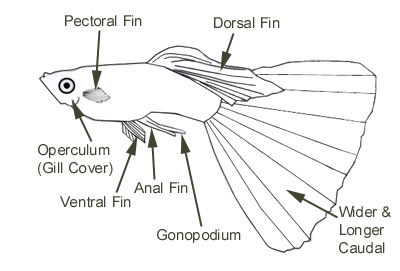
These are fish like guppies, platies, swordtails, and mollies. The males and females are very easy to tell apart. There is a large size difference with some females being almost one and a half times the size of the males. The males will have long, flowing fins and are very colorful. Males also possess a modified anal fin called a gonopodium; this is used to transfer sperm to the females. Below you can see two illustrations showing the differences between male and female guppies
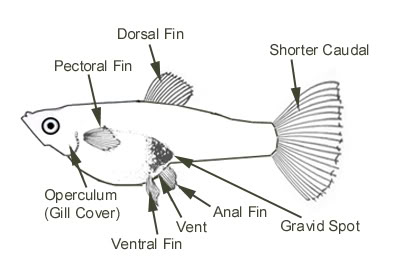
General female livebearer characteristics (jabraguppyroom.blogspot.com)

General male livebearer characteristics (jabraguppyroom.blogspot.com)

Cory catfish (Corydoras spp)

Another popular but difficult fish to sex, cories have no highly visible differences between the genders. Females will tend to be the larger ones and look much chubbier when they are breeding, but for the most part males and females look exactly alike.

Bristlenose pleco (Ancistrus spp)

These small plecos are surprisingly easy to sex. Both males and females will have the bristly nose, but the number and size of the bristles will be much greater in the males. This is especially true when the fish are in breeding condition. Scientists believe that males evolved the bristles to mimic young fish because females are more likely to mate with a male who is already caring for eggs.

Male bristlenose with month old offspring (goldy fk @ Flickr)

Oscar (Astronotus ocellatus)

Probably the most popular of the cichlids next to angelfish, but even more difficult to sex. Among wild populations the males show more color than females, but this isn’t reliable with the captive-bred fish that show up in stores nowadays because they have been bred for color.

Cherry barb (Puntius titteya)

This is a species that is easy to sex based on the general trends in fish genders. The males are smaller and have more red color and the females are larger and will be more brown in color. This holds true with wild-caught and naturally bred cherry barbs. There are some that have been specifically bred to make the red even brighter; these are much more difficult to gender. 

Female cherry barb on left, male on right (aquapage.cz)

Gourami

They aren’t as easy to sex as livebearers, but they are pretty easy if you know what to look for. If it’s not a captive-bred variant, the males will be a brighter color especially when breeding. If they are a color variant you have to look for a few other things. For the Trichogaster gourami (this is dwarf, honey, thicklips, and banded) look at the end of the dorsal fin; males will have a pointed dorsal, and females will have a rounded dorsal. These pictures below illustrate this as it can be hard to pick out if you’ve never seen it.

Male honey gourami (CK Yeo @ Flickr)

Female honey gourami (CK Yeo @ Flickr)

For the Trichopodus gourami (opaline, three-spot, blue, gold, pearl, and moonlight) you also look at the dorsal fin. The males will have a longer dorsal fin. Males of the pearl and moonlight species will show more red color than the females.
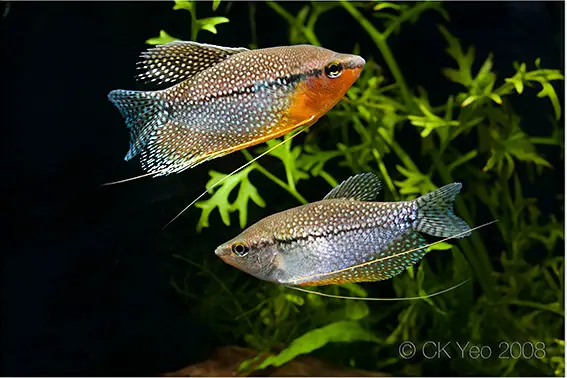
Pearl gourami. Male above, female below (seriouslyfish.com)

With some of our aquarium fish it can be very easy to tell the males from the females, but others can give you a lot of trouble. Some like oscars and angelfish can even give breeders trouble in determining gender. If you wish to breed any of these fish, I highly suggest you do a lot of research and read personal experiences. While breeding can be fun and rewarding, it can also be costly and heartbreaking when done incorrectly.

Works referenced

Christie F. 2006. Sexing Bettas: The Ovipositor. nippyfish.net. Retrieved: 31 Jan 2013

How to tell Male and Female Guppy Apart. Jabraguppyroom.blogspot.com. Updated: 29 July 2011. Retrieved: 1 Feb 2013.

Kortet R., J. Taskinen, A. Vainikka, and H. Ylonen. 2004. Breeding Tubercles, Papillomatosis and Dominance Behavior of Male Roach (Rutilus rutilus) During the Spawning Period. Ethology 110:591-601.

Seriously Fish

Sexing Angelfish. Koiangelfish.com. Updated: 2013. Retrieved: 1 Feb 2013. 

Sexing Goldfish. Bristol-aquarists.org.uk. Updated: 26 October 2012. Retrieved: 31 Jan 2013

Sexing Goldfish. theGAB.org. Updated: 16 Aug 2009. Retrieved: 31 Jan 2013

Friday, January 25, 2013

Guest Post: Brackish Aquariums

Quite a few of the fish commonly available in pet and aquarium stores nowadays aren't actually freshwater fish, even though that's what they're marketed as. Fish and invertebrates like Figure 8 Puffers, Knight Gobies, Red Claw Crabs, Mollies and Bumblebee Gobies all prefer brackish water, but that's definitely not what the average pet store will tell you! This is because they're afraid they won't sell any of these fish any more if customers find out about their real needs – people are still hesitant when it comes to setting up a brackish tank because they think it will be all about dying plants, boring aquascapes and confusing calculations to figure out the amount of salt needed to do a water change.

It's time to end that myth! Brackish aquariums are definitely not as hard to set up and maintain as many people think, and, like with freshwater tanks, the possibilities are endless! There are many different fish that can be kept in brackish aquariums, so there's always a species for you. However, before we get into choosing a stock, let's learn some more about brackish aquariums and smash some more myths along the way, shall we?

What is brackish water?
Water with a salt grade between fresh and marine is called brackish. This naturally occurs in places where rivers meet the sea, like estuaries. Because the salinity in these places fluctuates with the tides, the water can go from almost fresh to seawater in a few hours time and change back just as quickly. One of the most well-known examples of a brackish habitat are mangrove forests, which is where a lot of our favourite brackish fish species actually come from.

Mangrove from Queensland Australia (public domain)

Brackish water is usually divided into three categories:
Low-end brackish: salinity between 1.001 and 1.008
Mid-end brackish: salinity between 1.009 and 1.0015
High-end brackish: salinity between 1.0016 and 1.022
Water with a salt grade of 1.023+ is considered marine. These categories can help us determine more easily which fish are suitable.

What do I need to start a brackish aquarium?
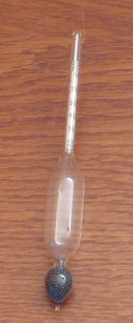
Hydrometer
(public domain)
Contrary to popular belief, you don't actually need a lot of expensive extra technology to start a brackish aquarium. Just like with freshwater tanks, you're going to need a filter, a tank hood/light, a heater, a (liquid) water testing set and a thermometer. A salt meter is also very important – without it, it's very hard to know whether your aquarium water is actually at the right salinity and mistakes are easily made. Refractometers (very accurate, but unfortunately also quite expensive) are usually recommended, but a hydrometer (less accurate, but much, much cheaper) is fine for most brackish aquariums too. Just make sure you get a salt meter that measures from 1.000 up – some are made specifically for reef tanks and start at much higher salinities (1.020+). A protein skimmer isn't necessary for a brackish aquarium.

How do I make brackish water?
Making brackish water is actually very easy; you just need water and marine aquarium salt. Some sites will tell you table salt is fine too, but table salt often contains iodine and anti caking agents, which can hurt your fish. Even “pure” salt, which is just NaCl and nothing else (and therefore often used for salt baths), isn't suitable – it doesn't contain the trace elements needed for a healthy aquarium and healthy fish. Marine aquarium salt is the way to go! To determine how much salt you need for a certain salinity easy, try one of the many online calculators so you don't have to figure it out yourself.

Actually 'making' brackish water should always be done outside the aquarium! If you just toss the salt in, you can't spot possible mistakes beforehand, which can result in a lot of extra work. Fish can also be burned when they try to eat salt grains, so always premix salt and water. To do this, fill a bucket (or multiple buckets) with the amount of water and salt you need. Using warm water will help the salt dissolve more easily, and if an airstone is also added you can just leave the buckets for a few hours – you'll find the salt has dissolved when you come back. Test whether the water temperature and salinity are correct (when doing a water change, the new water should be of the same salinity as the rest of the tank), add water conditioner if needed and voila! You have your brackish water.

How do I cycle a brackish aquarium?
Just like you would cycle a normal one! The salt can slow down the cycling process a bit, but if you use a liquid test kit to keep a close eye on the water parameters determining when fish can be added should be easy.

Converting an existing freshwater aquarium to a brackish one is also possible. Just take out any fish and plants that won't be able to survive in brackish water and increase the salinity of the tank with 0.002 every two weeks. Because the transition to brackish will be very slow, the beneficial bacteria in the filter have time to adjust and the cycle won't be damaged – increasing the salinity too quickly can cause ammonia or nitrite spikes.

If you find yourself with a brackish fish in your freshwater aquarium because you impulse bought or were misinformed, don't worry! You can set up a new aquarium fairly quickly and easily. If you fill up the new aquarium with fresh water, you can quick-cycle it by putting used filter media from another tank in the new filter. Move your brackish fish to the new (and now hopefully cycled) aquarium and closely monitor the water values for a week to see if they're stable – another week in fresh water should not be a problem for the fish. If you are sure the aquarium is cycled, you can start increasing the salinity very slowly until it's where it should be.

How do I decorate a brackish aquarium?
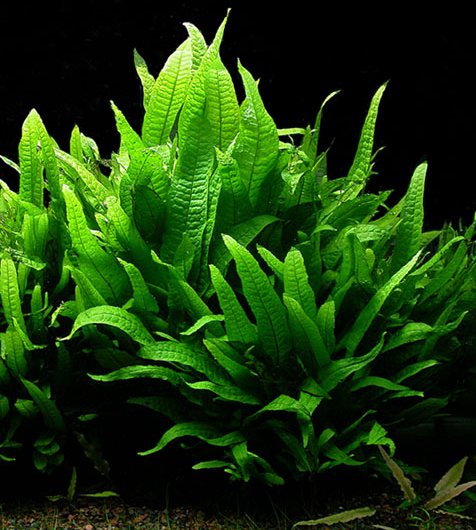
Java fern Microsorum pteropus (public domain)
A lot of people who think about setting up their own brackish tank are scared away by the seemingly very limited amount of decoration options, which is a shame! There are actually quite a few plants that can survive in low-end brackish aquariums, and even in mid-end brackish tanks there are still planting options – Java fern, Java moss, moss balls and mangroves all look great and can thrive in higher salinities. You can find a more complete list of plants that tolerate brackish water here.

But what about those high-end brackish aquariums? Even for those, there are many interesting aquascaping options. If you're in for a challenge, try sea grass – if you're not, or don't like the look of it, go for an interesting hardscape, silk plants, driftwood or artificial ornaments. You don't always need real plants to make a beautiful scape. Think out of the box!

So brackish aquariums aren't all that difficult to set up after all. But what about stocking them?

To make stocking your brackish aquarium easier, I have included a few of the less obvious species that tolerate or require brackish water – we all know about Monos and Scats, but have you ever considered these other fish and invertebrates for your brackish tank?

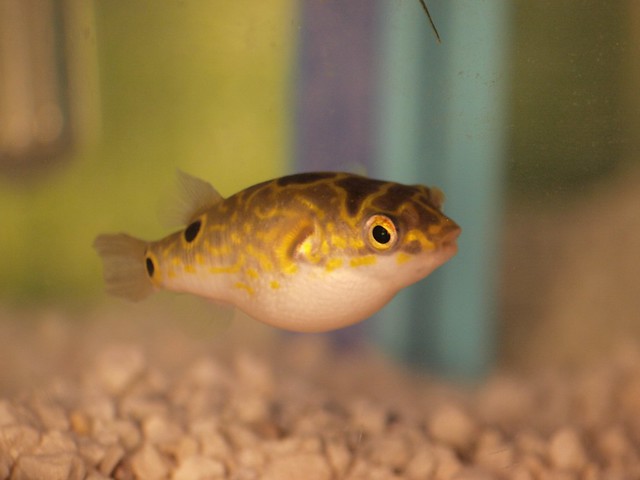
Figure 8 Puffer, Tetraodon biocellatus – contrary to what a lot of websites and pet stores say, the F8 Puffer is definitely not a freshwater fish, nor is it suitable for community tanks. If you've fallen in love with the F8's expressive face and interesting behaviour, be sure to set up a proper tank before you get one or you might not get to enjoy it for very long. Figure 8 Puffers can be kept in pairs when smaller, but get more aggressive as they age and should ideally be kept alone or with a select few tank mates. One F8 can live in a 20 gallon aquarium, as long as it's provided with heavy filtration and plenty of interesting plants, rocks and decorations to keep it entertained. The salt grade should be at 1.004-1.008 when the puffer is younger, but as it ages it should be increased to mid-end brackish: 1.009-1.015. To keep the teeth from overgrowing, feed your Figure 8 a varied diet of snails, crayfish, frozen/live shrimp, mussels and oysters.

Figure 8 puffer (jennifer.whiteford @ flickr)

Red Claw Crab, Sesarma Bidens – even though they are often kept in freshwater aquariums, these guys actually need brackish water and access to land, making a paludarium of at least 15 gallons with a salinity of around 1.005 in the aquatic part a much better home for them. Red Claw Crabs are omnivores, and will enjoy an varied diet consisting of peas, algae tablets, blood worms, zucchini, mosquito larvae and leafy greens. Be sure to eliminate any escape options, as these crabs love to go exploring and will try to crawl out of their tank – the holes for cables to go through should be as small as possible and the aquarium should be sealed. You don't want to spend your afternoon with a flashlight in your hands searching for a crab behind furniture!

Male and female red claw crab (badmanstropicalfish.com)

Knight Goby, Stigmatogobius sadanundio – although there is still much discussion on the salinity this interesting fish should be kept at, something between 1.004 and 1.007 is usually recommended. A 20 gallon aquarium with a sand bottom and some hiding places is enough for a small group – the Gobies will establish and defend their own territories and might eat smaller tankmates, so be sure to only keep them with medium-sized and larger fish! Knight Gobies will accept dried fish foods, but they prefer a diet consisting of live and frozen foods and a small amount of vegetable matter.

Knight goby (badmanstropicalfish.com)

Molly, Poecilia sphenops – yet another brackish water fish that is marketed as suitable for small freshwater aquariums, Mollies can actually survive in full marine setups and prefer a salt grade of at least around 1.004. Keeping them in an aquarium under 30 gallons can cause problems, as these active livebearers actually get quite large and like to live in groups of at least three. If you maintain mixed-sex groups, make sure there are at least 2 females for every male as males will constantly pursue females.

Captive-bred form of black molly (Marrabbio @ wikipedia)

Virgin nerite snail, Neritina virginea – if you're looking for an algae clean up crew for your brackish aquarium, look no further! These nerites do great in water with a salinity from 1.005 to 1.020+, and will do a great job at helping to keep the aquarium glass clear and clean without touching any plants. As long as you remember to feed your nerites some extra algae tabs when their regular food source runs out, they can be very useful and a pleasure to watch.

Virgin nerite shells (wikipedia)

Bumblebee goby, Brachygobius xanthozonus, Brachygobius nunus – Bumblebee gobies are one of the most interesting fish species to keep in a brackish aquarium, but they can also be quite the challenge because of their pickiness when it comes to food. They will not accept normal, dried fish foods and will have trouble getting enough to eat in a regular community tank – go for an aquarium with a limited amount of tankmates and target feed your Bumblebee gobies with frozen foods like bloodworms and mosquito larvae. The fact that they are territorial and can frequently be seen having little arguments over the best spots does not mean these gobies should be kept alone; keep 5 or more of them to keep them happy, preferably in an aquarium of at least 15 gallons with lots of hiding places, at a salinity up to around 1.007.

B. nanus (tropicalfishkeeping.com)

Hawaiian red shrimp, Halocaridina rubra – if you're looking for some inhabitants for your brackish nano tank, look no further! Naturally found in small, brackish pools near the beach, these small shrimp prefer an aquarium with lots of dark hiding places – lava stone is often used for this, as it mimics their natural habitat. They can adapt to a very wide range of salinities, so anything between 1.005-1.015 should be fine for them. When it comes to aquarium size, Hawaiian red shrimp aren't very demanding at all – a 5 gallon should be enough for a group. Feed your Hawaiian red shrimp with high quality algae wafers, freeze dried fish food and flakes and keep them in an aquarium with high water quality and they might actually live for up to 10 years!

Hawaiian red shrimp (www.petshrimp.com)

Indian mudskipper, Periophthalmus novemradiatus – Indian mudskippers are some of the the smallest mudskippers available in the aquarium trade, but they can still be quite a handful! They can actually walk and need access to land, making a paludarium the best choice if you want to keep them. Go for a tank of at least around 25 gallons for three mudksippers, with one or more large sand/mud island(s) for them to establish a territorium on. Be sure to eliminate any escape options, because these fish can actually climb up the glass and crawl through small holes! To ensure their health, keep your Indian mudskippers at a salinity between 1.005 and 1.015 and at a humidity of at least 60%. Feed them a varied carnivorous diet consisting of live insects like crickets and mealworms and frozen/live brine shrimp, bloodworms and shrimp.


Possible Stocking Options
I have also included a few possible ways to stock brackish aquariums of a certain size with the fish and invertebrates mentioned earlier. Remember not to just get these fish though, do your own research to figure out how to give them the best possible care. All of these stocks require a filtered, heated tank with ammonia and nitrites at 0 and a stable pH.

5 gallon aquarium
20 x Hawaiian red shrimp, Halocaridina rubra
4 x Virgin nerite snail, Neritina virginea

20 gallon aquarium
1x Figure 8 Puffer, Tetraodon biocellatus
8-10x Bumblebee goby, Brachygobius xanthozonus, Brachygobius nunus
(Bumblebee gobies are one of the only fish suitable as tankmates for a Figure 8)

55 gallon aquarium
3x Indian mudskipper, Periophthalmus novemradiatus
6-8x Molly, Poecilia sphenops
5x Virgin nerite snail, Neritina virginea
(Note that the mollies should have at least 25-30 gallons of swimming space, and the mudskippers need an island of about 12”x12”)

Now that you know how easy it is to set up a brackish aquarium, I hope you've been inspired to consider setting one up yourself! I'll be setting up mine soon too - it will be called home by a Figure 8 Puffer and a small group of Bumblebee gobies. 

Happy fishkeeping!
xoxo, Mari, admin of Aquariadise.

Wednesday, January 16, 2013

Better alternatives for an unheated tank

Goldfish and bettas are the most common fish found in small, unheated tanks. The irony of it is that neither fish is suited for this environment. Goldfish can live in unheated tanks, but they need large volumes of water. Bettas can live in small aquariums, but they need heated water. It may surprise you to learn that there actually are a few species of fish that are suited to living in a small aquarium (not a bowl). Some of these small aquariums can actually support schools of these little beauties.  Today I will introduce you to some of these fish.

Golden form on left; wild form on right (Seriouslyfish.com)

Name: Golden barb (Puntius semifasciolatus)
Size: 3 inches (7 cm)
Water params: up to 20dGH, pH 6.0 – 8.0
Temp range: 64 – 75F (18 – 24C)
Min tank size: 30 gal (113 L) 36 inches (91 cm) long
Additional: The golden variety is not found in nature and has been bred for the aquarium trade. While these little guys don’t get very large, they are a very active fish. They are also a schooling fish and can have a tendency to nip if the school isn’t large enough; for this reason most places recommend groups of 10 or more.

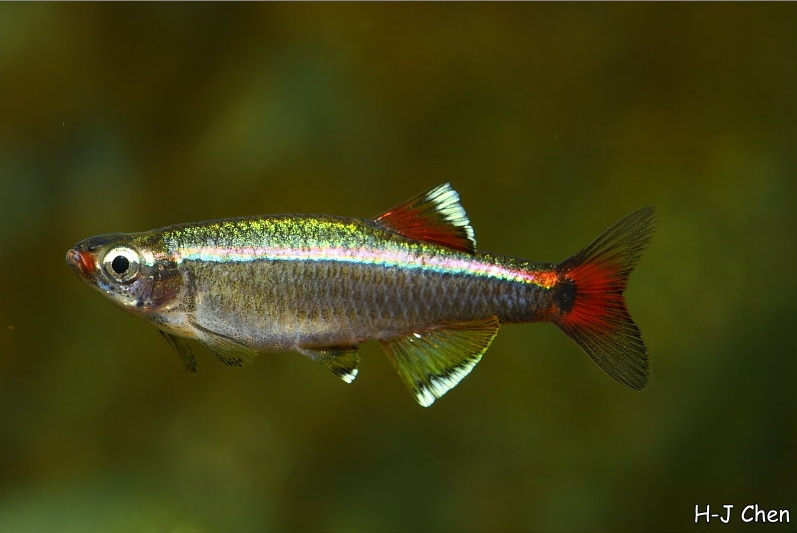
Male white cloud (Seriouslyfish.com)

Name: White Cloud Mountain Minnow (Tanichthys albonubes)
Size: 1.5 inches (3 cm)
Water params: up to 20dGH, pH 6.0 – 8.5 
Temp range: 60 – 75F (15 – 24C)
Min tank size: 10 gal (37 L) 18 inches (45 cm) long
Additional: These are small but rowdy fish and some sites suggest as much as a 20 gallon minimum on these little beauties. These fish commonly spawn in aquariums, and if your tank is heavily planted enough you may find a few fry making it to maturity. They are a shoaling fish, so a group of 6 or more is recommended and they will easily fit into a community that doesn’t include fish large enough to eat them.

Pair of paradise fish, male on right (public domain)

Name: Paradise fish (Macropodus opercularis)
Size: 3.5 inches (9 cm)
Water params: up to 30dGH, pH 6.0 – 8.0 (very adaptable)
Temp range: 61 – 80F (16 – 27C)
Min tank size: 20 gal (75 L) 24 inches (61 cm) long for a single fish; 30 gal (113 L) 30 inches (76 cm) long for a group
Additional: These fish are actually cousins to betta. And just like bettas, these fish can be temperamental. They will eat smaller fish and can bully fish of similar colors. The males are aggressive towards each other, so you will need a larger tank if you intend on keeping multiple males together. They are best kept with 3-4 females per male. They do best with tankmates like barbs and danio that can handle their volatile nature.

Captive-bred rosy red minnows (Practicalfishkeeping.co.uk)

Name: Rosy red minnow (Pimephales promelas)
Size: 3 inches (7.5 cm)
Water params: up to 20dGH, pH 6.0 – 8.0 (adaptable)
Temp range: 45 – 75F (7 – 23C)
Min tank size: 30 gal (113 L) 36 inches (91 cm) long
Additional:  These little beauties are actually color morphs of a fish common to the eastern US, the fathead minnow, so-called because the males will grow fatty lumps and breeding tubercules on their heads. They readily breed in aquariums and the males will guard the eggs. They are a shoaling fish and best kept in groups of 6 or more. While they may be small, they are active which warrants a minimum aquarium size of 30 gallons. 

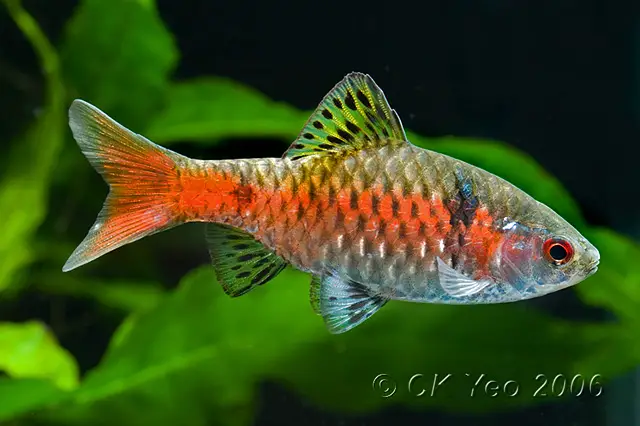
Male odessa barb (Seriouslyfish.com)

Name: Odessa Barb (Puntius padamya)
Size: 2.5 inches (7 cm)
Water params: 5 – 20dGH, 6.0 – 8.0 pH
Temp range: 61 – 78F (16 – 26C)
Min tank size: 30 gal (113 L) 36 inches (91 cm) long
Additional:  They are another shoaling barb that does best in groups of 6 or more and tend to stay around the middle of the aquarium. Despite their small size, they are rather active swimmers but peaceful to tankmates. Their boisterous nature may disturb slower-moving fish so tankmates should be active as well. Rival males will spar but serious injuries rarely result.

Captive-bred form of Rosy Barb (Seriouslyfish.com)

Name: Rosy Barb (Pethia conchonius)
Size: 3 inches (8 cm)
Water params: 5 – 20dGH, pH 6.0 – 8.0
Temp range: 61 – 76F (16 – 24C)
Min tank size: 30 gal (113 L) 36 inches (91 cm) long
Additional: Another active barb well-suited to a river type habitat. A golden form has been bred for the hobby; the wild fish are more green in color. Like all barbs, they are best kept in groups of 6 or more. In smaller numbers, they can be fin-nippers. They tend to stay in the lower half of the aquarium.

My favorite of these cool-water fishes is the white cloud mountain minnow as their small size enables them to live in a 10 gal tank which is often what the beginner fishkeeper has. While these fish come from far off lands, there are also many fish native to the US that would be suited to an unheated tank, but you won’t find them in stores. The barbs would do well in a river-type community with botine loaches and rasbora that tolerate the cooler temperatures these little beauties demand. An active aquarium like that offers a unique alternative to the typical calm, warm, and peaceful tetra communities. 

Works referenced

Seriously Fish. www.seriouslyfish.com. Updated: 16 Jan 2013. Retrieved 16 Jan 2013.
Practical Fishkeeping. www.practicalfishkeeping.co.uk. Updated: 16 Jan 2013. Retrieved 16 Jan 2013. 

-------------------------------------------------

This next post will be something special for our readers. We will have Mari from Aquariadise writing a guest post for us! It's a surprise what her article will be about, but I can assure you it's something very interesting!  Stay tuned and look forward to it next week. 

Monday, January 7, 2013

Goldfish Breeds

Goldfish are some of the longest domesticated fish. Today there are something like 20 different breeds recognized around the world. Many of these breeds originated in China and Japan, but the US and some Europeans have gotten into the game in the last century. Of all the breeds of goldfish only a handful would actually be recognizable to most people as a goldfish breed. I’ll recount most of the common ones (and some uncommon ones) here.

Single-tail goldfish

Common (also called hibuna)

This is your basic pet store goldfish. These are often the fish you see in the horrible “feeder goldfish” tanks. They are the stereotypical goldfish and resemble the first ones ever domesticated. They can come in any color from white to black to yellow. Their fins are short and their bodies are stocky.  

Common goldfish (Left: Bristol Aquarists Society | Right:raingarden.us)


Common goldfish, like all single-tail goldfish, are not suited for the typical home aquarium. Reports of these guys reaching 14 inches in a pond isn’t uncommon. They make good buddies with other single-tail goldfish as well as koi in a pond. They can be temporarily housed in large indoor tanks, but they are best kept in ponds away from fancy goldfish as commons will out-compete them.

Comet

These guys are one step up from the common goldfish. Their bodies are a bit slimmer, and they gain long, flowing fins. Comets come in solid or bi-color. Commonly found in pet stores, these are all too often stuffed into horrible fish bowls. But they really do best in pond with other single-tail goldfish and koi.

Comet goldfish (raingarden.us)


Shubunkin

Sometimes called the poor man’s koi, these are the goldfish that most resemble the typical koi colors. They have the same body shape and fins as the comet goldfish but are all tri-colored. A well-bred shubunkin will also have rounded ends to their caudal fins. Like koi, shubunkins don’t have a place in the home aquarium. They are best viewed in ponds with comets and common goldfish.

Shubunkin goldfish (raingarden.us)


Double-tail goldfish (fancy goldfish)

Fantail

This was the first fancy goldfish, and today remains the most common fancy goldfish. Their bodies have the typical rounded shape, and their dorsal fin is split into four segments. They come in all colors from black to yellow to tri-color and can have a variety of tail sizes from short to the elongated veiltail. These are generally hardy fish, and depending on how severe the winters are they can be kept in ponds year-round. For a fancy goldfish they are boisterous and fast and shouldn’t be combined with some of the fancier varieties I’ll cover later.

In terms of tank space, fancies are much less demanding than single-tail goldfish. A 30 gal (110 L) tank is just large enough to house two fancies, but really a 40 gal (150 L) or larger tank is best as goldfish like company.

Fantail goldfish (raingarden.us)


Wakin

Another uncommon goldfish breed that is best kept in ponds. These fish are like common goldfish in body shape and growth, but they have a short double-tail. The long-tailed version is called a wantonai. Due to their large size, these fish are best left in ponds as in fact they were bred to be viewed as such. They aren’t found in many pet stores around the country, but many goldfish breeders will have them or be able to acquire them.

Left: Wakin goldfish | Right: Wantonai goldfish (raingarden.us)

A variation of the wakin is the jikin. Jikin have the same body shape, but have all white bodies and orange fins. Since these fish are hard to breed, they are even more uncommon than the wakin.

Jikin goldfish Left: (exoticgoldfish.net) | Right: (Practical Fishkeeping)


Oranda

Similar to the fantail goldfish, but oranda have a fleshy growth on their heads and operculum called a wen. Often times the wen isn’t fully developed until three or four years of age. Oranda can be fast and feisty when they are young, but the large wen will slow them down as they age. Sometimes it will obscure the eyes and cause the fish sight problems. The fins can be long or short, and they come in a wide variety of colors. This is another variety of fancy goldfish that is hardy enough to survive in some ponds year-round provided the temperature doesn’t go below 55F (13C).

The redcap oranda is a specific variation of the oranda where the wen only develops on the top of the head. The wen is red, and the rest of the body completely white. This gives the fish an appearance like the tancho koi or the Japanese flag.

Left: calico oranda (cngoldfish.net) | Right: redcap oranda (lilopet.com)


Ryukin

My personal favorite, the ryukin, is another common variety of fancy goldfish. They have shorter bodies than fantails, but their bodies are thicker. The back should slope up sharply from the head and give a humped appearance. Their fins can be long or short, and they come in all colors from solids to calico. Because ryukin are so short, they often have digestion problems.

Ryukin goldfish (cngoldfish.net)


Telescope

Sometimes called “dragon goldfish” the telescope is another popular and widely recognizable fancy goldfish. They are defined by their bulbous, bulging eyes which give the fish a unique profile when viewed from above. This also gives them a sight disadvantage against other varieties of goldfish; for this reason they should be target-fed if kept with goldfish like fantails or orandas. They come in a wide variety of fin lengths and colors including solid, bi-color, and calico. When they are all black, telescopes are called black moors. The panda coloration (black and white) is another popular coloring.

Telescope goldfish | Center - black moor | Left - panda moor
Left: (exoticgoldfish.net) | Center (kokosgoldfish.com) | Right: (cngoldfish.net)


Tosakin

These little beauties resemble ryukin from the side, but show their true colors when viewed from above. Their fused caudal fins splay out to form a wide veil. They aren’t a very hardy breed, but are best kept in ponds as their tales are breed to be viewed from above. For this reason, they aren’t commonly seen in pet stores as few people can devote the energy to either heating a pond in the winter or constructing an indoor pond. They are most often seen in red and white, but some calico specimens are available. The breed was almost wiped out following the heavy bombing of Japan during WWII, but one breeder managed to find six fish still living in a restaurant. Today all tosakin goldfish are descended from those six fish.

Tosakin goldfish; Left (exoticgoldfish.net) |
Center (rafflesgold.com) | Right (Practical Fishkeeping)


Pearlscale

Still not common by any means, but gaining popularity is the chubby little pearlscale. These fish are even wider in body than ryukin. Their scales also have a pearlescences to them which gives them their name. Since their bodies are so bulbous, they usually have short fins to facilitate movement. They aren’t as hardy as the varieties I’ve previously listed, so they should be kept with other more fancy varieties. They are also prone to digestive problems due to their extremely rounded body.

A pearlscale with a wen is called a crowned pearlscale. Usually the wens don’t develop as fully as they do in oranda, but they do further hamper the swimming ability of these fish.

Right & Center: Pearlscale goldfish | Left: crowned pearlscale
Right (exoticgoldfish.net) | Center (Bristol Aquarists Society) | Left (petgoldfish.net)


Ranchu (sometimes called lion head)

These fish are distinguished by their lack of a dorsal fin and the presence of a wen that extends down the cheek. You may think this renders them rather useless at swimming, but they are adept enough to compete with oranda and ryukin. They come in all colors and typically have short fins. While not seen in all pet stores, they are found in some throughout the country and can be ordered online from breeders. 

Ranchu goldfish; Right: (Petgoldfish.net) | Center & Right: (raingarden.us)


Celestial

This is one of the most modified and fancy goldfish commonly seen. These goldfish have no dorsals, and their eyes bulge and face skyward, hence the name. This gives them a severe sight and swimming impediment. This is one of the breeds that does best in a single-breed aquarium with low water flow and no sharp decorations.

Celestial goldfish; Right: (Bristol Aquarist Society) | Left: (exoticgoldfish.net)


Bubble eye

Another highly modified breed of goldfish. These fish are defined by the large fluid-filled sacks that extend from under their eyes. They lack a dorsal fin and their eyes bulge upwards, too. Those fluid filled sacks are rather delicate and can be burst by objects in the aquarium. They will grow back and repair itself but the two sacks will not be equal in size anymore. Due to their delicate nature, they are best kept in single-breed aquariums. These goldfish are too delicate to combine with most other fancy goldfish.

Bubble eyes;  Right & Left (Bristol Aquarist Society) | Center (cngoldfish.net)


The images of fish and breed descriptions I have given you are from goldfish clubs and breeders. Often times pet store goldfish won’t quite fit into these categories nicely because they haven’t been bred for show. Sometimes you just have to take your best guess at what your pet goldfish is. If you have any questions, feel free to post a picture!

Monday, December 31, 2012

Other ideas for that small fish tank

I've seen a lot of cases where someone buys a betta and a bowl. They do get a heater for the bowl once they know the requirements of bettas. Then on down the line they upgrade to a 5 gal or a 10 gal tank. Now they have this bowl just sitting around. It's still large enough (but just barely) for a betta, so while it's still empty there is still that temptation to get another betta. Here are some nifty ideas to fill that bowl with things that aren't bettas. 

Shrimp Tank

Level of difficulty: Varied

There are a few variety of shrimp commonly found in pet stores. Ghost shrimp are most common. Red cherry shrimp can be found in some stores or from other hobbyists online. There are a lot of other varieties that can be found in specialized shops, but it's good to keep in mind that some are more difficult to care for than others. Shrimp are tropical creatures so they they will need a heater. They appreciate live plants and the benefits they bring, but you can just use low-light plants like anubias, java moss, and java fern. Shrimp have a very small bioload compared to fish, so you can have quite a few in a smaller tank. Some species also breed easily in aquariums. Just like fish, they will need some kind of regular maintenance.

Red cherry shrimp (Planetinverts.com)

Plants only Tank

Level of difficulty: Varied

A well-aquascaped tank even without fish can be a very striking thing. With a black background and black sand, the green plants pop. Add some rocks and driftwood to really complete the picture. This tank could be very easy or rather difficult depending on your choice of plants. Low-light, low-maintenance plants like anubias, java moss, and marimo moss balls can be grown with the ambient light from a window and little to no fertilizer. Marimo moss balls don't even need heaters. If you want a bit more of a project, you can have plants like crypts and dwarf hairgrass. These plants require enriched substrates, CO2, and in some cases high lighting.

Bowl planted with hornwort, java fern, and moss (plantetank.net)


Snail Tank

Level of difficulty: Moderate

While some people think them gross, a lot of people enjoy having snails in their aquariums for the benefits they offer as well as their interesting locomotion. A small tank without a betta is a great place to have snails. With larger snails like apple snails and rabbit snails, you could only have one, but with smaller snails like malaysian trumpet snails or ramshorn snails you could have quite a few. You will have to pay more attention to water quality and parameters as soft, acidic water will dissolve their shells. Larger snails like apple snails and rabbit snails will need to be fed, but the small snails can scavenge enough food from algae and biofilm supplied by water changes. Most snails will only eat dead and dying plant matter so you can combine them with a planted tank without worry. 

Golden rabbit snail (source)


Terrarium

Level of difficulty: Easy

One idea that people don't normally think about is removing all the water from the bowl. If you have a sunny spot in your house or office you won't need a light. Some aquarium plants can be grown on land if the soil is moist enough, or you could take house plants and pot them in the tank. Moss terrariums are another option and don't need to be watered often if the tank has a top that reduces evaporation. If you're worried that other house pets might get into the terrarium, you should plant species that are okay to be nibbled on by cats and dogs or get secure lids.

Moss terrarium in a bowl (mountainmoss.com)

I know that temptation to buy another betta when you have extra bowls and tanks laying around is very strong. I've fallen prey to it a few times, and I can tell you the best way to reduce that temptation is to fill those extra bowls with something else. My extra tanks are currently being used as moss terrariums and Marimo aquariums.