Saturday, May 25, 2013

Summer Tub Update: May

It has been almost a month since I began my summer tub experiment. It's in full swing now. I added the mosquitofish (Gambusia holbrooki) roughly two weeks after I started it. I put in roughly 15 fish, most of them females. They aren’t very visible, but I have seen them a couple of times when I checked on the pond. Unless I see some overcrowding, I’ll wait until the end of the summer to remove some and really take a count of how many I have in there.

Two females and a male mosquitofish

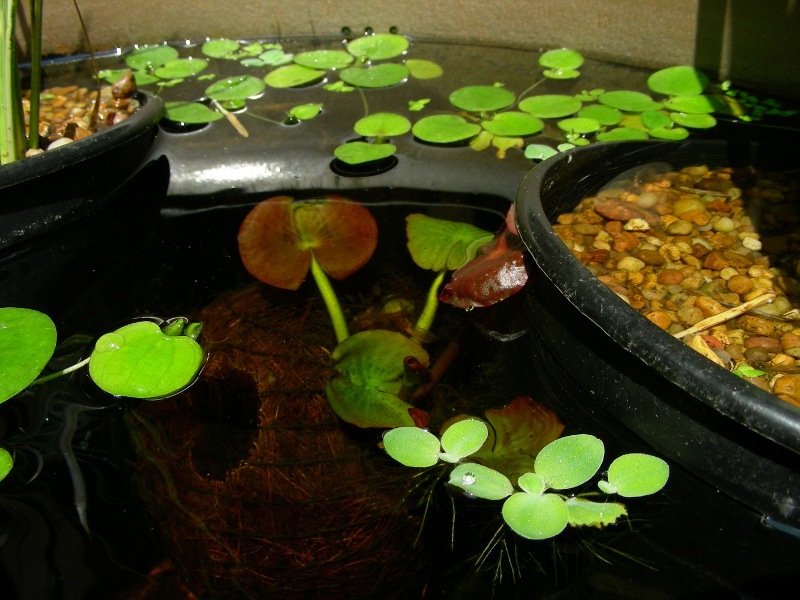
The plants took off after I added the fish. The frogbit has taken over, and I recently removed a couple of handfuls. The water lettuce hasn’t done as well, but that could be because the frogbit is chocking it out. Earlier in May my iris flowered, and the potted grasses are also doing well. 

The iris that flowered on 10 May 2013

Since my koi pond is simply too shaded for most plants, I have never been able to have lilies. This tub with its 5 hours of sun is my best chance to grow them. A week ago I bought a lily plant from Lowes and decided to give it a try in the tub. It has been doing great! No flowers yet, but it sprouted and has broken the surface. I’m really hoping to get a flower or two from it later this summer.

The lily in the middle with dwarf water lettuce in the foreground.

Thus far I feel this is going very well. Because of the cool spring we had I don't feel I could have added tropicals until at least May 15. It's a good thing I wasn't planning on them this year. Although I can't see the mosquitofish that well, I want something that I know will survive on my first try rather than something I will have to worry about while I get the basics down.

Full tub shot!

Saturday, May 18, 2013

My Tanks: 18 May Update

The times between my updates keep stretching out because my tanks are going through fewer and fewer changes. Once every couple of months is more than enough to cover everything. That said, I only have a few things to report this week.

My comminuty tank got some new residents in the form of Amano shrimp (Caridina multidentata). The gourami did pick off a few, but the remaining three are hard at work keeping down the algae. I have a bit of staghorn algae in the tank, and they have been very diligent in eating it. Amano shrimp are much larger than cherry shrimp and do just fine with the fish.

My new amano shrimp.

I have also added a new plant: Hygrophilia sp tiger. It is another stem plant, but it is one of the few low-light stem plants. It's in a temporary position right now, but during the summer I'm going to put a canister on the community tank. Then the hygro can be moved to where I want it. Thanks to the sharp eye of a friend, I've also realized I have a fourth species of crypt in my tank. He pointed out that I have a C. pontederiifolia as well as the C. spiralis, C. undulata, and C. wendtii. I'm guessing it came as an extra with my last order of crypts from Aquariumplants.com.

You can see the C. pontederiifolia to the right of the rock in the center.
The hygro is in the back left. And there is a bonus amano.

The shrimp tank underwent the most changes. Because my starting population was so low, I ordered 10 sakura red shrimp from HomelessAquatics.com. They arrive in good condition and acclimated well, but I had a mass die-off like 4 days after they went into the tank. I attribute it to first-time shrimping mistakes which could have been anything from not feeding enough, feeding too much, an immature tank, pH too high. I wasn't really sure, but either way only about 3 of the original 10 are still alive. I was about to give up on shrimps when a female became berried, but she died shortly after that. I put her body in a net over the filter in an attempt to hatch her eggs like I'd read online. And it actually worked! I was able to hatch about five eggs.

As for cosmetic changes in the tank, I have also made some large ones. I added two large pieces of driftwood as well as some X-mas moss and java moss. I removed the bacopa because I just didn't like the look of it. I also added some floating plants such as frogbit and dwarf water lettuce. I currently have one berried female and a few saddled ones.

Current state of the shrimp tank. I also added a feeding dish to the tank.

There aren't nearly as many updates as I would like with the pond because we've had a very cold spring. We even had a frost earlier this week. The plants are just flowering now. I added some water hyacinth to the pond, but it's not in top shape due to the cold weather.

Yellow iris and the koi

Stout blue-eyed grass

Up close on the iris and koi

The other major change in my fish tanks is a new goldfish!!! Mid April I bought a ranchu from DandyOrandas.com, and I'm in love with this little girl! She's slightly larger than my ryukin and oranda, but they are catching up fast. I have named her Ponyo, but my mother calls her Marlyn because she has a black dot on her check. She took to hand feeding extremely well, and fits in with the group perfectly. I am so happy to have her!!

Look at that cute face!!!

Like three peas in a pod.

The last and rather small (right now) change in the goldfish tank was the addition of six apple snails. A friend had too many in his tank and was giving away babies. I plopped them in while distracting the goldfish, but Ponyo was too quick and completely ate one, spitting out the operculum. So the apple snails are in a breeder box getting daily feedings so they grow large enough not to be goldfish food. 

My new snails with a cameo from Burbbles.

There will be something special in the next update! :3

Saturday, May 11, 2013

The Beauty in your Backyard

North American Native Fishkeeping

The first time I saw picture of a darter was in my ichthyology class, second semester of my junior year. We’d just finished covering marine fishes of the eastern US and were starting on the freshwater fishes. I couldn’t believe my eyes. I never knew there were such beautiful fish right outside my door. The first time I saw a darter in the flesh, I was forever entranced.

Redfin darter Etheostoma whipplei I caught while in Arkansas

When most people think of North American fishes, largemouth bass (Micropterus salmoides) and channel catfish (Ictalurus punctatus) are the first things to come to mind. These large gamefish are the ones that are seen and talked about the most, so it is no wonder that is where most minds go first. But there is so much more in our waterways than just these well-known fish. Surprisingly a lot of these are pretty easy to keep in a tank. They don’t need heaters like tropical fishes and some can be kept in ponds year-round.

In the US we have a lot of members of the cyprinid family—minnows—that are remarkably easy to care for. They are just like the barbs and rasbora of Asia. These minnows are subdivided into dace, shiners, and chubs. They are shoaling and prefer groups of six or more. North American minnows do best in 30+ gal (113 L) tanks and for the most part are just fine with other species of minnows. My favorites are mountain redbelly dace (Chrosomus oreas), saffron shiner (Notropis rubricroceus), and turquoise shiner (Cyprinella monacha), but these are just the ones I have in my backyard. 

Mountain redbelly dace (Chris Crippen @ Fishbase.org)

For those that like the cute appeal of the corydoras and other tropical catfishes, there are also cute catfish in the streams of North America: the madtoms (Noturus spp). They have the typical catfish look but stay small enough for a 30 + gal (113 L) tank. Some species are spotted or speckled with a bit of color, but their most entertaining qualities are their catfish antics and their adorable whiskered faces peeking out of rock caves.  

Tadpole madtom Noturus gyrinus (Ohio DNS)

Darters (Etheostoma spp) and (Percina spp) are the gems of North America. Hands down I believe they are the most stunning fishes we have here. They have reds, blues, greens, and yellows to match some of the most beautiful tropical fishes. But they have a catch: darters come from cool, flowing water. You have to provide that if you keep them in an aquarium. This often includes powerheads or simply a river manifold. Darters are also territorial, so make sure to provide enough hiding spaces for them in a tank. In the wild, they can just swim down to the next riffle; they don’t have that luxury in a tank. I have seen a few tutorials for how to set up a darter-specific tank like this one from the North American Native Fishes Association (NANFA). Or you could just use a setup typical of hillstream loaches detailed here at Loaches Online. 

Tangerine darter Percina aurantiaca (conservationfisheries.org)

When most people think sunfish, they think about bluegill (Lepomis macrochirus) or crappie (Pomoxis nigromaculatus). These large cichlid-like fish are only a few of the centracidae family found in the US. While not all of them are beautiful, there are a few worth pointing out. The pygmy sunfishes (Elassoma spp) are certainly some of the most stunning. They are the smallest fishes detailed today in this article; they can be kept in tanks as small as 10 gal (37 L). Pygmy sunfishes are also the most delicate and can prove difficult to feed. They are very shy and need a heavily planted tank with things like anarcharis, hornwort, and duckweed. They were once described to me as “not for the fishkeeper who needs to see their fish every day.” Unlike with most of these fish, you probably won’t be able to find pygmy sunfish in your backyard. They are generally restricted to coastal areas of the eastern US. 

Pygmy sunfish Elassoma gilberti male (Erica Wieser @ NANFA.org)

For those that like to see their fish a little more often, there are other more visible sunfish. The banded sunfish (Enneacanthus obesus) and bluespot sunfish (Enneacanthus gloriosus) are a good choice for a medium sized tank. With colors and temperament matching the South American cichlids, they make an excellent fish for a 30 gal (113 L) to 70 gal (265 L) native tank. Unlike the darters and minnows, they prefer the pools to the faster water.

Banded sunfish (Tennessee Aquarium)

Those with a much larger tank might enjoy the some of the most brightly colored Lepomis spp species like the long-eared sunfish (Lepomis megalotis), redbreast sunfish (Lepomis auritus), and pumpkinseed (Lepomis gibbosus). These fishes will need a 100+ gal (378 L) tank as they get large and are territorial much like the larger South American cichlids. These fishes also make interesting alternatives to goldfish and koi in a pond. In clear water their beautiful colors can easily be seen, especially during spawning.

Longear sunfish (Brandon Brown @ NANFA)

The North American fish lineup also includes some livebearers and killifish. While these aren’t the most colorful, they are still interesting to keep in aquariums nonetheless. Some of the best looking are the flagfish (Jordanella floridae), northern studfish (Fundulus catenatus), and the sailfin molly (Poecilia latipinna).

Northern Studfish (Stan Sung @ Aquabotanic.com)

This isn't intended to be a comprehensive guide to North American natives. I just want to open your eyes with this article and let you know there are lots of choices out there. If you have a further interest in these fishes, I highly recommend joining the NANFA forum. I am aware there is a bias in the listings of fish here: they are almost all from the eastern US, but that is where I live. I am most familiar with the fish in my backyard. I encourage you to get familiar with the fish in your backyard no matter where you live. You never know what little beauties you may find!

Works Referenced


"BTDarters." Updated: 26 Jan 2013. Retrieved: 11 May 2013.

"Compatibility and Feeding of North American Native Fishes in Aquaria." Jonah's Aquarium. Updated: 11 May 2008. Retrieved: 11 May 2013. 

"North American Native Fishes: Captive Care." Zimmerman's Fish. Updated: 15 April 2013. Retrieved: 11 May 2013.

Sung, Stan. 2011. "Forest Gems: Fishes of the Streams of the Deep South." www.aquabotanic.com. Retrieved: 11 May 2013.

Tuesday, April 30, 2013

Summer Tubbin'

It's getting warmer around the US and Europe which means pond season for the lucky few of us, but it's also something special for the serious hobbyist: a chance to expand your fishroom. I'm not talking about an extension on the house; I'm talking about your back porch. In most of the US and Europe, there are at least a couple of months of weather warm enough to house most of our aquarium fish outside.

Hobbyists take advantage of this warm summer weather to spawn and grow fish outside. Some accidentally discover that fish spawn like this while others, often going on the words of those with the happy accident, purposefully put fish outside to spawn. Most people believe the trick to getting the fish to spawn is how closely this replicates their natural environment. The floating plants, the live food, the cooling rain are all things the fish would naturally experience and have evolved to live with. People have had success spawning all kinds of fish from livebearers to egg-scatteres like barbs and tetra. Gourami are another favorite fish to spawn in these tubs.

Tubs used for breeding by renowned hobbyist Rachel O'Leary (msjinxkd.com)

Placement of the tub does matter. You can't put them in full sun all day long as this will heat up the water too much. Ideally you want about 4-5 hours of morning sun. This means  placing them on the eastern side of your house or yard. The tub (or tubs) should not be under cover or eaves of your house because the rain is important to them. Rain cools the water in the heat of summer and provides mother nature's water changes.

Most any tub that holds more than 20 gallons of water will due. Animal watering troughs are a favorite because they are large, built to hold water, and the plastic won't degrade under the UV rays of the sun. You might have to modify the tub a bit. If you don't like the idea of tubs overflowing when you get a lot of rain in a short time, then think about drilling overflow holes. These drain the tub when it reaches a certain water level and prevent the tub from overflowing and sending your plants and fish overboard.

Water trough made into a pond (azcopperpenny @ Photobucket)

An optional piece of equipment is a pump.  Some people like the calming noise of water moving, and some people just like to have some water movement in the tub to keep it a uniform temperature. Something like this would be less important if you were raising gourami or betta spawns.

When setting up these summer tub ponds, you are really at the mercy of mother nature. This often means being familiar with the weather patterns in your area: what time of year it really begins to warm; what time of year you see cooling off; just how much rain you get in the summer. When you see daytime temperatures steadily in the 70's (~ 21C) is when you should begin setup. Just as with a tank, start with the plants first. Fill the tub with a mixture of dechlorinated tap water and water from the tank that you will be bringing the fish. This gives the plants some nutrients to consume before you add the fish. Let the plants get settled for about a week. Then you add the fish. Don't just dump them in; acclimate them like you would any fish. You may also want to place some mesh netting over your tub pond because fish have a tendency to jump in the first few days.

Frogs in the pond are cute, but can eat fry (tomylees @Flickr)
Plants are a big aspect of these summer tub ponds. They are part filtration system, part cooling system, and part fry nursery. The best kind to have are floating plants like water lettuce, frogbit, water hyacinth, and duckweed. These all have roots that hang down and allow fry a good place to hide. Egg-scatterers can attach their eggs to these roots; bubble nesters can attach their nests to the undersides of leaves. If you are looking for some lovely blossoms, lotus plants do well in these setups, too. Marginal plants like iris, cattails, and rushes can be used to add some aesthetic appeal and make the tub really look like a pond. Just like with fish tanks, patience is key!

This summer, I've decided to try out these summer tubs. I have a lot of floating pond plants because they grow so well in the pond, and I have an old plastic tub that I used to haul around pond plants in. The only thing I would need is the fish. As much as I'd love to try breeding my gourami in a tub this summer, I don't want something to go wrong on my first try and accidentally kill them. So I'm going to use the livebearers from my pond, mosquitofish Gambusia holbrooki. When the summer is up I will just put the remaining mosquitofish back into my pond. Next summer I will be spawning my gourami. Wish me luck!!

My tub pond! Grow, baby, grow!!!

Works Referenced


Colleti, Tim, Dr. 2011. "Summer Tubbin': Breeding you Fish Outdoors."  Tropical Fish Hobbyist (June) 86 - 89.

Sipes, John. 2003. "Summer Tubbin'." www.aquarticles.com. Retrieved: 28 April 2013.

Marchio, Liz. 2008. "Urban Pond Tubbin' Water Gardens". AquaScaping World  (June): 8 - 11. 

Saturday, April 20, 2013

Removing the Water

This week I worked on a special project. It's unique from my other tanks because it doesn't involve water! Well it does, but this project isn't submerged! I made a moss terrarium from a Nature's Pure Glass 1 gal cube. I originally intended this for an aquatic project, but had to abandon that because it's positioning made water changes difficult. So I removed the water from the setup.

Because I know very little about terrestrial plants I searched around the internet for a tutorial (and some general guidance) on making a moss terrarium. This was my favorite that I found and the one I've generally been following. First I had to clean out the old cube because I'd kinda just let the water sit in it. I cleaned it with vinegar in an attempt to get most of the hard water stains off the sides.

I gathered all of my materials on the front porch. Then came the fun part, collecting the moss. You can buy it online, but since I have a lovely backyard I wanted to venture out and see just what moss was growing in the ravine. My pond does have a bit of moss on the rocks, but since it has taken about seven years to develop I didn't want to destroy that aesthetic. I grabbed an old backpack, some large freezer ziplock bags, and small trowel and went collecting. While I was out there I also dug up some rocks for this project. If you don't have a backyard like I do, you can go to a local park and head off the trail. But while you are out there make sure you are aware of your surroundings; carry a phone or go with someone else.

Moss in my backyard. I harvested this after I took the picture.

 When I returned with my moss I stated putting the substrate in the cube. First I added a layer of black sand in the bottom to give some added drainage and moisture storage. The room where this is sitting has a fan going all the time, and I'm afraid it might cause too much evaporation. I want to be able to "store" water in the bottom, too. Next, I added a layer of peat moss soil. Moss enjoys growing attached to things and in acidic soil. Since I didn't want moss on my rocks, I opted for the peat moss soil. It only comes in massive bags around here, so I'll be making a few more terrariums later this year. I tried doing some hardscape with the rocks, but most of what I brought back was too big. Finally, I moistened this with some nutrient-rich goldfish water.

Hardscape and peat moss soil

Now I added the moss. I'm not the greatest at making 'scapes, so I have a feeling I will be re-arranging it a few times before I'm totally satisfied. I tried to mimic an iwagumi but I'm pretty sure I failed. Either way, I brought my moss inside and am happy to have it sitting on my desk.


This begins my summer adventure into terrariums. I've never done too well with house plants before because you have to water them so much. I'm hoping that by adding the sand reservoir it will counterbalance my forgetfulness with watering them. If all goes well with this terrarium I'd like to try my hand at making another one with the leftover materials.