I do not own or claim to own this video.
Tuesday, November 27, 2012
Amazon: Secrets of the Golden River
A great deal of common freshwater fish in the hobby come from the Amazon River Basin, and with good reason as it's the second largest freshwater river system in the world. Angelfish, discus, and many species of cories and tetra are all only found in the Amazon. Due to the wide variety of species Amazon biotopes are very common. This documentary includes footage of many of these and other Amazon fishes in the wild.
I do not own or claim to own this video.
I do not own or claim to own this video.
Monday, November 19, 2012
Differences Between Goldfish and Koi
I know there are a lot of similarities between these two fish, but getting them mixed up is one of my largest pet peeves. Maybe this is because I’ve kept both species of fish for many years. Maybe it's because I dislike people who don't bother to think about what they are seeing. Either way, I would like to point out the major differences between koi (Cyprinus carpio) and goldfish (Carassius auratus auratus).
Size
This is the most obvious difference between adult koi and goldfish. If you see a colorful fish in a pond that is larger than 15 inches, it is a koi. Fishbase.org lists 12.5 in (32 cm) as the maximum size for goldfish while it lists 43 in (110 cm) as the maximum size for koi. Younger specimens in ponds can be more difficult to tell apart, though, so this isn't always reliable.
Coloration
Goldfish are pretty limited in their patterns and colors whereas koi have a much wider variety. Goldfish tend to come in solid colors of orange, white, black/blue, or red. Yellow can be seen but is very uncommon. White and black combinations and red and black combinations are also possible but rare compared to the common red and white combination. Koi come in a much greater variety of common combinations. The base colors are red, white, black, yellow, orange, and blue. The chart below illustrates some common koi colorations and the names of the patterns.
 |
| Koi color varieties (credit in picture) |
The barbels (sometimes called whiskers)
This is the most obvious difference between koi and goldfish. Koi will have these barbels and goldfish will not. If you can see these on a pond fish, that fish is a koi. However, these aren't always easily observable.
 |
| Barbels on koi (Stan Shebs @ Wikipedia) |
The Tail
Both koi and goldfish can have elongated tails, but only goldfish will have the signature double-tail. This is where the caudal fin (tail fin) is doubled. From above, this will often give the tail a three-pronged or a four-pronged appearance. This characteristic is only found in goldfish.
 |
| Typical split caudal as seen on wakin goldfish (fishsempai.com) |
Other less obvious physical characteristics
This illustration below points out more of the morphological differences between koi and goldfish. Often times these aren't visible unless you view two fish side by side or have looked at a lot of koi and goldfish. The difference in mouth is often visible when you feed them. Sometimes it will give you a chance to look for barbels, too.
 |
| Physical differences in koi and goldfish (credit unknown) |
Can they interbreed?
Yes. When found in the same habitat (either in the same pond or in the wild), the two species will hybridize, but the hybrids are infertile. Often times these hybrids will be the natural brown, but some can come out a beautiful solid black. When these are found in the aquarium trade, they are often breeding mistakes.
 |
| Genetically verified hybrid carp goldfish found in the wild (Jim Negus) |
I hope you now have a better understanding of the differences between goldfish and koi. These are two beautiful fish that deserve to be recognized for their own merits.
Monday, November 5, 2012
Color Changes in Bettas
As anyone who has keep bettas for a long period of time knows, they are apt to change colors. What you see in the cold cup in the store is never what you will see after a few days of warm, clean water in your tank. For this reason, bettas bought in pet stores are often gambles. You can buy a pretty white one in the store and it will turn a peachy-yellow in a few days. There are three reasons why bettas change colors: stress, age, and genetics.
All fish are known to change colors when stressed. Most of the time this is a whiting out or a dulling of their colors. In pet stores almost all fish are stressed. The tanks are crowded and often contain diseases. While the cold cups may not always contain disease, they will stress tropical fish like betta. And just like any other fish, the colors of the betta will dull and fade. The transformation from stressed fish to unstressed fish can take a matter of hours or sometimes days. This is the main reason betta change color when you first get them.
Often the fish you see sold in store aren't very old. Typically the smaller they are, the younger they are. Their colors haven't fully developed yet and neither have their fins. So essentially what you are buying is a "work in progress." Some will change more than others as not all bettas being sold are the same age. Below is a very young betta that I bought in July 2011.
Some betta carry what is called the marble gene. This gene sequence causes the betta's colors to changing even after they should have stabilized with age. Sometimes the betta will continue to change his whole life even looking like a whole different fish a year after you buy him or her. Sometimes the betta will "marble out" and become a cellophane, and some "unmarble" and turn a dark, solid color. There is no way to predict what you will end up with. This presents an interesting challenge to breeders, and they can be a neat fish to have as a pet. A month later you can end up with a completely different fish than you started with!
Parnell, Victoria. 3 Mar 2006. "The Ever-Changing Marble." bettysplendens.com. Retrieved 4 Nov 2012.
Stress
All fish are known to change colors when stressed. Most of the time this is a whiting out or a dulling of their colors. In pet stores almost all fish are stressed. The tanks are crowded and often contain diseases. While the cold cups may not always contain disease, they will stress tropical fish like betta. And just like any other fish, the colors of the betta will dull and fade. The transformation from stressed fish to unstressed fish can take a matter of hours or sometimes days. This is the main reason betta change color when you first get them.
 |
| This is the same betta. On the left is the betta in a cold cup in the store. On the right is after a month of being in clean, warm water. |
Age
Often the fish you see sold in store aren't very old. Typically the smaller they are, the younger they are. Their colors haven't fully developed yet and neither have their fins. So essentially what you are buying is a "work in progress." Some will change more than others as not all bettas being sold are the same age. Below is a very young betta that I bought in July 2011.
 |
| This image shows the same betta from July 2011 to February 2012. Notice the longer fins and more pronounced color. |
Genetics
Some betta carry what is called the marble gene. This gene sequence causes the betta's colors to changing even after they should have stabilized with age. Sometimes the betta will continue to change his whole life even looking like a whole different fish a year after you buy him or her. Sometimes the betta will "marble out" and become a cellophane, and some "unmarble" and turn a dark, solid color. There is no way to predict what you will end up with. This presents an interesting challenge to breeders, and they can be a neat fish to have as a pet. A month later you can end up with a completely different fish than you started with!
 |
| This is my marble plakat. The image on the right is from July 2012. The middle image is a month later. The far right image is from October 2012. My marble has unmarbled to a beautiful solid blue. |
Works Referenced
Parnell, Victoria. 3 Mar 2006. "The Ever-Changing Marble." bettysplendens.com. Retrieved 4 Nov 2012.
Monday, October 22, 2012
My tanks: 22 Oct Update
So while it has been a few months since my last update not much has changed in my tanks except with the goldfish.
I completely redid the aquascape. I removed the gravel once and for all and replaced it with aragonite sand to aid me in hardening the water. I figured out my light is too dim for most plants to grow in the substrate, so I opted for fake plants. I think they look realistic, and I like the cover they give to the fish.
The fake plants I have are Marineland jumbo bamboo which is floating while the live floating plants--which the goldfish seem to leave alone--fill in, the Marineland A-size multipack that includes red ludwigia, rotala, and moneywort (but I only used to two tallest plants in the center and right), and the Aqueon Begonia plastic plant 16" on the left. My live plants (most of which are floating and out of view) are hornwort, water sprite, and anarcharis. I also have that one little marimo ball on to bottom, too.
Unfortunately, right after I completed the re-'scape, I lost my two oldest goldfish within a week of each other. They had been with me for six years. I'm not positive on what caused either of their demises, but I am keeping a close eye on my remaining goldfish.
I also know I owe you guys some up close pictures of my newest (well relatively) goldfish. I'm fairly certain he is male as I've seen some breeding stars on his pectorals, but only time will tell. He's still pretty small. No bigger than 3 inches on body!
While it hasn't been getting that cold at night and the leaves haven't changed that much, I went ahead and put the net over my pond. It's been decent weather, and I wanted to make sure it was done right. There have been a few years where I was putting the net out when it was rainy, cold, and almost dark. Plus, I catch more leave if I put the net up before the they all start coming down.
And everyone got new lights. I noticed I needed new lights because I began to see an abundance of brown algae growing on the walls as well as some of the lower plants. Bulbs don't last more than a year, and the deeper the tank, the more often they have to be replaced. I probably could have gotten another few months from my betta tank bulbs, but I like doing them all at once. You might not notice a difference, but the plants do!
I completely redid the aquascape. I removed the gravel once and for all and replaced it with aragonite sand to aid me in hardening the water. I figured out my light is too dim for most plants to grow in the substrate, so I opted for fake plants. I think they look realistic, and I like the cover they give to the fish.
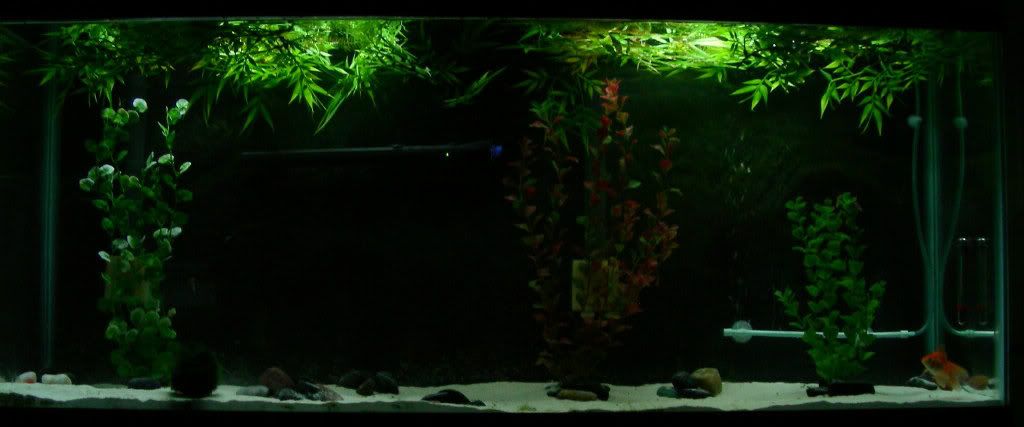 |
| If you can spot him, he's in the bottom right corner! |
The fake plants I have are Marineland jumbo bamboo which is floating while the live floating plants--which the goldfish seem to leave alone--fill in, the Marineland A-size multipack that includes red ludwigia, rotala, and moneywort (but I only used to two tallest plants in the center and right), and the Aqueon Begonia plastic plant 16" on the left. My live plants (most of which are floating and out of view) are hornwort, water sprite, and anarcharis. I also have that one little marimo ball on to bottom, too.
Unfortunately, right after I completed the re-'scape, I lost my two oldest goldfish within a week of each other. They had been with me for six years. I'm not positive on what caused either of their demises, but I am keeping a close eye on my remaining goldfish.
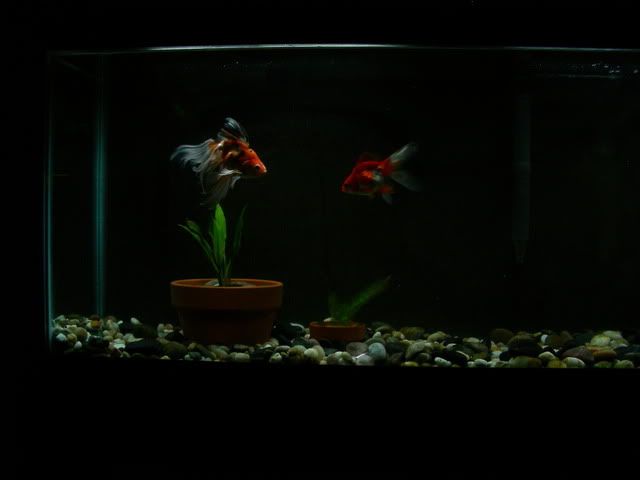 |
| Seaking on left, Goldeen on right. Together in life and together in death. |
I also know I owe you guys some up close pictures of my newest (well relatively) goldfish. I'm fairly certain he is male as I've seen some breeding stars on his pectorals, but only time will tell. He's still pretty small. No bigger than 3 inches on body!
 |
| Here he is sitting next to his "mirror buddy." Since goldfish enjoy company, this will be his best friend until I can find another goldfish and put him through a QT process. |
 |
| He's still a little shy! |
 |
| Here is a pretty good image to give you a size comparison. He's grown a lot since I brought him home. |
While it hasn't been getting that cold at night and the leaves haven't changed that much, I went ahead and put the net over my pond. It's been decent weather, and I wanted to make sure it was done right. There have been a few years where I was putting the net out when it was rainy, cold, and almost dark. Plus, I catch more leave if I put the net up before the they all start coming down.
 |
| It's still warm enough that the koi are happily swimming around under the net. |
And everyone got new lights. I noticed I needed new lights because I began to see an abundance of brown algae growing on the walls as well as some of the lower plants. Bulbs don't last more than a year, and the deeper the tank, the more often they have to be replaced. I probably could have gotten another few months from my betta tank bulbs, but I like doing them all at once. You might not notice a difference, but the plants do!
Sunday, October 14, 2012
Little things
Yesterday when I was finishing up with my work, I walked over to our local butterfly garden. It's a very nice little garden where my local science center hatches and grows native butterflies. In the back of the garden, they have a nice little goldfish pond. It's probably about 300 gallons or so. While I was sitting by it and trying to snap photographs of the butterflies that danced by, I noticed a white goldfish with a red splotch on his head, and he looked familiar.
A few years past the butterfly garden was the subject of vandalism when some punks broke in and killed a handful of the goldfish. A year or so before then I had donated comet goldfish with a red splotch on his head to them, but I thought him lost in the raid as he is a very recognizable fish.
On my way out of the garden, I asked the attendant who had worked there for a while how long that particular goldfish with the red splotch on his head had been there. She told me as long as she could remember, and then proceeded to tell me that the vandals only took the largest goldfish which would not have included my little comet. I came to the conclusion that the unique goldfish in the pond was the little comet, who I had named Tancho, that I'd released there years ago! The attendant was just as shocked as I was and even more so when I told her he could easily live another 10 years there.
I spent the next 30 minutes by the side of the pond watching him. His markings have changed a lot. Instead of a neat, almost circular mark, it's spread down to his cheeks. But the rest of his body is still as white as a cloud. And while I did spend a lot of time there, I never managed to get a picture of my goldfish who I'd named Tancho. But it made my day to be able to see him again, so strong and so healthy.
 |
| Some of the flowers and butterflies in the garden |
A few years past the butterfly garden was the subject of vandalism when some punks broke in and killed a handful of the goldfish. A year or so before then I had donated comet goldfish with a red splotch on his head to them, but I thought him lost in the raid as he is a very recognizable fish.
On my way out of the garden, I asked the attendant who had worked there for a while how long that particular goldfish with the red splotch on his head had been there. She told me as long as she could remember, and then proceeded to tell me that the vandals only took the largest goldfish which would not have included my little comet. I came to the conclusion that the unique goldfish in the pond was the little comet, who I had named Tancho, that I'd released there years ago! The attendant was just as shocked as I was and even more so when I told her he could easily live another 10 years there.
 |
| The only photo I have of Tancho. Taken in summer 2007. |
I spent the next 30 minutes by the side of the pond watching him. His markings have changed a lot. Instead of a neat, almost circular mark, it's spread down to his cheeks. But the rest of his body is still as white as a cloud. And while I did spend a lot of time there, I never managed to get a picture of my goldfish who I'd named Tancho. But it made my day to be able to see him again, so strong and so healthy.
 |
| The pond where Tancho now lives. He shares it with three other orange-red goldfish. |
Subscribe to:
Posts (Atom)