I do not own any of these videos. They were made by National Geographic.
Thursday, August 30, 2012
Jewels of the Rift
I decided to take a little different approach to my post this week. I've found a series of videos that comprise a documentary about the great rift valley lakes of Africa. Many of the cichlids commonly found in the aquarium trade come from these lakes. I'm not a big fan of cichlids, but I still found these videos fascinating. Watch and enjoy!
I do not own any of these videos. They were made by National Geographic.
I do not own any of these videos. They were made by National Geographic.
Wednesday, August 22, 2012
Visitors to the pond
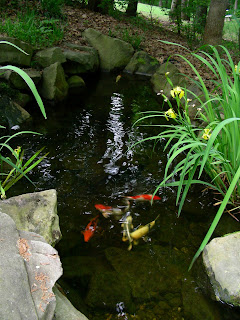
Not only does my pond give my family and me great joy,
but a number of wildlife get nourishment from it, too. I've seen deer dart away as I
approach and have observed birds bathing and drinking from the waterfall. I've been lucky enough to have my camera handy now and then to capture these visitors. Some, I have seen many times, and others were just fleeting glimpses.


This leopard frog (Lithobates spp) or at least his relatives have been at my pond for years. On rainy summer nights we can hear them croaking to each other. I've seen them in the upper stream and the main pond. The smaller ones tend to stay above the waterfall.

Dragonflies are another common sight at my pond. They are a welcome guest as they are ravenous predators of mosquitoes. Very rarely do I see them stop like this. They are usually zooming around and thus I don't often get a chance to ID them. This little beauty is a member of the Libellula genus. Species is really difficult to determine without a closer examination, but I wasn't about to disturb this little guy.

The eastern box turtle (Terrapene carolina carolina) was a pleasant surprise when I went out one morning to feed the koi. Unlike the frogs and dragonflies, this guy sat still for a while and even let me walk back in the house to grab my camera. Turtles are much less common at my pond, but I do see some from time to time. This was actually my second of the year.
I also have juvenile salamanders that call my pond home. They live in the upper pools as any in the main pond would quickly get eaten. I have never seen the adults that obviously lay the eggs year after year (I have different sizes of juvenile), but come they must because I see the results.
I'm happy that my pond also serves as a hub for local wildlife. It gives me a chance to observe them up close and it adds to the natural feel of the pond. I wanted the most natural-looking pond I could build, and I got just that. I couldn't be happier.
Wednesday, August 8, 2012
What I would do differently with my pond
Not often in life do you get a chance to do things over.
Hopefully, in 20 or so years, I will get a chance to build another pond. The
construction and maintenance of my pond has taught me many things. Some lessons
were learned the hard way, and others have just been slow realizations.

 I originally designed the pond to be aesthetically
pleasing. I wanted it to look like a natural stream with the water flowing in
from a waterfall and then out down another channel. It really does have that
appearance. But this has also caused some problems for me. The idea behind the
bog system is to have it be water storage area. It’s supposed to hold an extra
300 gallons of water and make sure the pump is always submerged. It also
provides a shallow bog area to grow plants like rushes, cattails, and others.
The main purpose of these plants is to be a nutrient sponge. However, these plants need full sun which my bog
doesn’t get. My bog is also not large enough to have a lot of these plants.
Next time, I will build a larger bog much closer to the pond and shorten the
stream or completely forgo it.
I originally designed the pond to be aesthetically
pleasing. I wanted it to look like a natural stream with the water flowing in
from a waterfall and then out down another channel. It really does have that
appearance. But this has also caused some problems for me. The idea behind the
bog system is to have it be water storage area. It’s supposed to hold an extra
300 gallons of water and make sure the pump is always submerged. It also
provides a shallow bog area to grow plants like rushes, cattails, and others.
The main purpose of these plants is to be a nutrient sponge. However, these plants need full sun which my bog
doesn’t get. My bog is also not large enough to have a lot of these plants.
Next time, I will build a larger bog much closer to the pond and shorten the
stream or completely forgo it.

What I will repeat
Understocking
My pond is roughly
4000 US gal and only has 6 koi in it. There are a lot of different stocking
ideas, but even by the most conservative levels, my pond is understocked. As a
result of this, I have never dealt with disease. The next time I have a pond,
it will most certainly have no more than one koi per 500 gallons.

Canopy cover
I built my pond on the edge of a forest. Granted, this
did make the actual construction a bit of a hassle, but the end result is a
wonderful canopy of leaves that cover my pond. Despite the temperatures
commonly soaring above 90F at my house, the water never got warmer than 80F.
The canopy also shields my pond from herons. I live less than a mile from a
river and have never had problems with them. The only problem the canopy does
bring is in winter, I must have my pond covered with a leaf net or it gets
really clogged. This is a small price to pay for everything the shade does.
What I will change
Contacting a professional
I started to dig my pond on my own. I planned my pond on
my own with rather little knowledge of how these things really work. While
digging, we realized that bringing in a professional water feature constructor
would be a much better idea. I believe that’s one of the reasons my pond looks
like water garden instead of a hole in the ground. Next time, I will bring in a
contractor from the start.
Bog system
 I originally designed the pond to be aesthetically
pleasing. I wanted it to look like a natural stream with the water flowing in
from a waterfall and then out down another channel. It really does have that
appearance. But this has also caused some problems for me. The idea behind the
bog system is to have it be water storage area. It’s supposed to hold an extra
300 gallons of water and make sure the pump is always submerged. It also
provides a shallow bog area to grow plants like rushes, cattails, and others.
The main purpose of these plants is to be a nutrient sponge. However, these plants need full sun which my bog
doesn’t get. My bog is also not large enough to have a lot of these plants.
Next time, I will build a larger bog much closer to the pond and shorten the
stream or completely forgo it.
I originally designed the pond to be aesthetically
pleasing. I wanted it to look like a natural stream with the water flowing in
from a waterfall and then out down another channel. It really does have that
appearance. But this has also caused some problems for me. The idea behind the
bog system is to have it be water storage area. It’s supposed to hold an extra
300 gallons of water and make sure the pump is always submerged. It also
provides a shallow bog area to grow plants like rushes, cattails, and others.
The main purpose of these plants is to be a nutrient sponge. However, these plants need full sun which my bog
doesn’t get. My bog is also not large enough to have a lot of these plants.
Next time, I will build a larger bog much closer to the pond and shorten the
stream or completely forgo it. Changes to the upper stream
I really like the setup I have with the large waterfall,
but I think with the next pond I want to elongate the upper stream and make the
first pool much larger. This will also give me more landscaping options, and I
would like to put a path and a bridge over the upper stream. A larger pond will
also allow more salamanders and frogs to live in my pond. These animals eat
insect larvae and are also an indicator of water quality.
More plants
Right now I only have about 3 species of pond plants. I
would like to add more, but there just isn’t the room or the sunlight. More
plants will make the water cleaner and out-compete with the algae. Plus, I love
the look of floating plants. The way I have the body of the pond set up now,
floating plants just don’t work well. And I would also love some lilies, but
again not enough sun. I would like to plan my pond so that some parts will get
enough sun for lilies. This will also mean having a larger surface area.

Sunday, July 22, 2012
My Tanks: 22 July update
So almost a month later, a lot has changed with my tanks. But all of the changes have been for the good.
The amazon sword has done well in the goldfish tank. I'm thinking about adding a root tab to boost it's growth; I would really like two huge swords in that tank. The hornwort has also taken off. It's really helped bring down the nitrate level in the tank. I will certainly need help with that when I add the newest goldfish to the tank.

The biggest change is the betta tanks. I ordered a double-decker stand and stacked them. Basically I can fit two tanks in the space that one would normally take, and run both filters from one air pump. I highly recommend this for anyone who is having trouble finding places for more tanks. I got the stand from Drsfosterandsmith.com for a very reasonable price. They come in sizes up to 55 gallons and are of a rather sturdy make. Industrial strength shelves also work if the tanks aren't going to be on display such as what you would find in someone's fish room.

So the other day I went into Petco looking for something (can't remember what), and I made the mistake of looking at the bettas. I saw this beauty a halfmoon king betta being sold as a plakat halfmoon. Kings usually sell for $25 around here, but I got this beauty for only $14 because he was miss-marked. His name is Lapis, but my mother likes to call him Captain America because of his patriotic colors. He is currently in the 29 gallon.

The changes to my 29 gal community were the most challenging ones. Removing the gravel and then adding the sand was a pain in the rear (and back and head and knees). The sand just didn't want to work with me. I used Estes Ultra Reef, and it looks great (it's also really soft so it won't hurt the kuhlies). I don't care what anyone says, it should be at least rinsed before going into the tank. At the very least it gets rid of a lot of air bubbles (which was my main problem). I've also added pygmy chain sword (Helanthium tenellum), dwarf sagittaria (Sagittaria subulata), and Rotala indica that I bought from Aquariumplants.com (very pleased with their service and quality of the plants and packaging). This is the first step in making this my first fully planted community.

My baby goldfish is still in QT mostly because I want him to grow more before I add him to the main tank. He's gotten bigger, but still not big enough for me to feel comfortable with him in the big goldies.

The amazon sword has done well in the goldfish tank. I'm thinking about adding a root tab to boost it's growth; I would really like two huge swords in that tank. The hornwort has also taken off. It's really helped bring down the nitrate level in the tank. I will certainly need help with that when I add the newest goldfish to the tank.

The biggest change is the betta tanks. I ordered a double-decker stand and stacked them. Basically I can fit two tanks in the space that one would normally take, and run both filters from one air pump. I highly recommend this for anyone who is having trouble finding places for more tanks. I got the stand from Drsfosterandsmith.com for a very reasonable price. They come in sizes up to 55 gallons and are of a rather sturdy make. Industrial strength shelves also work if the tanks aren't going to be on display such as what you would find in someone's fish room.

So the other day I went into Petco looking for something (can't remember what), and I made the mistake of looking at the bettas. I saw this beauty a halfmoon king betta being sold as a plakat halfmoon. Kings usually sell for $25 around here, but I got this beauty for only $14 because he was miss-marked. His name is Lapis, but my mother likes to call him Captain America because of his patriotic colors. He is currently in the 29 gallon.

The changes to my 29 gal community were the most challenging ones. Removing the gravel and then adding the sand was a pain in the rear (and back and head and knees). The sand just didn't want to work with me. I used Estes Ultra Reef, and it looks great (it's also really soft so it won't hurt the kuhlies). I don't care what anyone says, it should be at least rinsed before going into the tank. At the very least it gets rid of a lot of air bubbles (which was my main problem). I've also added pygmy chain sword (Helanthium tenellum), dwarf sagittaria (Sagittaria subulata), and Rotala indica that I bought from Aquariumplants.com (very pleased with their service and quality of the plants and packaging). This is the first step in making this my first fully planted community.

My baby goldfish is still in QT mostly because I want him to grow more before I add him to the main tank. He's gotten bigger, but still not big enough for me to feel comfortable with him in the big goldies.

Saturday, July 14, 2012
How to stock a fish tank
A very common beginner question is “how many fish can I put in my tank?” The process of adding fish to a tank is called stocking and is more of an art than a bright line rule. However, there are some generic guidelines that will help you understand the thought process that goes into choosing fish for an aquarium. When you are in doubt don’t hesitate to ask a more experienced aquarist.
The amount of fecal matter a fish produces is also important. Fish that eat continuously like many oto catfish, plecos, and goldfish produce a lot of poop. The poop breaks down into ammonia which is toxic to fish. The ammonia is made non-toxic by colonies of bacteria, but these bacteria need a surface on which to grow. In a small tank, the surface area is greatly limited, and the bacteria won’t have as much room to grow; this is one of the major factors that limit how many fish you can stock to a tank.
Tank size
This is probably the single most important aspect. A jack dempsey (Rocio octofasciata) could hardly turn around in a 10 gal tank. An adult koi (Cyprinus carpio) would be bouncing off the walls in a 20 gal. Some fish simply won’t fit in certain tanks. Size matters.
Length
The most important subset of size is length. Look at the body of a typical fish. It’s streamlined for moving forward not up and down. Fish need room to swim side to side more than they need room to swim vertically.
Footprint
This is the how much surface area the water will have. It is dependent on the length and width of the aquarium. Since oxygen exchange happens through the surface of the water, the larger the footprint, the more fish you will be able to have. Conversely, tanks that are taller than they are wide will have a smaller footprint than a long tank of equal volume. This will limit the number of fish the tank can hold.
Volume
While this isn’t as important as length and footprint, it still had great impact on stocking capacity. The more of it, the better; it dilutes more waste and gives fish more room to swim. A good way to think about it is to look at a 20 gal long which is 30" L x 12" W x 12" H versus a 29 gal tank which is 30" L x 12" W x 18" H. Both of these tanks are the same length and width, but the 29 gal is 6 inches higher than the 20 gal long. They both have the same footprint and swimming space, but you will be able to add more fish to the 29 gal simply because it has a larger volume of water.
Pulling these all together
What all of this means is that you will always be able to have more fish in a long tank rather than a tall tank. Long tanks give fish more room to swim, have more water surface area for oxygen exchange, and will allow you to have more fish.
 |
| School of angelfish Pterophyllum spp (Mr. Sepia @ flickr) |
Bioload
This is most easily defined as the amount of waste an organism produces. Waste can come in the form of solid or liquid. The total bioload of the aquarium (and therefore the total number and species of fish) is limited by the surface area the bacteria can colonize. The good bacteria in an aquarium live on solid surfaces instead of the water column. Without enough surface area to grow a large enough colony of bacteria to handle the bioload, the water will become toxic to the fish.
Not only does the shape of your tank matter, but the shape of the fish you plan to add matters too. While deep-bodied fish such as many cichlids, fancy goldfish, and puffers may be as long as some tetra and gourami, the deep-bodied fish will produce more waste because they have a greater total volume. You will always be able to keep more fish with a naturally slim profile in a tank than fish that are naturally thick. Larger fish have a larger bioload, so you will always be able to keep more small fish in a tank than larger fish.
While I’m talking about fish size and shape, I need to mention that you always look at the adult size instead of the current size. Yes a baby oscar could physically fit in a 20 gallon tank, but you will end up buying a completely different setup as it grows. Save your money and only buy one tank: the tank where it can live its whole life healthily. It’s not a good idea to buy a fish and plan to upgrade later because many things can happen in between now and when the fish needs the upgrade such as unemployment, family emergencies, personal injury, and any number of things that can remove your financial resources.
While I’m talking about fish size and shape, I need to mention that you always look at the adult size instead of the current size. Yes a baby oscar could physically fit in a 20 gallon tank, but you will end up buying a completely different setup as it grows. Save your money and only buy one tank: the tank where it can live its whole life healthily. It’s not a good idea to buy a fish and plan to upgrade later because many things can happen in between now and when the fish needs the upgrade such as unemployment, family emergencies, personal injury, and any number of things that can remove your financial resources.
Poop matters
 |
| Oto catfish (Otocinclus spp) with von rio tetra (Hyphessobrycon flammeus) in the background (lejoe @ flickr) |
Water changes
While I’m talking about the biology of stocking, I should mention how water changes play a role in this process. While they won’t do anything for the physical size and swimming needs of each fish, they do affect how many fish you can add. A typical healthy water change is between 25% and 50% of the total tank volume once a week. The more water you change on a weekly basis, the more fish you can have in the tank. This is because water changes remove nitrates, dissolved organic matter like hormones, and other crud from the tank. These can’t be removed any other way. Without weekly water changes the continued presence of these molecules in high concentrations in tanks causes stress to the fish. Larger water changes won’t allow you to cram your tank full of fish, but it will allow you to add another 4 or 5 fish to your tetra or corydora school.
Compatibility
Not all fish can get along. Some will gladly eat anything small enough to fit in their mouths, and some are so aggressive they will bully anything in the tank. Before you put more than one species in a tank together, you need to check compatibility. There are some general trends you can follow, but always double-check the individual species before you buy them.
Gourami males are territorial with other gourami males. Most males can be housed with two or more females, but to house more than one male together, you will need a rather large tank as all males need room to establish their territories. The exception to this rule is betta fish. The males and females should never be housed together except for breeding purposes.
Tetra, rasbora, and barbs are schooling fish and need to be in the company of their own kind. This means if you want to add one species of tetra to your tank, you should add at least 6 individuals of that same species. Having less than 6 usually results in these fish being aggressive towards any other fish in the tank.
 |
| Tetra look much better in large schools (nikkorsnapper @ flickr) |
Cichlids in general are aggressive. Different species can be housed together in specific setups. As I am no cichlid expert, I will just leave you with the caution that each species has specific needs as far as number of other fish around and decorations in the tank; cichlids need to be heavily researched before you buy as the wrong setup can lead to one fish killing everything.
Why your tap water matters
This is something almost no new fishkeeper considers. Not all water is the same, and fish have requirements. Livebearers need hard water; and tetra prefer soft water. The beginner aquarist should always get fish that can easily live in her or his tap water. Stock the fish to your water not the water to your fish. It is possible to change your tank’s water parameters, but it is not easy. A new aquarist could easily kill his or her fish attempting this. There are beginner fish for all water types. Right now focus on keeping fish alive and healthy.
What parameters you need to know
Hardness (GH and KH) and pH of your water are most important parameters that determine what fish you can have. The GH and pH directly impact fish physiology through osmoregulation and ion exchange; the KH just determines how much the pH will change. Each species of fish has preferences as a result of the environment in which they evolved. Some have a wide range (like the beginner fish in my Best and Worst Beginner Fish article), and some have very narrow ranges.
How to find your local water hardness
In the US, many cities will post the GH, KH, and pH in a water quality report. You can often find these online. If you can’t find it there, you can call your local water treatment plant. They have this information on record. If you are on well water, the hardness should be in your well water report. Call the company that manages your well for it. There are home test kits for GH and KH, but these kits are expensive; they aren’t worth it for beginner fishkeepers.
 |
| Hardness matters to sensitive fish like discus (Jessa BC @ flickr) |
While this is just a general map, it seems to be pretty accurate for water hardness across the US based on my conversations with other aquarists. Chart of city water hardness in the US. However, since it gives ranges, I still recommend you find the exact number for your source water (the water you will be using on your aquarium).
The “one-inch-per-gallon rule” and why it is bad
I often hear this rule quoted in stocking plans by people who don’t understand it. The rule says you can have one inch of fish per gallon of water in the tank. It was originally used as a guideline years ago to make fishkeeping easier to explain to the general public. No limitations were placed on it, so people thought it could be used across the board. It fails for the single reason that fish grow in three dimensions not just one. I’ll use a bit of basic math to explain why.
Let’s take a generic fish named Bob. Bob is only 1 inch long and has a certain width and height because he is a three dimensional object. To find the mass of Bob, multiply width x height x length. This gives us 1 for the mass. For simplicity’s sake we’ll say Bob needs 1*H of oxygen, and produces 1*W of waste with H and W as variables representing units of oxygen and waste.
Bob will grow and grow proportionately in all directions. When he is 2 inches long, he has also grown twice as wide and twice as tall. We multiply to get the mass: twice as long x twice as tall x twice as wide = 8 times the mass. Now Bob requires 8*H the oxygen and produces 8*W the waste compared to when he was 1 inch long.
Bob will continue to grow proportionately in all directions. When Bob is 3 inches long, he has also grown three times as wide and three times as tall as when he was a 1 inch fish. To find the mass, multiply: 3 x 3 x 3 = 27 times the original mass. Now Bob requires 27*H the oxygen and produces 27*W the waste. While length exhibits linear growth, mass has exponential growth. Mass will always grow faster than length. This is why a 3 inch fish cannot be compared to a 1 inch or 2 inch fish in terms of aquarium needs. Due to the larger volume (and therefore larger bioload) of the 3 inch fish, it will need a significantly larger tank.
Examples of good stocking plans
This is a lot to digest, so to help you get started, I have selected fish from my Best and Worst Beginner Fish article to give beginners examples of a stocked tank.
Hard water (GH 12, pH 7.5), 20 gal tank, 24 inches long
This is a great size for a beginner. Even weekly water changes of 50% would only be 10 gallons. In this size tank you can comfortably fit two schools of 6 to 8 fish each: one fish that swims in upper regions of the tank (column-swimming fish) like X-ray teta (Pristella maxillaris), bloodfin tetra (Aphyocharax anisitsi), or zebra danio (Danio rerio) and one fish that spends most of its time in the gravel (substrate fish) like the bandit cory catfish (Corydoras metae).
Soft water (dGH 4 pH 7.0), 40 gal tank
While on the large size for a beginner, it’s a good tank as it allows you to add a few more species of fish. In a tank this size you can have four species of fish: two schools of column swimming fish like glowlight tetra (Hemigrammus erythrozonus) and cherry barbs (Puntius titteya), one species of substrate fish like bronze cories (Corydoras aeneus), and a centerpiece fish such as the honey gourami (Trichogaster chuna).
I hope I haven’t overwhelmed you. I know this is a lot to take in. Just remember, when in doubt with stocking, less is more. If you don’t think you can fit that extra school of tetra in, don’t add them. Happy fishkeeping!
 |
| Pangio loaches (Rhizae @ flickr) |
Works Referenced
Hemdal, Jay. 2009. "How much swimming space do your fish need?" practicalfishkeeping.co.uk Retrieved 12 July 2012.
Subscribe to:
Posts (Atom)