Thursday, May 3, 2012
American Betta Fish Association
Another betta Facebook group has popped up! The American Betta Fish Association. It was started today by a few breeders that I know with the intention of spreading awareness about this lovely little fish. Right now they are focusing on betta rescue, adoption, proper care, and good breeding techniques. The founders would one day like to have regional shows for the beginner breeder who doesn't feel ready to show at the IBC (International Betta Congress) yet, but they also want it to be known that the IBC is still the betta organization. The American Betta Fish Association is also going to be sanctioning local betta clubs as good sources of information about bettas. Go check 'em out!
Monday, April 30, 2012
Betta Fish (Betta splendens) Care
Basics
True to their name, Siamese fighting fish (Betta splendens) were originally
domesticated for fighting around 200 years ago in what is now Thailand. At
first they were collected from the wild and made to fight, but soon the
villagers realized they could breed the most aggressive fish. Thus the
domesticated betta was born. When the long-finned varieties and vibrant colors
began emerging betta fish also became known as pets.
The most common tail shapes are veiltail, crowntail,
halfmoon, plakat, double tail, and delta tail. These are the types you are most
likely to encounter at pet stores. I have included a few pictures below. Unlike
with goldfish, the fins don’t affect the care requirements.
 |
| Crowntail betta (Betta Slave @ BettaFish.com) |
 |
| Veiltail betta (chrissylee13 @ BettaFish.com) |
 |
| Halfmoon betta (copperarabian @ deviantart.com) |
Unlike many other fish, bettas can actually drown. This
is because they possess a special organ called the labyrinth organ, a
specialized folded sac that enables them to utilize atmospheric oxygen. This
evolved because many betta and their relatives live in oxygen-poor environments
throughout part of the year in the wild.
Now I know you’re thinking “just because they can use
atmospheric oxygen doesn’t mean they can drown.” This is untrue. Betta are
obligate air breathers and actually have to use the labyrinth organ to breath
as their gills aren’t able to pull enough oxygen from the water. So without access to the surface a betta can
drown.
Minimum tank size
No fish should ever be maintained long-term in a tank
smaller than one gallon. Betta are no exception. The bare minimum tank size for
any fish is one gallon of water. However, I believe betta and other fish will
fare better in tanks that are 5 gallons (19 L) or larger.
Small tanks are hard to heat. They lose heat easily and
can heat up too fast due to the small volume of water. The water chemistry can
also change rather rapidly in a tank of this size as there is less volume of
water to buffer a change. One small decaying piece of food will cause the
ammonia to rise in a 2 gallon (7 L) tank at a much faster rate than in a 10 gallon
(38 L) tank. A 5 gallon (19 L) tank is also the smallest tank that can hold a stable
cycle (ie a colony of beneficial bacteria to change your fish's harmful waste
into a non harmful state). A simple google search will give you many guides on how to cycle a tank. Having a cycled tank means less water changes and
not having to remove the fish to do a 100% water change. This will cause less
stress for your betta. And less stress equals a healthier betta.
Many people (sale reps included) will advise against a
large tank for a betta, saying they “freak out” in large spaces. This actually
has some truth to it. Betta and fish in general don’t like large open spaces.
Many of the fish commonly found in the freshwater aquarium world are forest
fish that evolved in streams that run through dense forests. This means the
light is dampened and there are often lots of small branches fallen in the
water in which fish can hide from predators. In the aquarium they maintain this
innate desire to hide from (imagined) predators in cover.
What this all means is that betta, and any fish for that
matter, can and do “freak out” in large open spaces because they are not
comfortable out in the open. When given cover, betta tend to be less shy
because they know if something spooks them, they can always run and hide.
Without that “safety net” then they often become frantic. Think of it this way;
would you rather be out in the middle of a field without any trees or tall
grass for miles or watching the field from the tree line?
Tank decorations will really help enhance your betta’s
quality of life as well as colors. When betta are stressed, they will wash out
their colors. Many male betta enjoy caves that they can rest in. Female betta
enjoy decorations that reach up close to the surface of the tank. Just make
sure that whatever holes are in your decorations are either too large for the
fish to get stuck or too small for the fish to get into at all.
One final note about aquariums for betta is that they
should always have a lid. Betta fish are notorious jumpers, and many keepers
have lost betta when they forgot to put the lid back on the aquarium. These
little escape artists will even find the holes in the top of your hood if they
are large enough. Be sure to cover all spaces in the hood. Old egg cartons and
leftover craft canvas work great for this.
Temperature range
 |
| 3.5 month old juvenile (GeinahClarette @ BettaFish.com) |
Betta fish are tropical fish. This means that they live
in rather hot regions. There are native populations in Thailand, Vietnam, Laos,
and Cambodia. For anyone who has never been to that part of the world, it is
hot and humid. This means that betta fish are adapted to living in these hot
and muggy conditions and that they need a temperature between 76F (24C) and 86F
(30F) to thrive. They become sluggish and sickly in cooler water and may refuse
to eat. Or if they do eat, your betta may not be able to digest the food as
their metabolism depends on body temperature which is externally regulated.
Warm water helps boost their immune system and make them active.
Water quality
When it comes to pH and hardness, betta fish are very
unfussy. They will tolerate most normal ranges from pH 6.0 to 8.0. The most
important thing is that your betta have a stable pH; just because they are
comfortable in a wide range of pH doesn’t mean they can deal with a fluctuating
pH which is only achieved through regular water changes. Some people have
reported health problems associated with very hard water; however this appears
to be few and far between.
As with any fish tank, the ammonia and nitrite should
always be 0 ppm. In a cycled aquarium (which won’t happen in less than a 5
gallon (19 L) tank) this is nothing to worry about. The ammonia that your fish
excretes will be changed into a harmless substance called nitrate by the
beneficial bacteria that make up a cycle. Nitrate is controlled through regular
water changes. Provided you keep up with them, nitrate is nothing to worry
about.
An important aspect of keeping water quality top notch is
a filter. However since filters are only useful in a cycled tank, if you choose
to keep your betta in a tank less than 5 gallons (19 L) a filter isn’t a good
idea. It won’t improve water quality and will just push your fish around. Betta
come from very slow moving waters and any filter flow should be lessened to
prevent stress on your fish. My favorite filter to use with betta is a sponge
filters as they produce the least current and are the cheapest. However, they
do make a bit of noise, so if you have your tank in your bedroom, you might
want to look for another option.
Food
Most betta are unfussy about food and will take anything
you offer them. However, just like a kid with candy, just because they like it
doesn’t make it good for them. Because
betta are carnivores, they need a food that is high in protein (above 38%
protein as listed on the label). A good way to check the quality of a fish food
is to look at the ingredients list. If some kind fish or krill is listed as the
first ingredient then you know the food is high quality. My favorite foods to
feed my betta are New Life Spectrum’s betta formula and Omega One betta
pellets. Pellets are a better food for betta because flakes are known to cause
issues with bloat.
 |
| Bettas enjoy planted tanks (PandaBetta @ BettaFish.com) |
Like a dog or a cat, there are special treats that you
can give your betta. Frozen bloodworms or frozen brine shrimp are like filet
mignon to a betta. Freeze-dried food is a good alternative for the more
squeamish, but it shouldn’t be given on a regular basis due to issues with
bloating of the GI tract. If you really feel like treating your betta, you can
venture into live food like brine shrimp for him or her. Many fish specialty
stores will carry treats like this.
Tank mates
A common myth about betta is that they have to live alone
due to their high aggressiveness. This is not true. Betta can make great
additions to a proper community aquarium, but not just any community will do.
Since betta are small, the inhabitants can’t be too large to eat them like
oscar (Astronotus ocellatus) or
aggressive towards betta like gourami (Osphronemidae) or colorful enough that
betta might mistake them for another betta like guppies (Poecilia reticulata).
That being said there are a lot of good tankmates for
betta, provided the tank is 10 gallons (37 L) or larger. Many of the small
tetra species like ember tetra (Hyphessobrycon amandae) and Pristilla tetra
(Pristella maxillaris) make great
tank mates under one condition: the tetra are in a group larger than 8. Tetra
are schooling fish and do show aggression within the school. If there are not
enough neon tetra around, they will begin to pick on your betta. I compiled a more
complete list of suitable small schooling fish tankmates below. I encourage you
to use the scientific names for reference as the common names will change from
location to location.
- X ray tetra/Pristella tetra (Pristella maxillaris)
- Head and tail light tetra (Hemigrammus ocellifer)
- Ember tetra (Hyphessobrycon amandae)
- Harlequin rasbora (Trigonostigma heteromorpha)
- Lambchop rasbora (Trigonostigma espei)
- Glowlight tetra (Hemigrammus erythrozonus)
- Black neon tetra (Hyphessobrycon herbertaxelrodi)
You also have the option of keeping substrate
(bottom-swimming) fish with betta. Here you have many options with small
catfish and loaches. Again, most of these fish are schooling fish and need to
be in groups of 8 or more. Without sufficient group size, these fish will be
very shy and withdrawn. These fish need a tank larger than 15 gallons (57 L).
Here is a short list of suitable substrate fish with added notes about their
care:
- Oto catfish (Otocinclus macrospilus) groups of 3-4; need a mature, planted tank
- Kuhli loach (Pangio kuhlii) groups of 6 or more; provide lots of hiding places
- Bronze cory (Corydoras aeneus) groups of 6 or more; also comes in albino
- Pepper cory/Salt and pepper cory (Corydoras paleatus) groups of 6 or more
- Tail spot cory (Corydoras caudimaculatus) groups of 6 or more
- Bristlenose pleco (Ancistrus sp.) best kept singly; needs large aquarium to house multiple
- Leopard cory (Corydoras leopardus) groups of 6 or more
- Bandit cory (Corydoras metae) groups of 6 or more
As I am writing this for the beginner hobbyist all of the
fish I included are hardy and easy-to-care-for fish. There are other compatible
fish, but they are more difficult to keep alive and not for the beginner
fishkeeper. To find these, I encourage you to do your own research.
While there are many good choices for betta tankmates, I
feel the need to mention fish that are not suitable to be kept with betta. Some
of these fish are aggressive and notorious fin-nippers even in proper group
sizes, some can become targets for betta aggression, and some will gobble up a
betta without any hesitation. Either way, they have aspects that make them bad
betta tankmates.
- Angel fish (Pterophyllum sp)
- Oscar (Astronotus ocellatus)
- Other cichlids (Cichlidae)
- Guppies (Poecilia reticulata)
- Platies (Xiphophorus maculates)
- Swordtail (Xiphophorus hellerii)
- Mollies (Poecilia sphenops or Poecilia latipinna)
- Blue gourami (Trichopodus trichopterus)
- Dwarf gourami (Trichogaster lalius)
- Pearl gourami (Trichopodus leerii)
- Other gourami (Osphronemidae)
- Kissing gourami (Helostoma temminkii)
- Goldfish (Carassius auratus auratus)
- Tiger barbs (Puntius anchisporus)
- Serapae tetra (Hyphessobrycon eques)
- Black widow tetra/black skirt tetra (Gymnocorymbus ternetzi)
It will also surprise you to learn that some female betta
fish can live with other female betta fish. Males should never be kept
together. However, this female betta tank is not your everyday tank. This tank
is called a female betta sorority. The tank needs a lot of decorations and most
people choose to accomplish this by heavily planting the tank or adding so many
fake plants you can’t see the other side when looking through it. For a
sorority you will need a minimum of a 10 gallon (37 L) tank and 5 females. Any
less and you have a good chance of one or two females ganging up on the others.
More females means spreading out the aggression more. A longer tank is always
better than a taller tank with a sorority. If you want to peruse this avenue, I
suggest you do more research and talk to people who have maintained a sorority.
They’re not for the beginner betta keeper.
 |
| Successful betta sorority (kfryman @ BettaFish.com) |
Plants
Live plants are a great enhancement to your betta’s tank.
For the more adventurous you can research how to set up a planted tank, but for
those of us who just want one or two easy live plants. I’ve got some
suggestions for you. Anubias (Anubias
barteri) and java fern (Microsorum
pteropus) are two great beginner plants. You can easily find them at your
local pet store, and they don’t need much light. Anubias has large strong
leaves that betta like to rest on, and Java fern makes a great betta play
ground with its many leaves growing to the clouds.
Smashing the myths
Due to the popularity of betta fish, there are many myths
that surround these beautiful creatures. The first I hear used to justify
keeping betta in tiny (less than a gallon or worse a litre) containers: wild
betta live in mud puddles. While I am not going to deny that due to seasonal
water flow in their native range betta can survive in small amounts of water
for part of the year, I am going to point out that there is a large difference
between our captive betta fish and their wild counterparts. Most of the fish
available today are hundreds if not thousands of generations removed from the
wild. Remember, betta have been bred in captivity for around 200 years. If you
were to plop a pet store betta into the wild, it would die within weeks. In
fact, many of these betta that are caught in “mud puddles” would have soon died
when the puddle dried out in a few day. Just because an animal has evolved to
periodically withstand harsh conditions doesn’t mean they should be forced to
live in them. Betta fish evolved to survive in small spaces during extreme
circumstances (ie drought) but need at least a gallon of water to live to
healthily.
The second common myth I have seen and heard is the betta
in a flower vase ecosystem myth. People believe that it is a natural ecosystem because
the fish eats the roots and the plant eats the fish’s waste. This is not only completely
false but cruel. There is no way to completely replicate a natural ecosystem in
a volume of water that small; even in massive tanks at public aquaria they
cannot replicate a natural ecosystem. Also betta don’t eat plants, so when a
betta is kept in this type of tank, they slowly starve to death. Betta fish are
carnivorous and need a lot of protein in their diet as I have already
mentioned. The plants also take up surface area and without access to surface
air, the betta will drown.
 |
| (copperarabian @ deviantart.com) |
Many people don’t like betta fish. They see them as
boring and unattractive. This is probably so because they have never seen the
fish in a proper habitat. In properly decorated and heated 5 gallon (19 L)
tank, betta fish blossom. They are a wonderful dorm or apartment pet. For those
who want fish but don’t have the room for a large community tank, a 10 gallon
(37 L) with a betta and either substrate fish or schooling fish is a great
alternative. And for those who have even less space, a 5 gallon (19 L) tank
will easily fit atop a desk. They make a great kitchen buddy, too. If you are
just getting into the hobby or a long-time veteran, a betta fish can be a great
subject for a small aquarium or a chance to try something new like a micro
planted tank.
Works referenced
““Betta splendens” Regan, 1910.” Fishbase.org. Updated 15
Nov 2011. Retrieved 24 April 2012.
Christie F. 2004. “Betta 101.” Nippyfish.com. Retrieved 20 April 2012.
“Frequently asked questions on Siamese fighters.” Practicalfishkeeping.co.uk.
Updated 2 June 2011. Retrieved 25 April 2012.
Helfman, G. S., B. B. Collette, D. E. Facey, and B. W.
Bowen. 2009. The Diversity of Fishes: Biology, Evolution, and Ecology, 2nd
edition. Wiley-Blackwell, West Sussex, UK.
“The History of Betta Fighting Fish.” BettaFishCenter.com.
Updated 2009. Retrieved 25 April 2012.
Ng, Heok Hee. 18 April 2011. “Quick guide to anabantoids.” Practicalfishkeeping.co.uk. Retrieved 20 April 2012.
Parnell, Victoria. 30 June 2006. “Feeding your Betta.”
Bettysplendens.com. Retrieved 23 April 2012.
Warren, Eleanor. 2006. “Plight of the Betta.”
Badmanstropicalfish.com. Retrieved 25 April 2012.
Thursday, April 26, 2012
What to do with your aquariums in a power outage
So this morning I woke up to the sound of the filters in
my goldfish tank turning off. I muttered a few four-letter words and got out of
bed early. The beeping of my fire alarm let me know the power had indeed gone
out. No big deal for me; just a minor annoyance in the day. But I’ve dealt with
power outages before. For those of you who haven’t, here are a few tips to get
you through them with your fish and sanity intact.
 |
| (http://ashique47.deviantart.com) |
First thing: Don’t panic.
It’s usually not as bad as it seems. Trust me. Fish are
amazingly resilient, and unless you are keeping and breeding a very rare and
sensitive species, you’ll probably come out just fine. Take a breath and reach
for a flashlight.
Second: Assess the situation
Why did the power go out? You don’t have the find the exact cause, but
often the weather will give you a hint. If it’s snowing or icing, that’s
probably your cause right there, and conserving heat will be your main focus. If
you hear thunder, the storm probably caused it. While you are doing this, think
about your safety first and foremost. Never do anything to endanger yourself.
If you’re gone, who will take care of your family and fish?
Third: React
The two things you need to take care of are conserving
heat and saving the beneficial bacteria in the filter. When your house temperature
will drop take care of the heat first. Wrap your tanks in blankets or towels
and secure them with string, tap, or clothespins. This will help keep the heat
in. It may sound and look funny, but think of how a warm blanket on your lap
keeps the heat contained.
Taking care of your good bacteria is more difficult and
gets harder the longer your power is out. The beneficial bacteria live on your
filter media (filter cartridge) and will be fine just sitting in your filter
for about three hours. If your filters have a nasty habit of draining when they
are turned off (like mine today) just take a few scoops of tank water and fill
the filter. This will also prevent your filter from running dry if the power
returns and you aren’t there to fill it. It’s a good idea to do this once an
hour to keep feeding your good bacteria.
Once your power outage has gone beyond 3 hours, leaving
the filter media in your filter is going to cause the bacteria to die and the
tank to have a mini cycle when the power comes back on. At this point you are
going to want to put the filter media inside the tank. This is a double-edged
sword because both the bacteria and your fish need oxygen to survive. Here is
where the need for a battery-powered air pump comes into play. There are some
sold specifically for aquariums, but you can also find ones made for
bait-buckets at an outdoors store. You can either just insert a bubble wand
into your tank or set the system up with a sponge filter. This isn’t something
to make when you power goes out, but something to have ready before hand. I
will go into further details about it in the next section.
If your power outage persists for a few days and you have
access to clean water, doing a water change on the tank earlier than normal is
a good idea. To be safe, ad a double dose of your de-chlorinator. If you cannot
access clean water, don’t just take water from outside as you have no clue what
organisms are growing it in. The risk of infecting your fish is too great.
Always remember, think of yourself first.
While the power is out, don’t feed your fish. Again, they
are hardy, and a healthy fish can easily go a week without eating. Keeping
waste down is a priority during times like this. This may mean removal of
plants. Without a good light source to photosynthesize, plants actually compete
with the fish for oxygen and start to die, releasing ammonia into the water. If
you just have a few plants, remove them and place them in a clean (never been
used with chemicals) bucket with tank water near the window. With a heavily
planted tank, you are best just leaving the plants where they are as removing
them would do more harm than good.
Since I also have a pond to worry about, I thought I
would add a few more notes for people with ponds. The single most important
thing you need to worry about is water movement. It’s what keeps the pond
oxygenated in the summer and prevents freezing in the winter. A large
battery-powered air pump is going to be best for this. If the power goes out in
a storm, the rain action on the surface should be sufficient for a few hours,
but after the storm if the power isn’t restored soon, you could be in trouble.
For lightly stocked ponds the danger is going to be much less than heavily
stocked ponds.
Fourth: Be prepared for this to happen again
If you weren’t ready at all during your first outage,
don’t worry. Now is the time to think about gathering supplies for the next
one. If you live in an area where long power failures are common, you should
consider getting a backup generator for your tanks and house in general. You
won’t have access to the internet or any guides on your computer, so it’s best
to write this stuff down.
Three most important things are blankets for warmth,
battery-powered bubbler for oxygen, and flashlights (headlamps are my
favorite). We usually rely on the tank light to observe our fish, but without
electricity this is impossible. You will need to keep an eye on them to check
for indicators of stress. Always keep extra batteries on hand to operate these
electronics. You should always have a good supply of dechlorinator, too.
Another important piece of equipment I keep around is a
home-made sponge filter. It serves the purpose of both oxygenating the tank and
preserving the good bacteria. I followed this man’s tutorial,
and made two filters, one for each of my tanks that uses a power filter. All
told it took me about an hour per filter. The supplies were readily available
at local chain pet stores and only cost me about $10. A worthy investment in my
eyes. In the event of a power outage lasting longer than 3 hours I would set
these sponge filters up in my tanks using the media from my filters. The catch
about them is, they were difficult to make, and I don’t believe making them during a power outage would be a good
idea. So get them made beforehand and put them with your emergency tank
supplies. It’s a great idea to keep them all in the same place.
If you are aware of an approaching storm that will
probably knock out your power, there are certain things you can do before an
outage to help minimize damage. Perform a large water change and stop feeding
the fish. Again, these are steps taken to reduce the waste in the aquarium. If
you have tropical aquariums, acquiring a few heat packs or thermal blankets
isn’t a bad idea, either. Set up everything including the battery-operated
pumps, so you won’t be fumbling in the dark when the power does go out. If you
have the space, fill old but clean milk jugs and buckets with treated water in
case you need to make a water change.
Now I hope you have a better grasp of how to handle a
power outage. Just remember: don’t panic and carry a towel. They come in handy
for keeping tropical tanks warm and cleaning up those pesky water spills! ;)
Works referenced
"Emergencies and your betta: how to prepare." BettaFish.com. Updated 3 March 2012. Retrieved 26 April 2012.
Wednesday, April 18, 2012
Betta Fish Awareness Day
First off, I would like to apologize for the wait in my publishing of the goldfish care guide and apologize for the long way off the betta fish care guide is. I'm currently dealing with the death of my 14-year-old cat. I don't feel that I can write a long and in-depth article right now. I published the goldfish article on the last night she was with us, but the only reason it was published is because I wrote it before she took a turn for the worse. I'm not going to leave you hanging forever.
In the meantime, you can look over the Betta Fish Awareness Day group on Facebook. Right now it is a small movement to aid in the spread of correct care about betta fish (or Siamese fighting fish). An actual Betta Fish Awareness Day has been set for 21 June in which betta enthusiasts will be out at pet stores trying to spread information about them such as the need for heaters, more than a gallon of water, and weekly water changes.
People (especially new pet owners) go to pet stores thinking they will get reliable advice from employees. Many times this is not the case, but occasionally you will come across a pet store employee who really knows their stuff. What this group wants is for the pet stores to train their employees more about proper betta (and fish in general) care. While I do believe a degree of responsibility lies with the new owner, employees that sell living animals should at least know their basic care.
In the meantime, you can look over the Betta Fish Awareness Day group on Facebook. Right now it is a small movement to aid in the spread of correct care about betta fish (or Siamese fighting fish). An actual Betta Fish Awareness Day has been set for 21 June in which betta enthusiasts will be out at pet stores trying to spread information about them such as the need for heaters, more than a gallon of water, and weekly water changes.
People (especially new pet owners) go to pet stores thinking they will get reliable advice from employees. Many times this is not the case, but occasionally you will come across a pet store employee who really knows their stuff. What this group wants is for the pet stores to train their employees more about proper betta (and fish in general) care. While I do believe a degree of responsibility lies with the new owner, employees that sell living animals should at least know their basic care.
Monday, April 16, 2012
Goldfish (Carassius auratus auratus) Care
Basics
Goldfish have been domesticated for around 1,000 years. They’ve been domesticated longer than any other fish species. Through the years around 20 breeds of goldfish have developed from the strange, dorsal-less celestial-eyed goldfish to the elegant shubunkin. The most common goldfish you will encounter in the hobby fall into two categories: single-tail (which I often call commons) and double-tail (which I often call fancies). Here are two examples below.
.jpg) |
| Fancy goldfish; note the shortened body and elongated fins (pogiebate @ theGAB.org) |
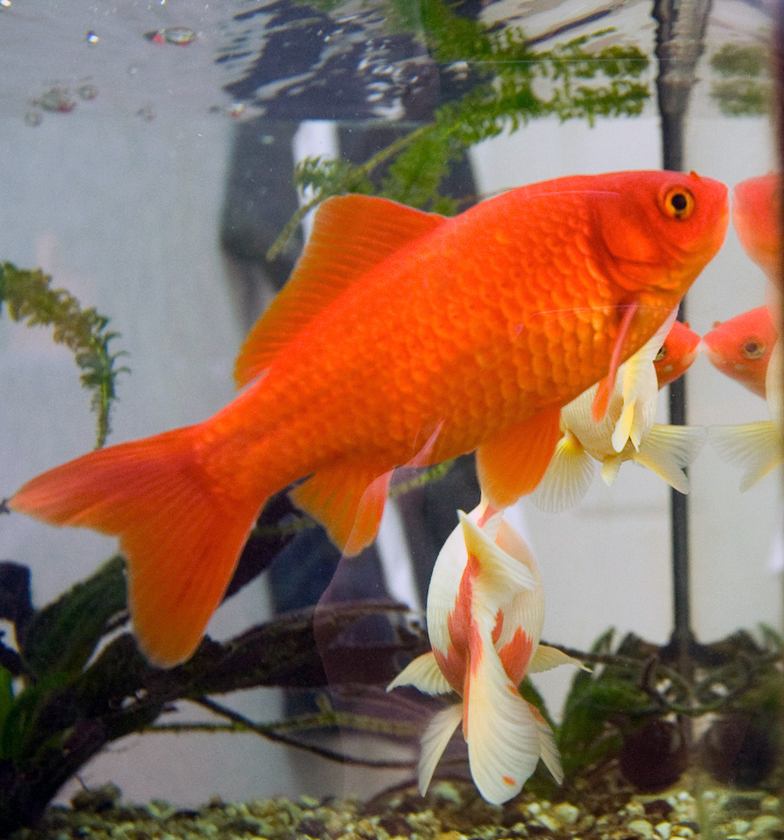 |
| Single-tailed goldfish; note the long and slender body form (public domain) |
For the rest of the article I will be grouping the goldfish into these two tail groups to define the different care requirements for each.
Another category of goldfish that needs mentioning are the sight-impaired goldfish; this includes the bubble-eyes, moors (or dragon-eye), and the celestials. These are generally some of the most sensitive goldfish. It is best to keep them with only other sight-impaired goldfish. Due to their eye shapes these fish are often slow swimmers and will have trouble feeding and competing for food even with some of the other double-tailed goldfish.
Before I talk about the care requirements, I should say something about goldfish size. There are a lot of misconceptions about goldfish, one being that goldfish stay small. This is absolutely false. Fishbase.org places the average goldfish length at 12 inches (32 cm). The fish you often see in the store are babies probably no more than a month or two old. Make no mistake. They will be monsters in no time with proper care and food.
Minimum tank requirements
No matter what the sales associate tells you or how your friend was able to keep them, a bowl is not a suitable home for a goldfish! They are often less than a gallon and don’t provide enough surface area for oxygen to diffuse into the water. In fact, a fully grown goldfish couldn’t even fit in a bowl!!
 |
| Bowls are not suitable! Original photo by Luigi Diamanti |
At minimum your tank should have 10 gallons (40 L) for each fancy goldfish and an additional 10 gallons (40 L) as a buffer zone. For example, if you want four double-tailed goldfish you are looking at a minimum of a 50 gallon (190 L) tank. Single-tailed goldfish need room as well as gallons. They are fast and like a lot of swimming space. For one single-tailed goldfish you will need a 75 gallon (285 L) tank. A 125 gallon (475) is well-suited for a small group. With their large size and large swimming area needs, they make much better pond fish than aquarium fish.
I know some of you are thinking that if the pet store can cram hundreds of goldfish in a tiny tank, why can’t I? You should not base your fishkeeping habits on pet store displays. The fish are usually only there for a short time which is why the stores can get away with minimal decorations and no plants. It’s the difference between a hotel room and your bedroom. Wouldn’t you feel more comfortable in something personalized to your liking rather than generalized for everyone?
Temperature range
A common misconception about goldfish is that they are coldwater fish. This is untrue. They are temperate fish. The largest difference between a temperate and tropical fish is that the tropicals have a steady, high temperature year round while temperate fish have large fluctuations from close to freezing to around 85F (30C). All this means is that goldfish can live at a wider range of temperature than most fish commonly found in the hobby.
As I mentioned before single-tails and double-tails have different requirements in this department, too. Due to the more sensitive nature of the double-tails they are best kept at temperatures between 70F (21C) and 80F (27C). This may mean that your goldfish need a heater if the tank is in a colder area of the house in the winter time.
Single-tails are hardy enough to withstand pond life year-round and will survive at temperatures close to freezing and as high as 95F (35C). If they are kept in an aquarium no heater is needed. They can be overwintered inside if the pond is too shallow, but the aquarium must be large enough for them. A 50 gallon (190L) is a good size.
Water quality
This is the most important aspect of having a goldfish. Clean water means a healthy fish. The best way to tell if your water is clean (nope clearness doesn’t count) is to have a home test kit. The drop kits are the best; the strips are just a waste of money. In a goldfish tank the ammonia and nitrite should ALWAYS be 0 ppm. Nitrate can be hard to control because goldfish are so messy, but we aim to keep it under 40 ppm.
 |
| 6 month old redcap orandas (Bettasngoldfish @ theGAB.org) |
Filtration is another important aspect of keeping good quality water. A filter than can turn over the volume of the tank 10 times per hour is recommended for goldfish. This can also be accomplished by running two hang on the back (HOB) power filters. I am using this method with my 50 gallon (190L) goldfish tank. Filter brands vary depending on what part of the world you are in, but in the US I have found the AquaClear brand filters to be very reliable.
Food
Water quality has the largest impact on goldfish health, but without a good diet, your fish won’t reach his or her full potential. A high quality food should be used as a staple diet. New Life Spectrum is currently the best pellet food around. And you don’t just need to buy the stuff labeled for goldfish. Any of the diets will do; just make sure they fit inside your goldfish’s mouth and are not floating.
Due to the body shape of fancy goldfish, many experience gastro-intestinal problems associated with pellet food. When this happens, you should switch to gel food. Mazuri gel food is the best commercially available, but many goldfish keepers chose to make their own. It is much more cost-effective and can easily be personalized for the individual fish because like us, some fish don’t like certain foods. It can also be an interesting way to bond with your fish.
Substrate
This is something most people don’t think about, but watch your goldfish for a little while. They spend a lot of time picking at the substrate and really anything else in the tank. It is important to have a substrate that is either too large to fit in the goldfish’s mouth or small enough to pass through their system if it does get swallowed. I use large river rocks (from a store not the creek as items intended for aquariums have undergone a sterilization process) but have seen other keepers use sand. There are also keepers who have used regular aquarium gravel and never had a problem, but there are confirmed cases of gravel getting caught in the GI tract and killing the goldfish. It is at your discretion as to whether or not you want to take the risk.
Tank mates and compatibility
Goldfish are a very social species and should be kept in groups of 3 or more goldfish, but there are some compatibility issues between the single-tails and double-tails. The single-tails are much faster swimmers and more boisterous and for these reasons, should not be kept with double-tails.
When looking at non-goldfish tankmates for your goldfish you have to consider a few things like adult size, fin-nipping tendencies, and water parameters. Many livebearers such as guppies (Poecilia reticulata) share a lot of the same water parameters (cooler, hard, alkaline water), but they are small enough to be a goldfish snack. And they will be. Goldfish will try to eat anything that fits in their mouth. Personally, I believe that double-tailed goldfish should be kept with just double-tailed goldfish but others have had success keeping them with zebra danio (Danio rerio) and white cloud mountain minnows (Tanichthys albonubes).
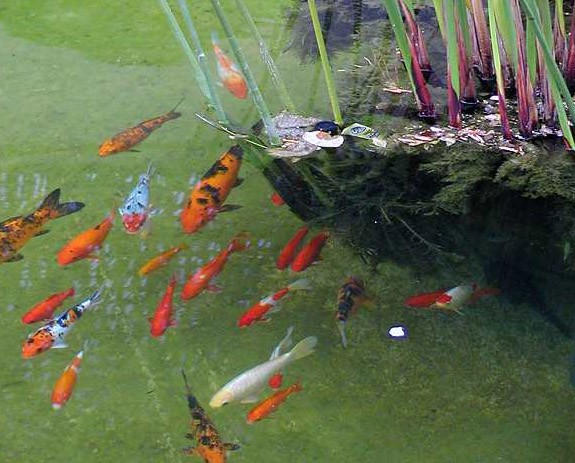 |
| Goldfish and koi in pond (Public domain) |
For the single-tailed goldfish your options are even more limited. They are a large fish to keep in home aquariums, but would do well with many of the same tankmates as the double-tails. In a pond you can keep koi (Cyprinius carpio) and single-tails together. These fish are closely related and share many of the same requirements. Mosquito fish (Gambusia spp) are another pond fish that can be kept with goldfish.
There is some debate as to whether or not goldfish can or should be kept in typical tropical tanks. I do not believe this is a good idea for a few reasons, the first being that while goldfish can live at the higher temps in which tropical communities are kept, having them at these temperatures presents a few obstacles. First, at higher temperatures goldfish need to be fed more to maintain the same body weight. More food in means more waste out, and goldfish are messy enough as it is. Many tropicals don’t appreciate the large mess that goldfish make, and some of the more sensitive fish will succumb to it. Second, at a higher temperature goldfish take up more oxygen. Goldfish need a high level of oxygenation in the water, and the warmer the water gets, the less oxygen it holds. The other reason goldfish aren’t good for tropical communities is poor compatibility with most tropicals. Most fish typically chosen for tropical tanks like soft, acidic water, an environment in which goldfish will not thrive. Many are also small enough to become food or will see the long flowing fins as irresistible targets for fin-nipping. There are just too many complications that can come from keeping goldfish in a typical tropical tank, and I highly advise against it.
Plants
Most people have heard that goldfish will eat all live plants and will always uproot anything you put in the aquarium. While this does happen some of the time, if you are feeling adventurous you can try plants with your goldfish. Just make sure you have the right lights and lighting schedule. There is more to a planted tank than just throwing plants in there. I will give you some suggestions for plants with the understanding that more research should be done on planted tanks in general.
Of the plants that other goldfish keepers including myself have had success with, the best have been the thick-leaved plants like anubias and amazon swords. I have also had success with fast growing plants like anarcharis and hornwort. It’s usually hit or miss with goldfish and plants. But don’t ever let anyone tell you it can’t be done. Plants are great for keeping good water quality (but won’t eliminate the need for a water change).
Smashing the myths
One of the excuses I hear for someone keeping a goldfish in a one gallon (4 L) bowl or 10 gallon (40 L) tank is that “the fish will grow to the size of the tank.” This is false. It came about because goldfish kept in these small tanks often live in terribly dirty water. As a result of the poor water quality, they typically die anywhere from a few days to a year after they are purchased. The owner usually assumes that “it was the fish’s time anyway.” Due to these poor conditions the fish either grew just a bit or didn’t grow at all. The lack of growth in the small tank leads people to believe that “fish grew to the size of their tank” and then died when it got old. As we know from earlier, this isn’t true as goldfish live between 10 and 20 years and commonly grow 10 inches (25 cm) or larger.
If the fish does survive this ordeal and is either placed in a larger tank by their owner or re-homed to a larger tank, the goldfish will suffer long term effects in the form of stunting. In anecdotal studies using juvenile discus, aquarists have shown that water quality has a greater stunting effect than being kept in a small environment. So if you are reading this and have just put a goldfish in an insufficient tank: there is still hope. Large, daily water changes will ensure good water quality until you can secure your buddy a larger tank. For those on a tight budget, try to look for secondhand tanks.
With a life span comparable to a cat or dog, goldfish are a lengthy investment and may not be for every aquarist. Some people buy them and then learn about their care requirements. If you find yourself with goldfish you no longer want, do try to rehome them before you euthanize them. Many people see goldfish as throw-away fish, but they are not. They are a rather intelligent fish that will recognize the faces that feed them and be shy around new people. They feel pain, bond with their school mates, and show signs of grief when a tank mate is lost. A lot of people don’t like the ephemeral nature of fish, afraid that a child will be sad when his or her “fishy” dies. With a properly cared-for goldfish, that child won’t have to know loss so soon in life and will grow up with wonderful memories of taking care of “fishy” with mommy and daddy.
Works Referenced
"''Carassius auratus'' (Linnaeus, 1758)". Fishbase.org. Updated 15 Nov 2011. Retrieved 16 April 2012.
Betty (Dataguru). 02 August 2009. “Goldfish Nutrition Part 2: Food and Nutrition.” theGAB.org. Retrieved 10 April 2012.
Gay, Jeremy. 25 March 2010. “What do I need for goldfish?” Practicalfishkeeping.co.uk. Retrieved 16 April 2012.
Hill, Nathan. 14 May 2011. “Goldfish with tropicals – wrong or right?” Practicalfishkeeping.co.uk. Retrieved 15 April 2012.
Muha, Laura. 2006. “Fish Growth vs. Tank Size” in “The Skeptical Fishkeeper” column. Tropical Fish Hobbyist (December).
**Disclaimer** Since there is little to no scientific research about fishkeeping published, much of the hobby today is opinion, but they are opinions given by keepers and breeders who have been doing this longer than some of us have been alive. Temperature ranges and adult sizes are not opinion. They have been scientifically documented.
I publish this in the memory of my cat, Potpourri. While I wrote this article in the days before, I published it on the last night she was with us. She was sitting on my lap and purring. She always loved to watch the fish and had been my constant companion for 14 years.

Subscribe to:
Posts (Atom)