Showing posts with label aquarium cycle. Show all posts

Tuesday, November 24, 2015

The Classroom Aquarium

Pets are a common fixture in many elementary classrooms all around the country. I still remember walking into my 2nd grade teacher’s room and brimming with joy that she had a fish tank. And I’m not alone in that delight. Many researchers have found that classroom pets have a positive impact on students. Pets increase students’ positive attitude towards school and can actually make them want to come to school (Anderson & Olsen). They have been found to improve the emotional well-being of students and contribute to humane education (Daly & Suggs). Contrary to popular belief, one study showed pets did not distract from the teacher (Kortschal & Ortbauer).  And of all the possible choices for classroom pets, fish are the most common (Rud & Beck).

Freshwater aquarium (Neale Monks)
This is with good reason. Fish are relatively easy to care for. They don’t need to be fed daily, so they can easily be left over the weekend or a short break. During the summer, they can be taken home or just cared for on a weekly basis. There are also a wide variety of species that can be very easily acquired. It is also possible to keep fishes that are native to your location to give students a view of wildlife they don’t normally see.


Aquariums also have a well-established relaxing effect. Watching aquariums is known to reduce heart rate and blood pressure (Cracknell et al). And if I remember school correctly, tests certainly can generate some elevated heart rates! My mother is a middle school teacher and if there is one thing teachers need, it’s reduced stress levels. So in this way, the fish tank will help the teacher as much as the students. 

Lessons with an Aquarium


Aquariums can be very useful teaching tools. Students can examine how a fish tank attempts to reproduce a native habitat. How the light emulates the sun; how the filter gives the fish clean water like a stream; how the pump oxygenates the water like a waterfall. If native species are available students can observe their natural habitat and try to recreate it. Fish don’t have to be the only inhabitants in an aquarium. Plants can be added to further simulate a natural environment. Plants can also be used to introduce students to the idea of nutrient cycling.

Trout Unlimited volunteer helping with tank maintenance on the class's Trout in the Classroom project. Trout in the Classroom is a program started by the nonprofit Trout Unlimited which seeks to preserve freshwater streams and rivers around the USA. Students raise fish from eggs and release them at the end of the year. (Julia Ross, Troutfest.org)

Water chemistry and pollution are other lesson that can be taught with fish tank. Many pet stores carry small freshwater testing kits simple enough for middle school students. They can measure, record, and graph the temperature, pH, and nitrate levels in their fish tank. These water quality readings can be compared to local a river or pond. Teachers can actually let the fish tank get dirty to show students what happens to fish in polluted environments.

The nitrogen cycle is very important to success with an aquarium, and although it isn’t the same nitrogen cycle that happens in the air, it can be used to introduce students to the concept. Fish tanks can also help illustrate the water cycle from cloud to ocean. Students can even measure how much water evaporates from the tank on a weekly basis.

Math and science are very tightly linked, so an aquarium can also help with math lessons! Students can calculate the volume and surface area of the fish tank and convert those measurements from metric to standard units. From the volume, you can have them calculate the weight of the aquarium (hint hint, water weights 8.34 lb/gallon). These fun examples bring math out of the textbook and into real world.

Help Setting up a Tank


Right about now, you may be thinking, this sounds great but where do I start? Thankfully fish tanks aren’t difficult to set up and maintain, but they will require a bit of effort on your part initially. The first thing you will want to read and research is the freshwater nitrogen cycle. This is the article I wrote on it. Many many resources exist online to help you in starting a fish tank, and I encourage you to check out the other fish blogs I recommend for additional resources. My friend Mari at Aquariadise has some wonderful articles to help new fishkeepers such as types of filters & choosinga substrate. The National Science Teachers Association also has guidelines for keeping live animals in the classroom which I highly recommend reading.

Suggestions to a New Fishkeeper


If native fish are at all an option, I highly recommend them. In the eastern USA we have many stunningly beautiful fish right in our own backyard. You can read more about them in my article: The Beauty in Your Backyard.

 If native fish aren’t an option, then the next best suggestions I can make are small tetra like the glowlight (Hemigrammus erythrozonus) and X-ray tetra (Pristella maxillaris). Small barbs like cherry barbs (Puntius titteya) and gold barbs (Barbodes semifasciolatus) also make great classroom fish. Zebra danio/glo-fish (Danio rerio) are a staple and great, hardy fish. All of these species need to be in groups larger than 10 because they are shoaling species, meaning they survive best when in groups. They all need a tank larger than a 10 gallon, too. You can read more about these species in my article: Best and Worst Beginner Fish.

A few of the glowlight tetra in my personal tank. They are rather hardy and don't mind me leaving them for a weekend. 

For tank size, I recommend starting with a 20 or 30 gallon tank. It seems counter-intuitive but small tanks are actually harder to keep. Larger volumes of water mean there is more of a buffer in case something goes wrong. Larger tanks also mean you’ll be able to keep more fish which are always delightful to students.  

I highly recommend plants in an aquarium. They create a soothing natural environment and open new doors for educational opportunities in addition to helping keep it clean. To successfully grow plants you will need a plant-specific light. An aquarium kit should come with a hood and light, but that light isn’t going to be tailored to plants. You will need to get a 6500k full spectrum daylight bulb. Many pet stores also sell these, but hardware stores will have them if your pet store doesn’t. They only need to be replaced once a year to keep your plants growing green and beautiful. Some plant species that are a good, hardy beginner species are anubias, java fern, amazon sword, and duckweed. Pet stores often have these common plants for sale.

Help with Funding


Aquariums (like all pets) require money, but fortunately for you, there is a nonprofit organization that gives grants for teachers interested in getting a classroom pet. Pets in the Classroom allows teachers to submit proposals for grants to assist with setting up and maintaining classroom pets. Their website also contains lesson plan and habitat ideas for many species of pets. I highly encourage you to check it out. If regulations and demographics allow, you can ask for a small donation from your students to help fund your classroom pet experience.

Works Referenced

Anderson, K.L. and M.R. Olson. 2006. The value of a dog in a classroom of children with severe emotional disorders. Anthrozoƶs 19(1): 35-49.

Aquatic WILD: K-12 Curriculum & Activity Guide. 2013. Revised ed. Council for Environmental Education, Houston.

Cracknell D., M. P. White, S. Pahl, et al. 2015. Marine Biota and Psychological Well-Being: A Preliminary Examination of Dose-Response Effects in an Aquarium Setting. Environment and Behavior. DOI: 10.1177/0013916515597512

Daly, B. and S. Suggs. 2010. Teachers’ experiences with humane education and animals in the elementary classroom: implications for empathy development. Journal of Moral Education 39(1): 101-112.

Kortschal, K. and B. Ortbauer. 2003. Behavioral effects of the presence of a dog in a classroom. Anthrozoƶs 16 (2): 147-159.

Responsible Use of Live Animals and Dissection in the Science Classroom.” National Teachers Science Association. www.nsta.org/. Updated: March 2008. Retrieved: 24 Nov 2015.

Rotman, E. 2008. Hatching Stewardship. Outdoor California (March-April): 33-35.

Rud, A.G. and A.M. Beck. 2003. Companion animals in Indiana elementary schools. Anthrozoos 16 (3):241-251.

Rutherford, B. 28 March 2015. Tanks in Classrooms: Setting Up an Educational Aquarium. Reef to Rainforest Media. Retrieved: 24 Nov 2015.

Trout in the Classroom.” Trout Unlimited. www.troutintheclassroom.org/. Updated: Nov 2015. Accessed: 24 Nov 2015.
Sunday, October 18, 2015

Freshwater Aquarium Nitrogen Cycle

Welcome to the most important article I or anyone can ever write about fishkeeping: the aquarium nitrogen cycle. Contrary to what you may hear at a pet store, it is not just filling your aquarium and running the filter for a week.

What Is It?


The nitrogen cycle is how we maintain a healthy environment, and it surprisingly relies completely on bacteria. These microorganisms change the toxic waste of our fish into a relatively harmless substance, thereby allowing us to keep fish in contained areas. In the wild, the fish waste is diluted by the humongous volumes of water. 

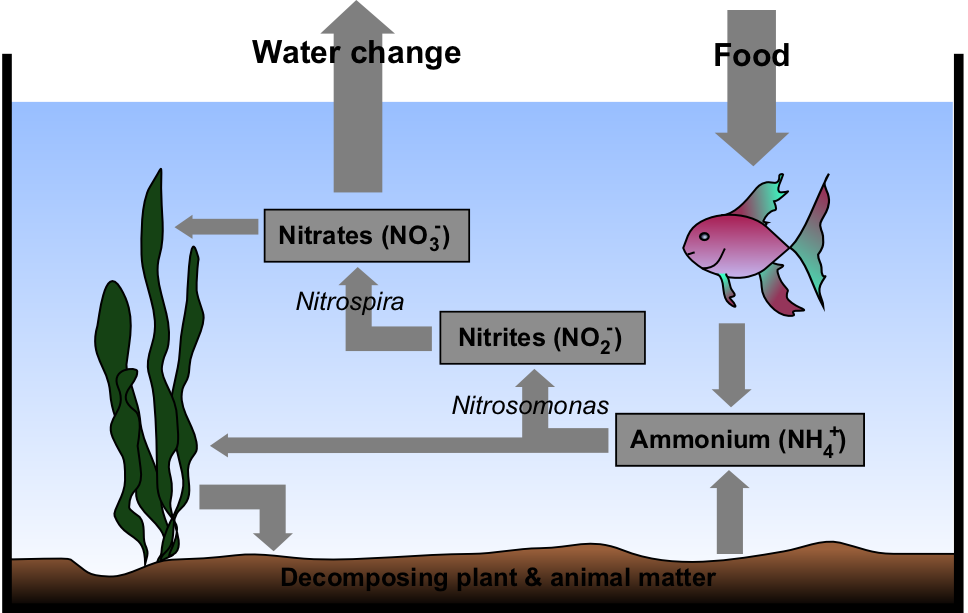
The cycle begins with fish. They produce ammonia as a byproduct of their metabolism. The problem is ammonia is toxic to them (and us for that matter). Luckily a genus of bacteria called Nitrosomonas exists. These bacteria take ammonia and convert it into nitrite to generate energy for themselves (much like plants use photosynthesis to generate energy from the sun). However, nitrite is still toxic to fish. That’s where second genera of bacteria called Nitrobacter and Nitrospira come in. They convert the toxic nitrite into nitrate which takes much higher levels to reach toxicity. However, nitrate is still toxic to fish and will need to be removed from the aquarium by its caretaker. This is one reason we perform periodic water changes on our aquaria.

Aquarium nitrogen cycle schematic. (public domain)
Nitrobacter and Nitrosomonas also have requirements just like our fish. They live on surfaces in your aquarium although a small amount can be found floating in the water. They operate best between the pH’s of 6.0 and 9.0 and need water above 50F. They also require highly oxygenated water, so they are most commonly found in the filter. For this reason, it is important to never wash your filter media in chlorinated water. 

When plants are added to an aquarium, they use up nitrogen in all three of the forms (ammonia, nitrite, and nitrate). If enough fast-growing plants are present, there may be very little ammonia that makes it to the filter. However, even with a planted aquarium, I recommend having some type of filter where these important bacteria can grow. Plants can be finicky and stop growing for odd reasons, and when that happens an ammonia spike can be deadly to fish and invertebrates. Having plants does not negate the necessity of the nitrogen cycle in your freshwater aquarium.

How to Establish a Cycle


Cycling an aquarium takes weeks to a month because the colonies of bacteria replicate slowly. Nitrosomonas need a source of ammonia to produce nitrite before Nitrobacter can begin to grow.  The only way to know when it is complete and what stage you are in is to test for ammonia, nitrite, and nitrate. First you will see an ammonia spike, followed by a nitrite spike, and then nitrates. You should test your water daily and record your results to chart your progress. A few different methods of getting ammonia into your aquarium and starting the cycle are detailed below.

Chart of expected ammonia and nitrite spikes while recycling a tank. (theaquariumwiki.com)

Live Fish

This is the most common and oldest method. Simply throw the fish in and hope for the best. The bacterial colonies will build up over time, but while you are waiting your fish will be subject to ammonia poisoning and nitrite poisoning in the weeks it takes the Nitrosomonas and Nitrobacter colonies to establish themselves. This is how many ignorant aquarists (including myself) originally establish a cycle, however it is not the most humane. Other alternatives should be explored first. 

Fish Food

In addition to living fish producing ammonia, decaying food will also produce ammonia and can be used to start a cycle. You can use fish food or raw seafood. However, this method isn’t without risks as rotting food will attract other bacteria and fungi. If you are using this method, you need to do a large (70% or more) water change before you add fish and invertebrates. 

Pure Ammonia

You can find this sold as a cleaning agent in many stores. Just make sure you check the label because the ones with surfactants will not work. Add the ammonia to your tank water until you get a concentration of 3ppm (any higher and it will inhibit the Nitrosomonas). When the ammonia concentrations drops to zero and you see nitrites, add more again. Keep doing this until adding ammonia produces nitrates. You will have to keep dosing the tank until you add fish to sustain the colonies. Before you add fish, do a water change to reduce the nitrate levels to below 40ppm. 

Seeded Filter

If you have a friend or store you trust, you can ask for some of their filter media to add to your filter. Because these bacterial colonies are most commonly found attached to filter media, you will instantly establish a cycle. You can add fish the day you add in the media. If you have multiple tanks you can borrow media from one tank to cycle another. Since I cycled my first aquarium, I have used this method exclusively to cycle my tanks. 

Bacteria in a Bottle

Nitrosomonas and Nitrobacter can be bought from pet stores and online. A few select products are believed to work quite well. Dr. Tim’s One and Only and Tetra Safestart are two that are claimed to work wonderfully. By adding these products you can cycle your tank instantly and add fish that day. You can also use these products in conjunction with any other method to increase your chance of success. I have not personally used these products at the time of writing, however I have heard amazing reviews from others. I do have plans to try these products myself one day.

Cycling an aquarium is the single most important thing you can do for the health of your fish. It is time and effort, but it is worth every minute for the headaches it will save you. The best medicine is clean water, and that is just what a cycle gives you.

Works Referenced


Ammonia & the Nitrogen Cycle: Important Steps for YourAquarium.” Drs Foster and Smith. www.drsfostersmith.com. Updated: 18 October 2015. Retrieved: 18 October 2015.

Aquarium Nitrogen Cycle.” Fishlore. www.fishlore.com. Updated: 30 September 2015. Retrieved: 18 October 2015. 

DeLong, D.P. and T.M. Losordo. 2012. "How to Start a Biofilter." Southern Regional Aquaculture Center. Retrieved: 18 October 2015. 

Fishless Cycling.” Algone. www.algone.com. Updated: 15 March 2012. Retrieved: 18 October 2015. 

’Fishless’ Cycling.” The Skeptical Aquarist. www.skepticalaquarist.com. Updated: 21 March 2011. Retrieved: 18 October 2015. 

Helm, Ben. 2014. “Controlling Ammonia in a Fish Aquarium.” www.fishchannel.com. Retrieved: 18 October 2015.

 Losordo, T.M., M.P. Masser, and J. Rakocy. 1998. "Recirculating Aquaculture Tank Production Systems: an overview of critical considerations." Southern Regional Aquaculture Center. Retrieved: 18 October 2015. 

Monks, Neale. 2011. “FishlessAquarium Cycling Method.” www.fishchannel.com. Retrieved18 October 2015. 

Nitrifying BacteriaMixtures Work.” Dr. Tim’s  Aquatics. www.drtimsaquatics.com. Updated: 8 September 2015. Retrieved 18 October 2015.