Monday, October 22, 2012

My tanks: 22 Oct Update

So while it has been a few months since my last update not much has changed in my tanks except with the goldfish.

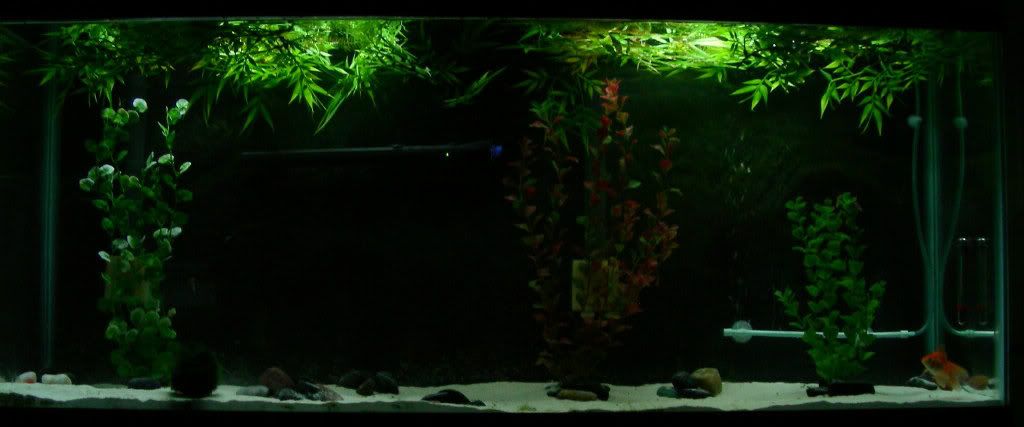
I completely redid the aquascape. I removed the gravel once and for all and replaced it with aragonite sand to aid me in hardening the water. I figured out my light is too dim for most plants to grow in the substrate, so I opted for fake plants. I think they look realistic, and I like the cover they give to the fish.

If you can spot him, he's in the bottom right corner!

The fake plants I have are Marineland jumbo bamboo which is floating while the live floating plants--which the goldfish seem to leave alone--fill in, the Marineland A-size multipack that includes red ludwigia, rotala, and moneywort (but I only used to two tallest plants in the center and right), and the  Aqueon Begonia plastic plant 16" on the left. My live plants (most of which are floating and out of view) are hornwort, water sprite, and anarcharis. I also have that one little marimo ball on to bottom, too.

Unfortunately, right after I completed the re-'scape, I lost my two oldest goldfish within a week of each other. They had been with me for six years. I'm not positive on what caused either of their demises, but I am keeping a close eye on my remaining goldfish.

Seaking on left, Goldeen on right. Together in life and together in death.

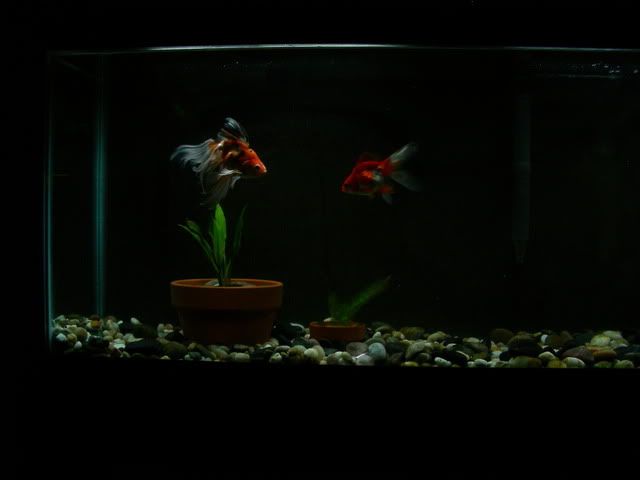
I also know I owe you guys some up close pictures of my newest (well relatively) goldfish. I'm fairly certain he is male as I've seen some breeding stars on his pectorals, but only time will tell. He's still pretty small. No bigger than 3 inches on body!

Here he is sitting next to his "mirror buddy." Since goldfish enjoy company,
this will be his best friend until I can find another goldfish
and put him through a QT process.

He's still a little shy!

Here is a pretty good image to give you a size comparison.
He's grown a lot since I brought him home.

While it hasn't been getting that cold at night and the leaves haven't changed that much, I went ahead and put the net over my pond. It's been decent weather, and I wanted to make sure it was done right. There have been a few years where I was putting the net out when it was rainy, cold, and almost dark. Plus, I catch more leave if I put the net up before the they all start coming down.

It's still warm enough that the koi are happily swimming around under the net.

And everyone got new lights. I noticed I needed new lights because I began to see an abundance of brown algae growing on the walls as well as some of the lower plants. Bulbs don't last more than a year, and the deeper the tank, the more often they have to be replaced. I probably could have gotten another few months from my betta tank bulbs, but I like doing them all at once. You might not notice a difference, but the plants do! 

Sunday, October 14, 2012

Little things

Yesterday when I was finishing up with my work, I walked over to our local butterfly garden. It's a very nice little garden where my local science center hatches and grows native butterflies.  In the back of the garden, they have a nice little goldfish pond. It's probably about 300 gallons or so. While I was sitting by it and trying to snap photographs of the butterflies that danced by, I noticed a white goldfish with a red splotch on his head, and he looked familiar.

Some of the flowers and butterflies in the garden

A few years past the butterfly garden was the subject of vandalism when some punks broke in and killed a handful of the goldfish. A year or so before then I had donated comet goldfish with a red splotch on his head to them, but I thought him lost in the raid as he is a very recognizable fish.

On my way out of the garden, I asked the attendant who had worked there for a while how long that particular goldfish with the red splotch on his head had been there. She told me as long as she could remember, and then proceeded to tell me that the vandals only took the largest goldfish which would not have included my little comet. I came to the conclusion that the unique goldfish in the pond was the little comet, who I had named Tancho, that I'd released there years ago! The attendant was just as shocked as I was and even more so when I told her he could easily live another 10 years there.

The only photo I have of Tancho.
Taken in summer 2007.

I spent the next 30 minutes by the side of the pond watching him. His markings have changed a lot. Instead of a neat, almost circular mark, it's spread down to his cheeks. But the rest of his body is still as white as a cloud. And while I did spend a lot of time there, I never managed to get a picture of my goldfish who I'd named Tancho. But it made my day to be able to see him again, so strong and so healthy.

The pond where Tancho now lives. He shares
it with three other orange-red goldfish.

Tuesday, October 2, 2012

Goldfish Salvation

I don't often talk about fish art because there simply isn't a lot of it, but the other day I found an artist who deserves recognition. Riusuke Fukahori was a struggling artist who found inspiration in his pet goldfish. These beautiful works resulted from his chubby, golden muses.

Photo of Riusuke Fukahori's work displayed at thisiscolosal.com

It looks real, doesn't it? It's all done in resin. He makes these 3D painting by pouring layers of resin on top of paint in a similar manner as a 3D printer. Watch a video of him working here:


Beautiful works inspired by beautiful fish. If you look in the background of the video, you can get a quick glimpse of his fish comfortably living in a 50 gallon tank.

Photo of Riusuke Fukahori's work displayed at thisiscolosal.com

You can find more photos from his ICN gallery expo here: Goldfish Salvation by Riusuke Fukahori at the ICN gallery.

Sunday, September 23, 2012

Largest Aquariums in the World

These are tanks like we can only dream of. So take in these videos of the world's three largest aquariums (they do have sound) and dream away. They are spread out over three continents. If you ever get a chance to visit just one of them, take it. These videos are nothing compared to the real thing. 

# 3 "Kuroshiro Sea" Okinawa Churaumi Aquarium (1.98 million gallons)


# 2 Dubai Mall Aquarium (2.64 million gallons)


#1 Georgia Aquarium (6.3 million gallons)


I do not own any of these videos. Credits are in the individual videos.

Monday, September 17, 2012

Emergency Preparedness and Aquariums

It’s hurricane season in the south eastern US again. For some that means potential evacuations. For others it just brings the possibility of a few days without power. Either way, we want to consider our pets. Animals like dogs are easy to move in case of an evacuation. Fish are not. You need to have a plan with them.

I’m going to divide emergencies into two types to simplify this a bit: sudden emergencies and predicted emergencies. Sudden emergencies would be things that you don’t have a day or even a few hours’ warning. Predicted emergencies could potentially give you up to a week to prepare. But first let’s go over a fishkeeper’s emergency kit.

Hurricane Irene that hit the eastern US in August 2011 (kakela @ flickr)

Things to have around


Battery-powered air pump and sponge filter: these can be rigged up when the power goes out to provide both mechanical and biological (if the sponge filter was already in the tank) filtration for your tank. Pumps can also be used to provide aeration if fish suddenly need to be moved. Always make sure you have an extra set of batteries or two.

Blankets or extra towels: in case of a winter power outage, these can be used to maintain a warmer temperature in your tanks. The air temperature may fall but an insulating layer around your tank will help keep the water from getting too cold. If you live in an area that can get very cold in the winter, having an extra space blanket and duck tap to secure it to your tank is a great idea.

Flash lights: let’s face it, emergencies can happen in the dark, too. It’s no fun to fumble with cords and batteries when you can't see. A head light comes in handy here, too. Always make sure you have an extra set of batteries.

Medicines: while I don’t recommend stuffing your cabinet more thoroughly than your local vet clinic, having things like aquarium salt, General Cure, and Maracyn I & II around is a great idea. After a disaster there is a chance your fish could get sick. Depending on the severity of the disaster, you might not be able to get to the store for a while. These medications or a combination of them can treat most common tropical illnesses.

Sudden Emergencies


These would be things like tornadoes, earthquakes, mudslides, house fires, and some volcanic eruptions. Disasters that you didn’t get warning of. Often times in these situations, we simply don’t have time to think about our fish or other pets before our safety comes into question. First rule of thumb is save yourself. If you aren’t alive when it’s over who will take care of your fish if you protected them first?

Certain areas of the world are more prone to some of these immediate disasters, and there are things you can do to help lessen damages when they happen. If you live in an earthquake zone, consider stabilizing your stands to the wall (the studs not the drywall) or nailing stands to the ground. If you are in an area where tornadoes are prevalent, consider putting most of your tanks in the basement or other central area of the house. The best thing you can do for these types of emergencies is preventative preparedness.

Predicted Emergencies


These are situations like hurricanes, blizzards, most tsunamis, some severe thunderstorms, and some wildfires. In some case you might just have a few hours warning, but in others you could potentially have days to prepare. When you have a warning, your fish have the best chance of survival if you make the necessary preparations.

You typically have some warning with a thunderstorm (rejected reality @ flickr)

First: Stop feeding


Healthy fish can go up to a week without eating. Depending on the fish, they can be pushed to two weeks with no food without suffering major ill effects. This is actually rather natural to the fish. Often times they will go weeks without a meal especially in the dry season. Not feeding your fish will reduce the amount of physical waste and ammonia that is in the tank. It will also reduce the need for water changes. If you are unable to attend to water changes for an extended period of time, this will help keep your tank from becoming too polluted.

Second: Perform a large water change


Depending on the severity of the approaching disaster, you may not get to do another water change for a while. Doing a large water change before it strikes will ensure that your fish are in cleaner water when they go through other stressors like falling water temperature and rising ammonia. Fill up some extra jugs and barrels with water especially if you are on a well system and are expecting a few weeks without power. If you are in a city where the water pressure and quality will remain intact, this is not as important.  

Third: Clean your filters (with tank water not tap water)


This is especially important if you don’t clean your filters often. Once the power goes out and water stops running through the filters, the organic waste that is trapped in there will quickly decay, and the water will become toxic. You won’t want this in the tank with the fish when the power returns. Leave the filter media in the filters until the power goes out.

If you have to evacuate and leave your fish behind, unplug the filters and put the filter media in the main tank. Running a battery-powered air stone through the filter media will help give the beneficial bacteria enough oxygen to survive the power outage.

Fourth: Double check your emergency equipment


Because these types of emergencies don’t come along very often, locate your emergency equipment and make sure it is in good working order. Turn on the battery-powered pumps and flashlights. Double check your batteries. Make sure the medicines haven’t expired. Put your equipment in an easily accessible place, so you won’t be scrambling for it when the electricity does turn off.

Natural disasters are hard enough on families without having to worry about pets. Please remember, your safety is of the utmost importance. You are the only person who will take care of your fish as you want. In case your family doesn’t have an emergency plan for themselves, you can take a look at the US Federal Emergency Management Agency’s guide for family preparedness called Are you ready? An in-depth guide to citizen preparedness. Be safe and happy fishkeeping!